

This was originally posted on Feb. 13, 2012
Elizabeth Kelly Inglis died in 1927 at age 62 from complications of a stroke. Secondary causes were malnutrition and exhaustion.
When I was a child, my father, though he was very close to his own parents and sister, spoke very little about his ancestors. I knew that both of his parents lost their fathers when they were small children. I was told that the Christs were German and the Inglises were Scottish and Irish. My grandmother Mary Inglis Christ was as Irish as the day is long. She prayed to the blessed Virgin and took me to church with her in the early mornings where she lit candles and whispered the rosary while fingering faceted lavender beads. She voted for Kennedy because he was Irish and Catholic—to the horror of my father and his father who had no use for the Democrats. My grandmother sometimes cried when she showed us photographs of her family, especially when she pointed to her sister Veronica, called Very. I sensed that my grandmother felt sad to have left her family in New York when she moved with her husband and children to California during the depression, but I was too young to understand fully. As far as I know, I never met any of the relatives from her side of the family, even when I moved to “back east.”
Recently I answered a message posted ten years ago on a family search website asking for information about a Mary Inglis who married a John Christ in New York. Through the wonders of the internet, I heard back the next day from my third cousin Hattie Murphy of New York who is almost exactly my age. We are related through our great-great-grandparents James Inglis, born in Scotland, and Anne Corliss, born in Ireland. Apparently they met and married in New York sometime before the birth of their first child in 1855. Their son James Inglis was my great-grandfather and their daughter Margaret was Hattie’s great-grandmother. Both married Irish.
Neither Hattie nor I have been able to find traces of our great-great-grandparents in Scotland or Ireland or indeed before the 1860 census in New York when they were already married with three children. There were several James Inglises (Ingalls, Ingles, Engels) born in Scotland in 1838, the year listed as his birth date on the census, two of them born to James and Isabella (Isobel), the names found on his death certificate. We have also failed to find Anne Corliss (Carlis, Carlos, Corlers) or her parents, James and Mary, in Ireland or the United States prior to her marriage.
While waiting for a packet of information to arrive from Hattie Murphy, I happened to watch an episode of Who Do You Think You Are UK that provided some clues as to why James Inglis emigrated from Scotland. If he was from a city, his father and grandfather could have been among the craftsmen such as weavers who lost their livelihoods to the factories. If he was born in the Lowlands, his father might have lost his job due to the mechanization of farming. If he was from the Highlands, his family’s fate may have been far worse. The first part of the 19th century was the time of the Highland “Clearances” when the farmers were driven off their lands in order to “make way” for large sheep farms. Whole hamlets were cleared in a single day, with families and animals being forced to walk toward uninhabited lands close to the sea with only what they could carry and no shelter from the wind and weather when they got to their destinations. The houses and the fields were torched, so that no one would be tempted to try to return. In 1846 when my great-great-grandfather would have been about eight, the potato famine reached Scotland, causing many bad situations to become worse.
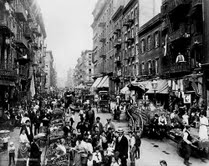
Not even this prepared me for the feelings that would be evoked by the documents that arrived in the mail from my cousin Hattie. Included were copies of death certificates filled in by hand. On most of them there was a space where the doctor had written “tenement” and the number of families living together. Obviously, this space existed on the form because there was so much disease and death caused by poverty and overcrowding. The addresses were on the Lower East Side, the poorest area of New York at the time. When my great-grandmother Elizabeth Kelly Inglis lost her husband to pneumonia in 1906, she was left to raise four children on her own, my grandmother among them, with the help of her oldest son. At that time she had already lost her father who committed suicide in Ireland leaving the family destitute, emigrated from her homeland leaving family behind, lost a baby girl after four days and a second little girl at age three to diphtheria. She would lose Veronica, just grown up, in the flu epidemic of 1917. It is sometimes said that people didn’t suffer “in those days” at the loss of a child “like they do now.” But I don’t believe a word of it. My mother’s depression lasted for years after she lost a baby, and her sadness affected all of her children. Elizabeth Kelly Inglis probably did not have time to grieve any of her losses properly, but I am certain that the memories of her dead children haunted her.
I have lain awake several nights in a row thinking about the words “tenement,” “malnutrition,” and “exhaustion.” I begin to understand why my Dad never wanted to talk about his family. It was just too sad. He had every reason to be happy to have “melted into a pot” that did not include the daily realities described by those three words. My father wanted to protect me from the pain I am experiencing now by not telling me his grandmother’s story. Elizabeth Kelly Inglis swallowed her tears and went hungry to feed her children in crowded, disease-filled, airless tenements. Her daughter Mary, my grandmother, survived to cook us Irish stew and to show us family pictures while sitting on a brocade couch in a single family home in Daly City. I begin to understand what it took to get us there.
Discover more from Feminism and Religion
Subscribe to get the latest posts sent to your email.

 Feminism and Religion
I understand why Carol spent so much time ferreting out the secrets of her family lineage. I think as we age that there is a deep need to fill in the holes of our family stories. To close the circle of our lives. I grew up in a sea of confusion secrets and lies – nothing was what it seemed. When I was young I believed I could leave these holes behind, but no, we must return to our roots even if it means moving through even more pain. The need to understand why our parents/relatives might have acted the way they did using silence as a decoy/defense becomes more important, I think.
Carol also writes,”It is sometimes said that people didn’t suffer “in those days” at the loss of a child “like they do now.” I have never heard this comment and am glad I haven’t. Losing children/siblings is the worst anguish I can imagine – all animals grieve the loss of their babies/ children relatives.
Speaking of other – than – human animals I remember a wood duck who gave birth to one chick on a pond of a cabin I was renting – a predator killed the baby and that duck uttered the most unearthly haunting sounds for days on end as she circled the pond in anguish -I witnessed and wept with her day after day….excruciating.
LikeLiked by 1 person
I began to research my family history about the time Carol began to write these posts and she was such an inspiration. We even found that we had ancestors who went to near the same area of Michigan (as she noted in last week’s post) at about the same time and so had similar experiences. I was surprised/not surprised when I did my family history how many characteristics seemed to go down generation after generation. For example, I just found a story that one of my ancestors from the 17th century was known for never hitting her 17 children, but instead gently guided them, which was pretty unheard of in Puritan New England at the time. My grandmother, her descendant, was exactly the same way to a degree that was unusual in the 1960s. Was that a trait that went mother to mother for 350 years? Or did it somehow just reach through the generations because it was the loving thing to do? Or a coincidence? I know what a gift it is to be able to trace my ancestors to the 17th century, one that Carol’s posts showed me the importance of.
LikeLike