

February, the month designated as Black History Month, will see us focus on the voice, the faith, and the heartbeat of one of the greatest singers in all of US History. Many have stated that the voice and songs of Mahalia Jackson can be considered one of the most influential voices of the 20th Century. She not only became one of the most modern voices to bridge popular music, blues, and religious hymns but she also became intrinsically linked to the Civil Rights Movement and became one of the first commercially successful Black musicians of the modern era.
Mahalia (1911-1972) was born Mahala in New Orleans, Louisiana. Both sets of her grandparents were born into slavery. Mahala’s childhood was filled with hardship, yet a persistent faith emerged. Mahala was raised in a very charismatic Baptist church, Mount Moriah Baptist Church. It is at church that Mahala would start to sing, find her voice, and start to uplift the souls around her.
Mahala would move to Chicago in 1927 as a teenager and would continue singing in the church. She was deeply influenced not just by the hymns within hallowed walls but also the deep soulful voices of Bessie Smith and Ma Rainey. When Mahala started to consider music as a form of career, she would slightly change her name, by adding an I – and thus Mahalia Jackson emerges.
While living in Chicago, Mahalia would meet the person that would change the course of her life, Thomas A. Dorsey. Dorsey would later become one of the founding fathers of mainstream Gospel Blues music. Dorsey would pen over 3,000 songs, many of which Mahalia would later sing into popularity. Dorsey recruited Mahalia to become the voice on his recordings that he would pitch to recording houses, churches, and radio stations. These two would go on to create a fusion genre now known as Gospel Blues.
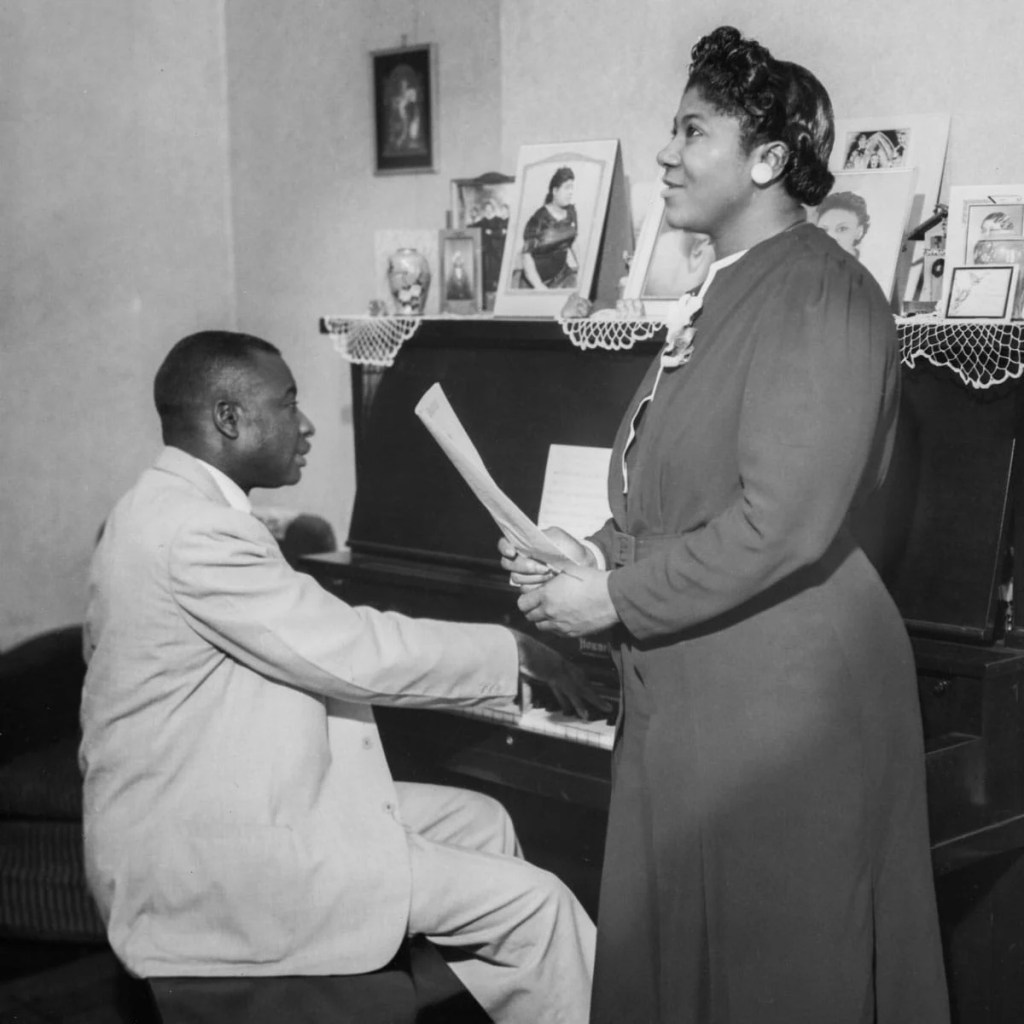
Mahalia made her first recording in 1931 in hopes to sell her song and voice at the National Baptist Convention. Her growing popularity saw her being invited as a soloist at services, including funerals and public announcements. She sing in an FDR presidential campaign. By 1937, Mahalia started to solo record Gospel Blues songs.
In 1948, Mahalia would sign with Apollo Records and record “Move On Up A Little Higher” which became an instant success and phenomenon in creating a space for popular religious music. Stores nationwide struggled to keep Mahalia’s recording on their shelves. Over two million copies were sold nationwide and even landed in the top two of the Billboard Charts. Through her popularity and demand, Mahalia was being played across the nation on multiple radio stations. Many of which were not playing African American voices. In 1948 Mahalia was invited to the White House in response to her work on the Truman Presidential Campaign.
Mahalia was later asked to perform Gospel Blues at Carnegie Hall – the first for this type of music. The 1951 performance not surprisingly became a hit that it would become an annual performance that Mahalia would headline and host for many years.
In little over 7 years, Mahalia was given what would become a highly popular CBS Sunday night radio show. Mahalia would become a guest on the Ed Sullivan Show in 1956 which would cement Mahalia’s popularity and connection between the popular culture and religious communities. She would appear multiple times on the Ed Sullivan Show. One of which can be seen below:
She would meet Martin Luther King, Jr. at the National Baptist Convention in the same year, which would lead to a lifelong friendship.
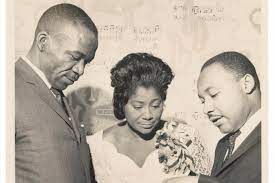
She would be later invited to sing for President Eisenhower, sing at the inauguration of John F. Kennedy, and was even awarded the French Grand Pix du Disque, becoming the first gospel singer to win this award. Many people would perpetually ask where the line between religious music and secular was. She has been on record stating, “Baby, don’t you know the Devil stole the beat from the Lord?“ She would go on to perform at Prince Albert Hall as well as multiple venues worldwide.

She would later sign with Columbia Records, becoming the first Gospel singer to sign with them. If you have not figured it out, Mahalia was the first in many categories, spaces, and experiences! Sadly, her radio show was canceled not because of lack of popularity but because of lack of sponsors. With her entrance into the mixed media, Mahalia would then venture onto the Silver Screen in St. Louis Blues and Imitation of Life.
She was performing two hundred engagements a year which would continue for 10 years straight. Despite her success, while Mahalia would perform in the South, she encountered substantial amounts of racism and prejudice. She also had problems getting checks cashed (as did many women at this time) which caused her to demand to be paid in cash.
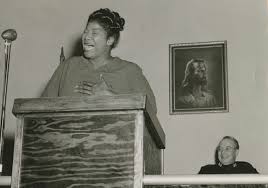
She pushed boundaries and societies’ status quo. She would demand ushers seat black and white guests together. She would sing pro-bono for causes, fundraisers, and charities. She would become one of the most prominent gospel musicians to be tied to the Civil Rights Movement.
She would travel to Montgomery Alabama to lead her voice and support for the Bus Boycotts. She would also travel to the Holy Land. Dr. King was known to call Mahalia multiple times including in the middle of the night for support, prayer, and for her to sing solace, wisdom, and faith to him. She would sing a spiritual before King’s famous 1963 “I Have a Dream” speech. As seen here,
She would later perform at King’s funeral seen below:
Mahalia would continue to perform, contribute to the Civil Rights Movement, and spread her gospel blues music until she passed in 1972.
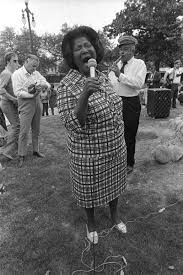
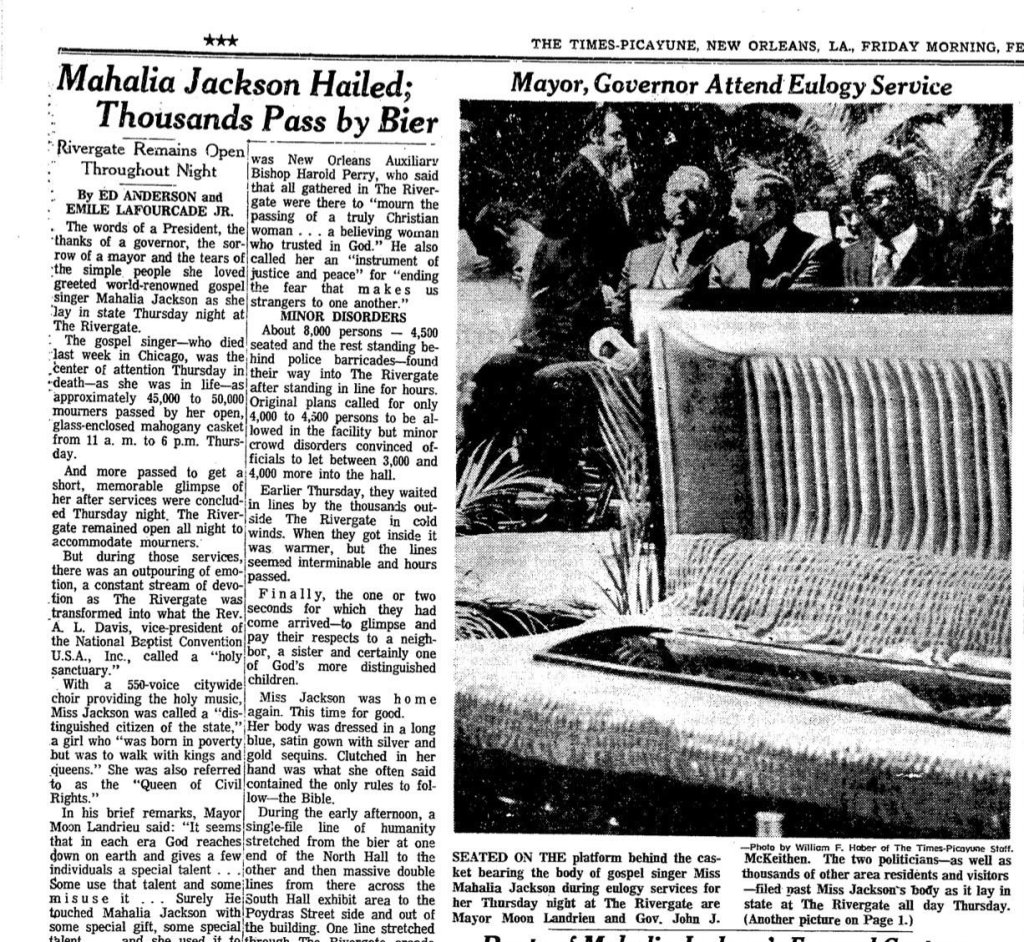
50,000 came out for her funeral in Chicago where Coretta Scott King gave one of the eulogies. The next day Mayor Daley hosted a memorial service as her body left the city for her final resting place in New Orleans. Over 60,000 came out to view her casket before she was laid to rest at Providence Memorial Park.
She has sold more than twenty-two million records. Under her contract with Columbia, she would make twenty-eight records. She was inducted into the Rock and Roll Hall of Fame in 1997 for her contribution to modern music in all genres and mediums. She continues to be remembered for her soulful and spiritual voice.
Further Resources
Amazing Grace https://www.youtube.com/watch?v=ZJg5Op5W7yw
Mahalia Jackson Documentary https://www.youtube.com/watch?v=KROglGDesPI
We Shall Overcome https://www.youtube.com/watch?v=TmR1YvfIGng
Elijah Rock https://www.youtube.com/watch?v=BoMrB2Q1rFA
Where You There When They Crucified My Lord? https://www.youtube.com/watch?v=3ji7eP7k8cA
PBS Documentary The Black Church
PBS Documentary Gospel
Mark Burford “Mahalia Jackson and the Black Gospel Field”
Laurraine Goreau “Just Mahalia, Baby”
Jesse Jackson “Make a Joyful Noise Unto the Lord!: The Life of Mahalia Jackson, Queen of the Gospel Singers”
https://www.biography.com/musicians/mahalia-jackson
https://nmaahc.si.edu/explore/stories/mahalia-jackson-gospel-takes-flight
https://neworleanshistorical.org/items/show/977
https://www.npr.org/templates/story/story.php?storyId=123498527
Discover more from Feminism and Religion
Subscribe to get the latest posts sent to your email.

 Feminism and Religion
What an incredible voice. I don’t know that I ever heard her sing before. To be such a great talent and to use that talent to break so many barriers is remarkable. Of course, that she had to break these barriers at all to be recognized and respected is one of the great tragedies of our culture. It is stunning that she couldn’t get her paychecks cashed and even with her popularity, her show didn’t have monied sponsors.
Thank you for sharing her with us.
LikeLike