

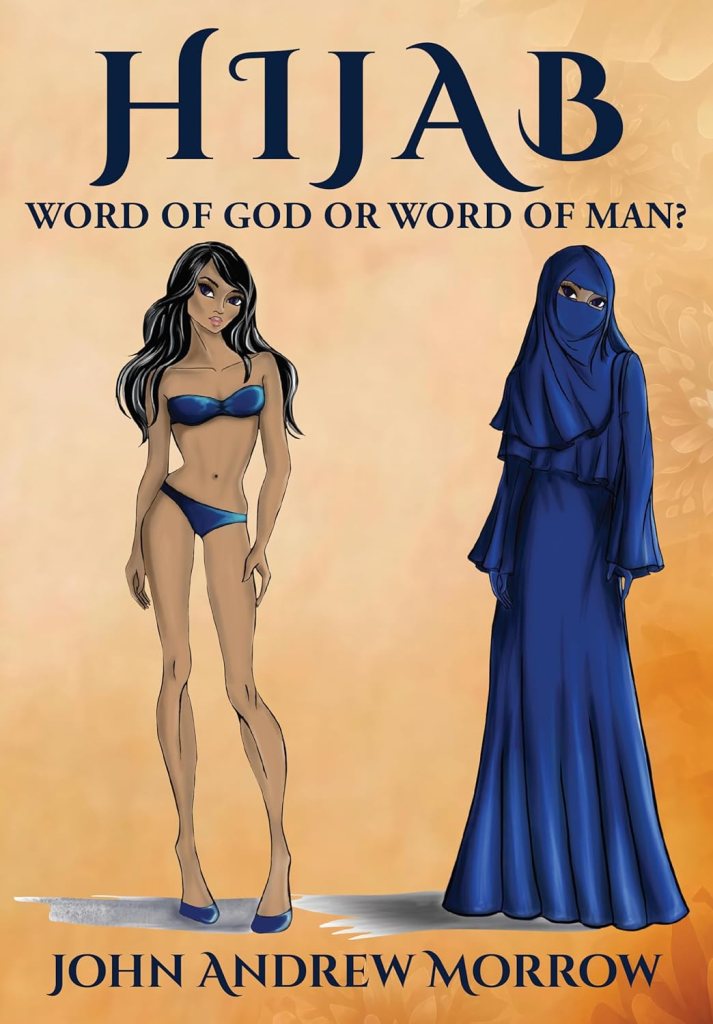
Dr. Morrow’s book is a treasure chest of facts that also includes a wide variety of scholarly opinions regarding hijab. His meticulous scholarship, laser-like vision, and accessible writing style clearly differentiate between what the Qur’an requires of women’s dress and what the jurists (overwhelmingly male) have enforced. Morrow’s book would be an invaluable addition to Islamic Studies curricula in the academy, yet it’s comprehensible enough to a lay person interested in learning about hijab.
I thoroughly enjoyed reading this substantial volume. I got a fuller picture of the meaning of hijab over time. Dr. Morrow is clear—women ought not to be forced (legally or socially) to wear hijab. Muslims are fond of saying: There is no priesthood in Islam. There is no mediator between an individual and Allah. Yet, many Muslim clergy enforce a patriarchal bent (that social system absorbed from their culture and society) to their juristic rulings that constrict women from making a free choice.
Dr. Riffat Hassan, Professor Emerita, University of Louisville, introduces Dr. Morrow’s “exhaustive and meticulous research” that focuses on various viewpoints regarding hijab. Hijab means to hide or separate. Hijab came to mean “scarf.” It was imposed on Muslim women as a way to exclude them from the sociopolitical sphere (Lamrabet). “The hijab is a symbol of subordination to male authority and dominance” (Morrow).
CHAPTER 1—“Women’s Dress in the Qur’an and Hadith.” The Qur’an is Muslim Scripture. Hadith is a collection of narratives about Prophet Muhammad. The dominant view among Islamic scholars today insists that Muslim women completely cover themselves. The “spectrum of opinion,” though, is (and has been) varied. The Qur’an expects humans to cover their ‘awrah (genitals) in public and when with other people not closely related. The Qur’an doesn’t use the word hijab (hair covering) rather it uses the term jilbab, covering ‘awrah, a concept “bound by culture and time.”
Modesty is the principle. The Qur’an exemplifies modesty using clothing practices in Arabia (600 CE). Jurists (creators of Islamic law based on Qur’an and hadith), many of whom are misogynistic control-freaks, have made hijab mandatory, force-feeding “misogynistic material as if it were the Word of God.”
CHAPTER 2—“Are Women Vulvas?” Women’s bodies and their voices have been considered ‘awrah, making them “walking vulvas.” Hence, many Muslim women feel naked without their veils. Some Muslim women, particularly Western converts, find the hijab “liberating,” freeing them from objectification. Many Muslim women, though, view the hijab as oppressive. Muslims may claim that hijab is about modesty, respect, and chastity, however, “Islamic” dress is all about protecting men from women. Interestingly enough, only free women (not slave women) were required to veil, however, we’re under no obligation to follow the views of people who lived over a thousand years ago.
CHAPTER 3—“Boobs, Bosoms and Beyond” demonstrates how jurists have made a travesty of their Scripture, insisting that properly-covered women be completely cloaked. The Qur’an requires that women (and men) cover their genitals and recommends women cover their bosoms. Perhaps “the animosity towards women found in Judaism, Christianity, and Islam…was part of a gender war [where] the followers of God the Father wanted to suppress any signs of God the Mother….The new spiritual male supremacists wished to erase every sign of the Goddess.”
The Qur’an called for free Muslim women to cover their bosoms for their protection, reflecting “sickening social circumstances.” The larger question is: “Why is the burden placed on women when it comes to chastity, purity, and honor?” Why not hold Muslim men who sexually harass women accountable? The hijab ultimately is not about clothing, “it is about piety, reverence, and righteousness.”
CHAPTER 4—“Foundations of Falsehood Built on Shifting Sands” contrasts enslaved women’s dress with free women. How can any scholar claim the hijab to be about modesty when classical jurists forbad slave women to cover their bosoms? God revealed one book—the Qur’an. Muslims have used other books (hadith and words of Imams [Muslim leaders]) to create law, often putting the Word of Man above that of God. “Interpretations must never be accepted uncritically.”
CHAPTER 5—“The Imposition of ‘Islamic’ Dress Upon Women” gives a historical evolution of Muslim women’s dress and “demonstrates how the veil, a pre-Islamic custom…became a so-called Islamic obligation…turning women into walking vulvas and vaginas.” Jurists rallied economic and political support for some of their more extreme wardrobe rulings. Historically, the veil is “a cultural norm [more] than a religious imperative.” Is the Islamic hijab really Islamic? “The dominant form of Islam…propagated today is radical, political Islam….The veil is an article of clothing. It is not a divine duty, a dogma, or a doctrine.”
CHAPTER 6—“The Reemergence of Reformist, Rationalist, Secularist, Qur’anist, Progressive, and Revivalist Voices” looks at what the Qur’an says about hijab in light of modernity. Patriarchy and sexual segregation are incompatible with the Qur’an’s universal message. “For the veil to be a free choice, it cannot be an obligation….Solidarity of Western allies [wearing hijab] is damaging to Muslim women who struggle against the sexism of the coerced hijab” (Bestandji).
CHAPTER 7—“The Views of Men on the Hijab,” unfolds the work of several male scholars, intellectuals, writers, and leaders. While there are differences among them, they concur that the Qur’an does not mandate hijab. “To adopt the hijab, which was invented by jurists [in early Islam] is an act of human regression” (Bestandji).
CHAPTER 8—“The Views of Women on the Hijab” unpacks perspectives of women intellectuals, academics, scholars, and activists. “The veil is no longer the sign of an anthropological culture but of a political culture….I do not accept a political culture that discriminates against women” (Tamzali). Amina Wadud, a contributor to FAR says, “If you think that the difference between heaven and hell is 45 inches of material, boy will you be surprised.”
CHAPTER 9—“A Long, Long Way to Go” reminds us that hijab has pre-Islamic origins and rooted in patriarchy, misogyny, and male supremacy. Morrow believes “secular governments should…stop allowing religious and cultural communities to transgress human rights.” Most Muslim women think it’s their right to choose whether or not to wear hijab. Patriarchal and misogynistic governments, though, do not give women the right NOT to wear hijab. “For moderate, secular, feminists from the Muslim world, the sight of Western women voluntarily adopting the symbol of retrograde fundamentalist Islam is a…slap in the face.”
Morrow, a Muslim, longs to further justice, equality, and love in Islam, not letter-of-the law reductionism. “The hijab means nothing. The heart means everything.”
BIO of author John Andrew Morrow received his Ph.D. from the University of Toronto, where he focused on Hispanic, Indigenous, and Islamic Studies. He has also completed over four decades of Islamic seminary studies, both independently and at the hands of a series of Muslim scholars. Dr. Morrow has taught at universities around the world and reached the rank of Professor. Recognized as a Master Teacher and a Distinguished Faculty Member, he received a Student Impact Award, an Interfaith Service Award, and a Certificate of Special Congressional Recognition. A prolific, pioneering, and path-forging author, academic, and activist, he is considered of the leading authorities on Islam and one of the most influential American Muslims. You can find his book here.
Discover more from Feminism and Religion
Subscribe to get the latest posts sent to your email.

 Feminism and Religion
There is no MAN made religion, patriarchal faith, that will serve women. None. There is no way that a laughable man-god will ever serve the interests of women. There is no sense to be made from the rules, designed to subdue the feminine power and no amount of explanation that will make these rules acceptable. She is the only answer for women, for humanity.
LikeLiked by 2 people
Thank you, Deborah, for commenting. I agree with your sentiment. All our institutions, including religion, are shaped by patriarchy and its need to contain/control women and all “others.” I think what often happens is that what was useful–even helpful–at the time religious texts were written down no longer work as our cultures/societies have moved forward. For whatever reasons(s), so many of us (humans) find it comforting to hold on to the traditions of our ancestors–traditions that were meaningful and helpful to them, but have outlived their usefulness.
LikeLiked by 1 person
Thanks for this summary. My understanding is that ‘awra literally means “shame” (a word that is used for “modesty” in some languages, as in Indic lajjā (thus, Lajjā Gauri), and is used for “vulva” in others, such as some Nordic languages. Theologians extended this marking of “shame” to the entire female body, except for the hands and sometimes the feet, while applying the sexual double standard to exempt men. As the author notes, the claim is that women have to cover (and suffer discomfort) so that men will not feel tempted (and thus assault them). It makes women responsible for male sexual desire and lack of self control.
LikeLiked by 1 person
Right. As I understand Dr. Morrow, the nascent Muslim community understood ‘awra as something shameful to be exposed and practically speaking, it came down to the pudendum. That idea of shame in some Muslim circles widened to include (as you note) the whole female body including their voice. It’s why many Muslim feel naked without full coverage and feel “righteous” when silent.
LikeLike