


This post is dedicated to the memory of Mara Lynn Keller, who passed away on 12/23/23. Mara was an expert on the Eleusinian Mysteries, and much of this post is based on her scholarship. Mara was a life-long friend and ally of Carol Christ’s, going back to their days in the Ph.D. program at Yale. She co-founded the Women’s Spirituality program at the California Institute of Integral Studies (CIIS) with Eleanor Gadon (The Once and Future Goddess). Mara was an unusually warm, welcoming, and generous presence, and must have been a fabulous teacher.
The Eleusinian Mystery Rites were practiced in Athens and Eleusis from 1450 BCE to 329 CE, a period of almost 2,000 years, before they were expressly forbidden by the newly Christian Roman Empire, and years later the temple was destroyed. The Rites had originated on Crete, and continued to be practiced in Knossos and in the caves there for many centuries. It is likely no coincidence that the origin of the Mysteries in Eleusis in 1450 BCE is the same date as the fall of Knossos.
The religion is based on the myth of Demeter and Persephone, To Deo, the mother and daughter. As the story goes, Persephone was picking flowers with her girlfriends when the earth opened and Hades, god of the underworld, carried her off to be his queen. Demeter was inconsolable at the loss of her daughter; she raged and withheld the bounty of nature, when Zeus did not agree to return her. In her grief, she wandered over the countryside coming to rest in the town of Eleusis. There she disguised herself as a nanny and went to work for the kindly king and queen who had offered her lodging.
When she is caught passing their son through the fire, in a rite to give him immortality, she is forced to reveal her divinity. Meanwhile, Zeus had become alarmed at Demeter’s withholding of the fertility of nature, and pressured his brother into releasing Persephone. The name Eleusis means “advent” and it is here that Persephone is joyfully reunited with her mother, but because she has eaten several pomegranate seeds in Hades, she is destined to return there for a third of each year.
The Greater Mysteries, known as the Thesmophoria, were performed over 9 days, from 9/15 to 9/24, and imitated the 9 days that Demeter searched for her daughter. Initiation into the Mysteries was considered one of the great experiences of a lifetime, and it required a month’s salary, in addition to elaborate fasting and purification.
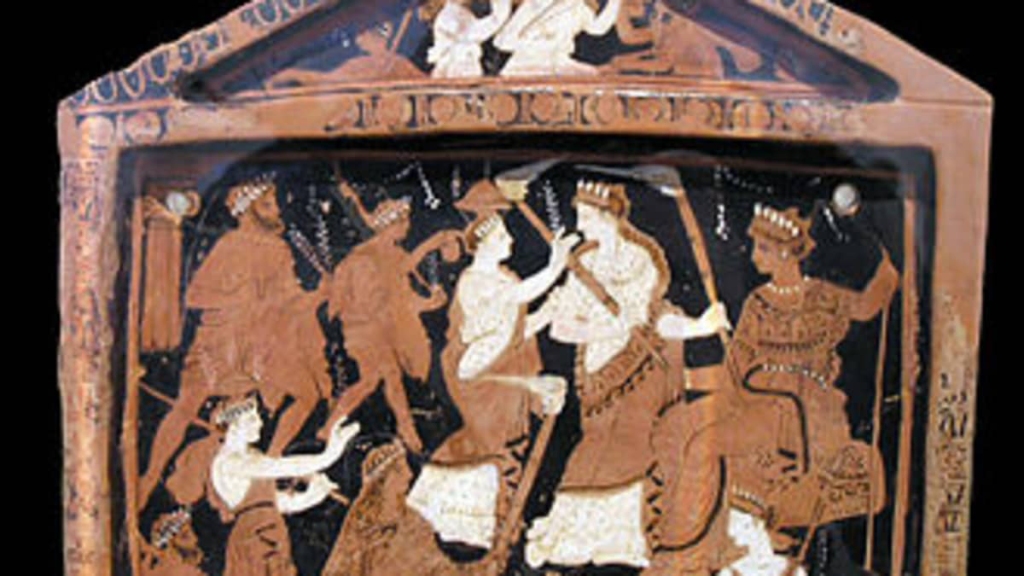
The Rites would begin with the priestesses transporting the sacred objects from Demeter’s Temple in Eleusis, the Telesterion, to her temple on the north slope of the Acropolis. As they went, they issued a call to participate.
- Day 1. The Gathering, in the Agora in Athens.
- Adelade, Mystai! The initiates walked several miles to bathe in the Aegean Sea to purify themselves in the healing salt water.
- Fasting, sacrifice of a piglet, feasting at night. During the 9 days, initiates fasted during the day, eating only after nightfall. In this way, they identified with Demeter, who fasted the 9 days that she sought Persephone. Pigs were sacrificial animals during the Neolithic and beyond, the quickly fattening animals representing the richness and fertility of the soil. Seeds were found embedded into the votive figurines of pigs in old Europe, and in Egypt pigs trod the seeds into the black soil left by the receding Nile.
- Incubate a healing dream at the dormitories of the temple of Asklepios on the southwest slope of the Acropolis. Asklepios’ primary healing center was in Epidaurus, but there was a smaller temple on the Acropolis. “Therapistes” spoke to the initiates about how to implement the action the dream spoke to, the new sense of purpose.
- Pomp. Begin the 14 mile walk to Eleusis, passing sacred shrines and springs. Crossing over the Bridge of Jests—where they are ceremonially mocked and ridiculed, stripping away pride—onto the temple grounds. The little bridge can still be seen, although it is beginning to sink into the creek. Iambe (Baubo) is celebrated, the lewd, jesting figure that appeared to Demeter to lighten her spirits, extolling the power of laughter to alleviate grief. Saffron strings were fastened at the wrist and ankle of each initiate to indicate belonging to Demeter.
- Night of revelry—singing, dancing, feasting, festivities around the well outside the Telesterion to celebrate their arrival. Staying up all night, followed by a quiet day.

7, 8) Nights of Mysteries—inside the Telesterion, Demeter’s Temple, the Hall of Completion. There are dramatic enactments of the myth of Demeter and Persephone, recitation of the Homeric Hymn to Demeter. A fire on the Anaktoron (shrine), possibly housing the hieros gamos or sacred marriage of a hierophant and priestess of Demeter. The magical return of Persephone from Hades, and the triumph over death and grief. The experience of the Epotopia, a new way of seeing. The drinking of the Kykion—barley water infused with mint and pennyroyal, which after fasting might have had some mind-altering effects. If there was ergot (mold) on the barley, the drink would have been a powerful hallucinogen, as strong as LSD, and none other than Albert Hoffman, the inventor of LSD, weighs in on the subject. In his view ancient people were not only capable of harvesting such a drug, but this was the primary purpose of the Rites, the hallucinogenic trip the Epotopia, or new way of seeing, the realization of the divinity within the self. (This view is far from universal, and Keller didn’t subscribe to it.)
9) The Epistrophe, or the Return. The arrival of Triptolemos, who Demeter empowers to go out and teach the world her sacred agricultural rites, laws for a successful harvest, the thesmoi. The goddesses are reunited with Hekate, the grandmother, the triple goddesses of abundance, barrenness, and renewal.

Part 2, tomorrow

BIO: Sally Mansfield Abbott is the author of MIAMI IN VIRGO , a mystical feminist coming-of-age novel. She taught classes on Goddess Worship in Prehistory at a number of colleges in the Bay Area.
Discover more from Feminism and Religion
Subscribe to get the latest posts sent to your email.
 Feminism and Religion
Very interesting.
LikeLiked by 1 person
Thank you for this wonderful, informative, and inspiring tribute to Mara Lynn Keller. What a life-changing experience these rites must have been! It makes me wonder what updated rites serving the same transformative purposes might look like in the 21st century? I look forward to Part 2!
LikeLiked by 1 person
Thank you so much, Carolyn. What a great idea to use these Rites as a model to create our own transformative Rites!
LikeLike
I was close to Mara. She was my dissertation committee chair and my teacher for years. I knew she didn’t subscribe to the idea of the dark goddesses and their rage, violence and destruction being an elemental aspect of the original divine feminine, and I think she felt that way about animal sacrifice, but I didn’t know she didn’t agree with the Kykion being a sacred vehicle for altered states of consciousness. In my studies of this I can’t see how it could have been anything else. Without a consciousness shift back to alignment with natural law, we couldn’t clear our minds and sensibilities and remember our flawed human laws and ways of living are temporary and arbitrary.
Anyway, thank you for this succinct synopsis. We have a lot to learn in these tumultuous contemporary times about the wisdom of this rite and the mythology of the mothers and daughters in communion with the earth/goddess who gives and takes life. Mara’s passion for this area of study and self-reflection was unique and inspiring.
LikeLiked by 1 person
I think Mara saw the Kykion as a meaningful communal experience, a shared drink that tasted like mother’s milk, but from what I remember and have read, she never emphasized its mind-altering properties. Her belief in the power of the Rites rested with the drama, the enactments, and the communal, collective experience.
I’m glad you had a close relationship with Mara, and I’m sure she was an inspiring teacher. I think those of us who did are lucky. She and I were friends and colleagues years ago, and then lost touch for a long time, only connecting again in recent years.
LikeLiked by 1 person