


Last week, once again, I had the good fortune to bring a small group of dancing friends to southern Morocco. As always, our travels there unfolded in a blessed and beautiful way, rich in experiences of ancient Berber/Amazigh culture and encounters with local women.
At Tioute oasis in the foothills of the Anti-Atlas mountains, we bought unleavened flatbread baked in rounded clay ovens.
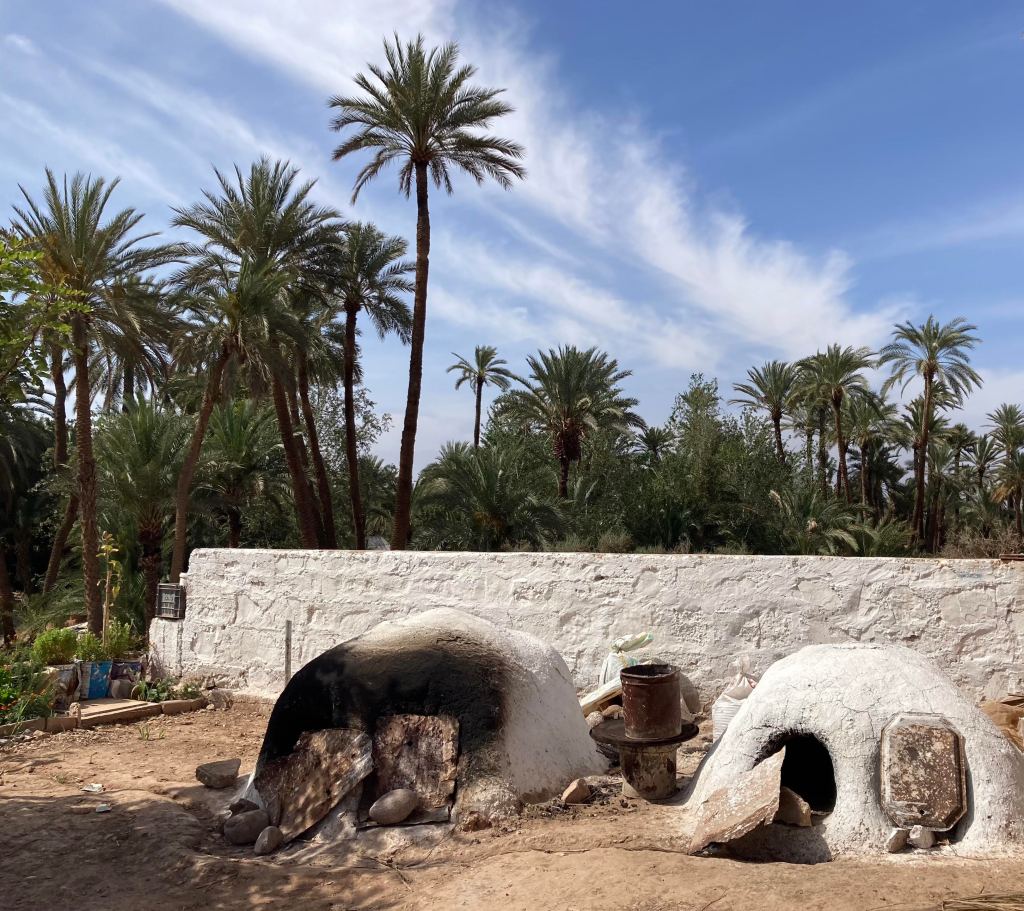
The wheat and barley are heirloom varieties, cultivated by hand in small fields set among clusters of date palms. Oven, fields, grain, water, and fire are all considered sacred, as are the women’s hands whose work feeds the community. The style of oven and the recipe for the bread – made only with flour and water, rising to a tender softness thanks to its own steam – are as old as agriculture itself.
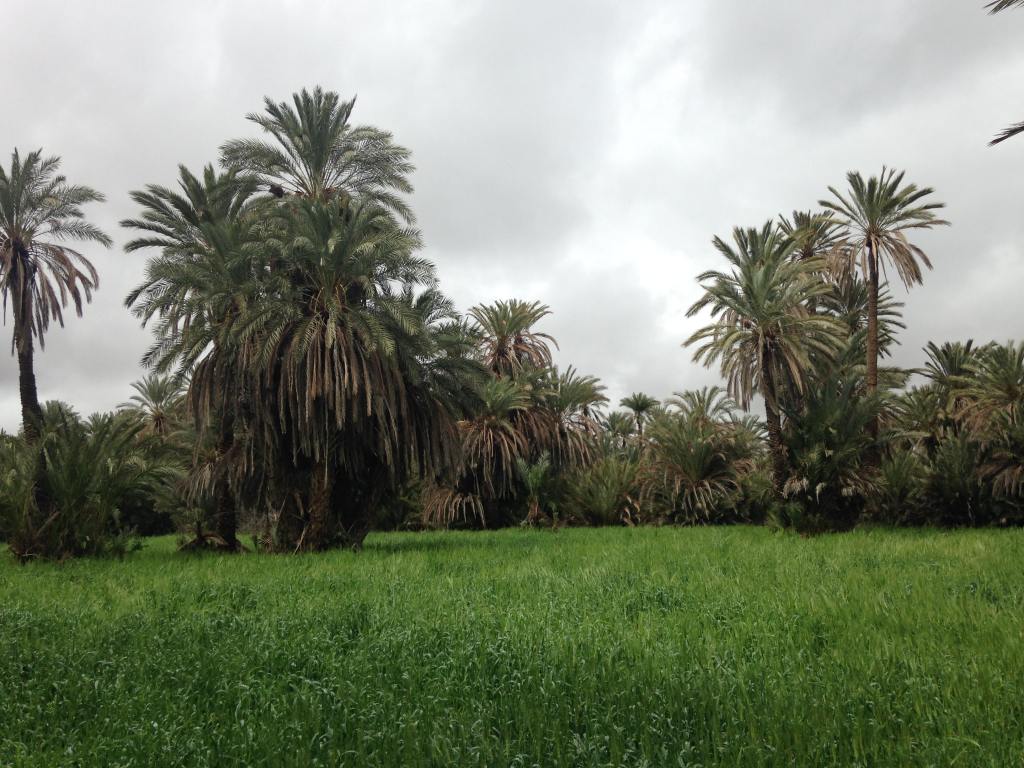
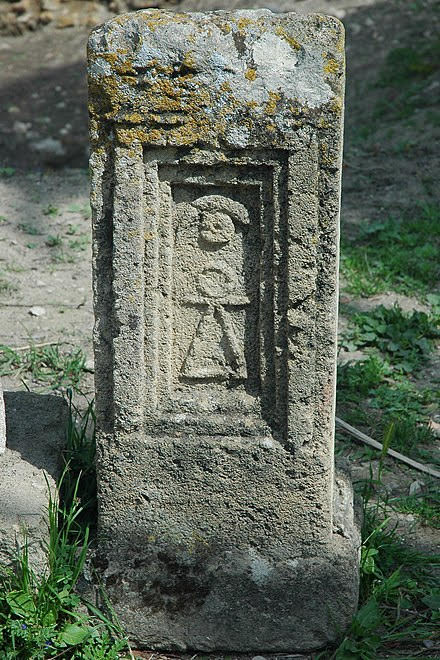
Reverence for the date palm is even older. In early North African and Phoenician culture, the date palm was a symbol of the goddess Tanit, allied with Astarte and Ishtar. Tanit’s sign was a triangle surmounted by a horizontal line and a circle, resembling an abstract representation of a female form with outstretched arms.
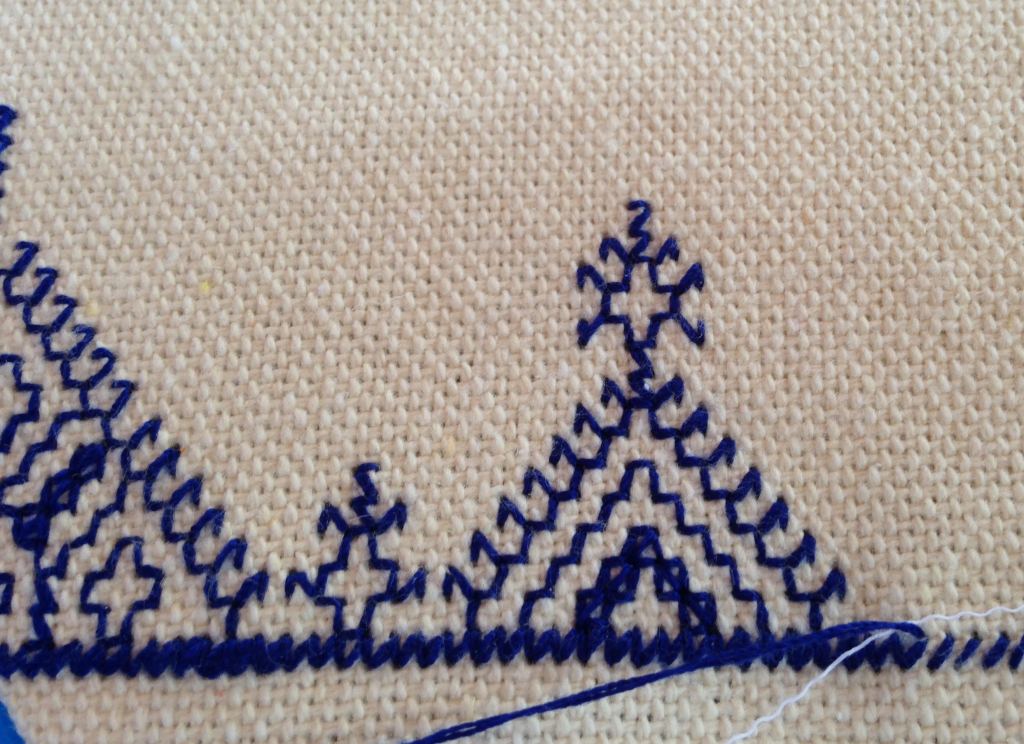
The upright triangle still features in Berber women’s arts and crafts including the specialised double-sided fassi embroidery, where it represents the mountain goddess or Mountain Mother.
The same three elements of the Tanit symbol – circle, triangle, line – appear in the fibula, the quintessential element of Berber women’s adornment.
Large fibulas in pairs served to fasten the fabric of the women’s haik (a wrap-like outer garment) at the shoulders, while smaller fibulas were pinned into hair braids or worn over the forehead. Fibulas also made formidable weapons of self-defense; Berber Amazigh women were reknowned for their skills as warriors. Along with decorative and practical aspects, the fibula carries symbolic meaning: the inverted triangle signifies women’s creative power, and protects the wearer from misfortune and the ‘evil eye’.
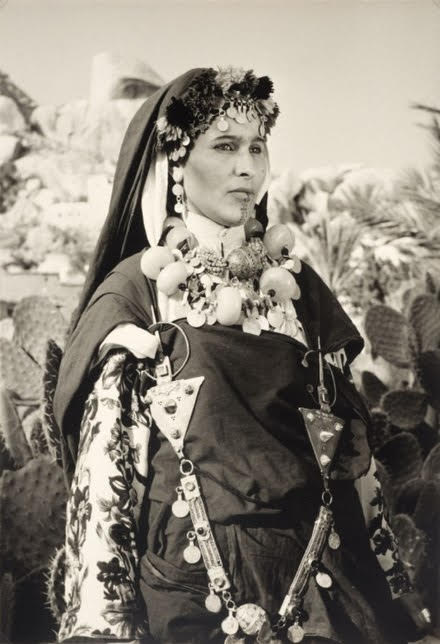
Berber women, both Jewish and Muslim, also wear the Hamsa or Hand of Fatima as an amulet.
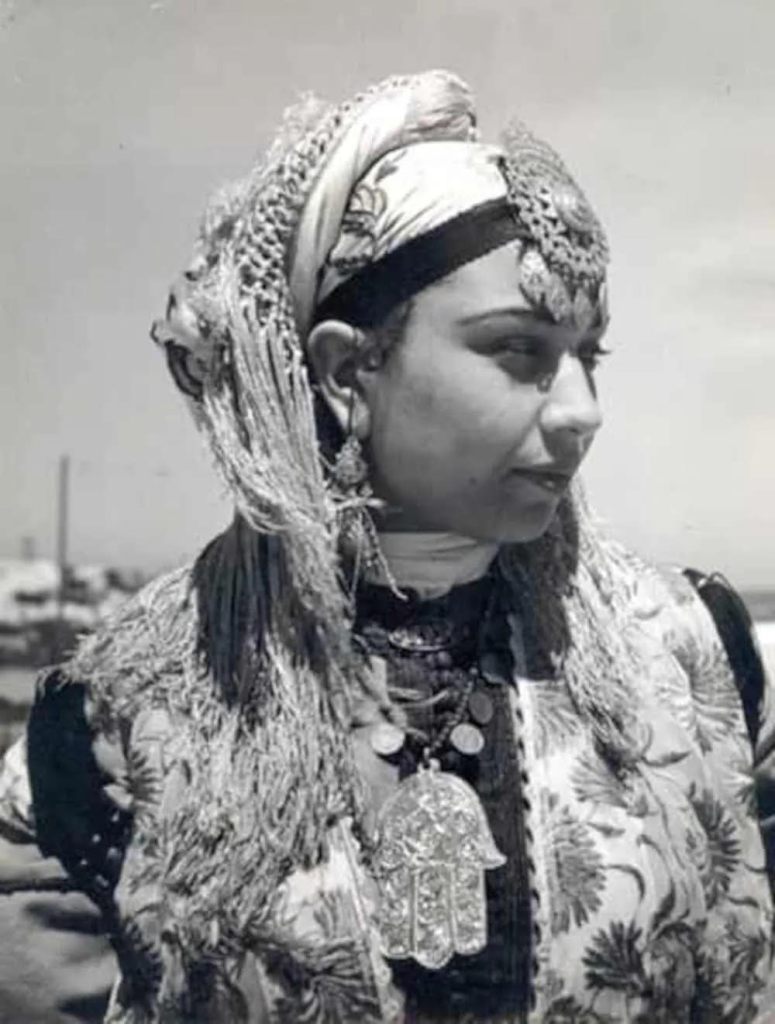
The Hamsa represents both the hand of the Goddess protecting the wearer, and the power of the woman herself and all she brings into the world through craft, cooking, and every kind of creative act. As Cynthia Becker explains in Amazigh Arts in Morocco: Women Shaping Berber Identity, “Amazigh women…play an important role in their communities by providing commodities such as tents, clothing, rugs, sacks, and ceramic pots, in addition to acting as healers, marriage brokers, midwives, cooks, agriculturalists, and pastoralists.”
To this list I would add music and dance, specifically the women’s drumming, singing, and dancing which my dancers were able to experience with different groups of local women. The musicians weave a hypnotic soundscape from multiple frame drums and water jugs of different sizes, which the women toss easily between themselves, taking turns to play percussion and to lead the singing. The overwhelming power of the women’s voices, ululations, and calls of blessing, interwoven with handclaps in sophisticated syncopation, and the rhythm, grace and strength of their dancing – each woman perfectly at ease with her body, whatever her age, shape, or size – will stay with me for a long, long, time.
Along with silver jewellery, Moroccan brides wear necklaces of cloves. One young woman from a village in the High Atlas first showed us the clove bridal necklace her mother-in-law prepared for her when she got married, then taught us to make our own, by soaking cloves overnight, then stringing them with needle and thread to create a simple three-strand necklace ornamented with red beads and a silver hamsa, wonderfully fragrant with the revitalising aroma of cloves.
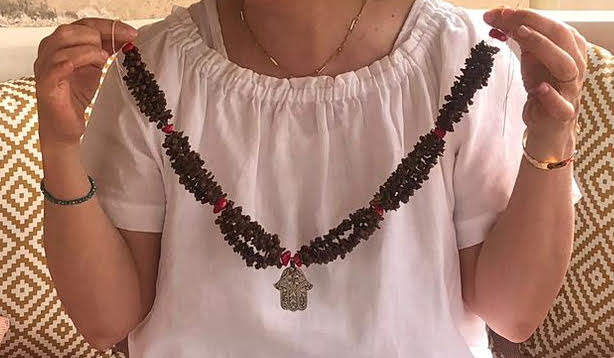
After learning about clove necklaces, I found a similar one in the Taroudant souk.
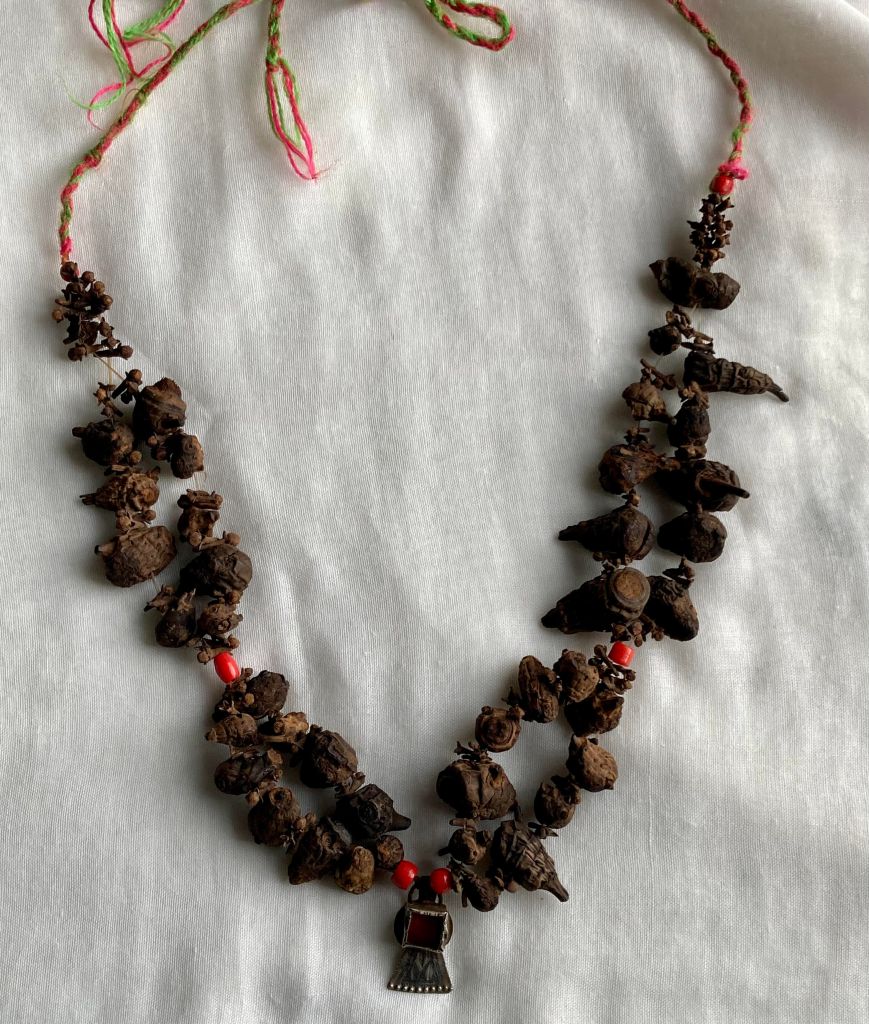
It is strung with cloves and the round dried roots of nutgrass (Cyperus rotundus), which is an antioxidant specific for skin and hair, provides a lovely perfume for hair and clothes, and also serves as a powerful apotropaic and protective amulet. Cloves are antioxidant and anti-inflammatory, particularly effective for toothache and stomachache. Both are valuable medicinal plants with many uses, which new brides would have benefited from having always to hand.
When I bought it, the central silver pendant was completely black with grime, but a little cleaning revealed incised motifs combining the yoni, the double-peaked mountain Goddess, and the azemmur or olive tree, Amazigh symbol of quiet strength and tazmat, life force.
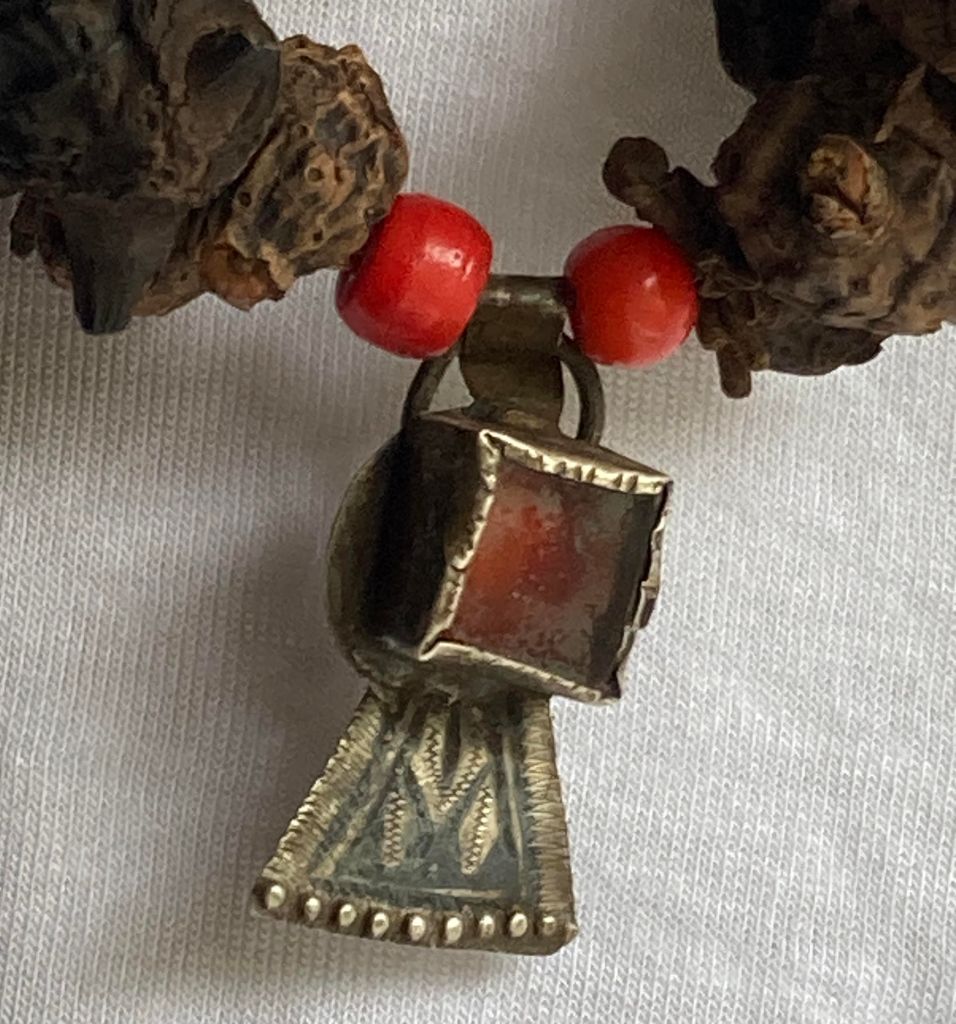
The triangular shape surmounted by a circle resembles the sign of Tanit. The square glass inside the circle embodies the Light that protects and guides, while the dots represent sacred seeds, or perhaps the dance steps of the women, or perhaps the drops of longed-for rain.
We made our clove necklace in preparation for another traditional ceremony whose revival we were privileged to witness. Our Berber friends recreated for us the rain-bringing ritual they remembered from childhood, with special songs and customs centred around the Taghonja, a life-size Goddess figure known as ‘the bride of the rain’. Fashioned from large wooden ladles, a pestle, and a household broom, the Taghonja figure was dressed in bridal finery, including our newly-finished necklace. We carried her through the streets of our ‘village’ to the threshing ground, where we danced for rain and joyfully flung drops of water over one another in an age-old enactment of sympathetic magic.

It’s going to take more than one rain ritual to bring balance to drought-stricken Morocco, where the reservoirs are low, the water table is dropping, and even the hardy olive and argan trees are brittle and parched. Yet rather than despair, I take heart from the survival of healthy symbol systems celebrating the sacred feminine, and the many life-affirming crafts and customs still alive in the hands of the Berber women of southern Morocco.
The living legacy of this ancient culture, literally matriarchal in origin with its emphasis on ‘mothers at the centre’, attests to the survival from pre-patriarchal times of values based on care for the earth, for the community, and for all who are weak and vulnerable.
May we continue to learn from these strong, intelligent, creative, talented, and generous Berber women! And may the seeds we glean from our encounters with them bring a rich harvest for a sustainable future.
[Note: a correction to this post was made on July 30, 2025, to correctly identify the plant strung with cloves in the vintage necklace as nutgrass (Cyperus rotundus), not Moroccan Cedar (Cedrus atlantica) as previously stated.]
Discover more from Feminism and Religion
Subscribe to get the latest posts sent to your email.

 Feminism and Religion
Interesting article – so many ancient cultures give brides necklaces of herbs – But as I see it the problem here is that the Berber way of life is no longer viable – even for them – we are not living in a sustainable culture – we are embracing its opposite with every car trip plane ride heat source – well you get the idea – we are living in chaos and it worries me so much when folks imply otherwise… sustainable is behind us – what we need to be doing is thinking how we can best mitigate the damage we are all incurring as part of a disintegrating system. – pre – patriarchal is NOT our current reality… a soothing place to visit – but?
LikeLike
Yes, Sara, as you say, we are living in chaos. All the more reason to make meaningful connections while we can with those who are the guardians of a living lineage from a sustainable past. For us southern Morocco is not ‘a soothing place to visit’ – there is lots about this part of the world that awakens profound concern, and we address the deeper issues in all we do here, for instance engaging with projects which support local women and children, especially after last year’s devastating earthquake, as well as orphanages and schools, beekeepers, heirloom seeds and sustainable agricultural techniques, ecological building and traditional artisan skills, (e.g. the women’s embroidery project we initiated here in 2014), as well as the Berber women’s music and dance traditions I’ve mentioned on FAR before. My own sense is that even as we bear witness to vanishing traditions, we are able to participate in keeping them alive, through the respectful connections we have made here on many visits over the last decade.
The Berber people are the indigenous inhabitants of North Africa, with roots in a matriarchal culture which are still tangible, discernible, and accessible. Taroudant is the only Moroccan city where Berbers are in the majority, so here we can see many ways in which ancient values of sustainability uniquely survive in a modern urban context. People here are also likely to belong to one of the local Sufi tariqas, which means they see everyone as a sister or brother in the human family, all religions as branches of the same tree. This is a priceless experience to be able to have in this time of ever-increasing fractures along ethnic and religious lines.
I was so moved by your own recent post, Sara, The Circle of Giving and Receiving, about your various experiences of the Tewa Seed Ceremony (and its associated rain dance). You write about feeling ‘struck by lightning’ by your participation ‘in an ancient ceremonial exchange that may have originally extended back to Neolithic times’. You describe beautifully how the ritual ‘exchanging of seeds acknowledges the sanctity and power of these beings to create new life’, ‘affirming the critical importance of uncontaminated seeds as well as the unity that is possible between all peoples.’ The conclusion of the Berber women’s Taghonja rain dance ritual I witnessed last month in Taroudant, btw, involves joyfully flinging grain and seeds over the threshing ground – joy and celebration following the solemn ceremony, just as you described among the Tewa. The Tewa and Berber peoples may come from different continents, yet they share the universal indigenous reverence for the earth we can still find all over the planet.
I’ll close with another moving quote from your post, Sara. You write,
‘I believe that seeds of hope are planted with each act of sharing – seeding a kinder more compassionate way of being on this Earth. If there is hope for humanity, we will find it here.’
I agree completely and could not have said it better myself. Thank you!
LikeLiked by 2 people
I am familiar with the the People of which you speak and I too, having lived in NM for 4 years, engaged much as you did – always deeply moved by the authenticity of these people – I loved your article – but my concern is NOW… Indigenous peoples are not taken seriously, I know, I have been passed over so many times because of my own Indigenous roots – this is why I say we need to appreciate and live the indigenous way – not by taking over ceremonies but by learning how it could be to live in genuine community – although how we can shift the present cultural trajectory is simply not humanly possible under patriarchy – Robin Wall Kimmerer discusses what will come next – and we must prepare.
LikeLike
Thanks for your thoughtful reply, Sara. It has also been my experience to be ‘passed over so many times because of my own Indigenous roots’ – which in my case include not only several Native American tribes but also a small percentage of Berber DNA – and I agree that the way forward in these times of chaos is to ‘appreciate and live the indigenous way…by learning how it could be to live in genuine community’. Robin Wall Kimmerer is one of so many prophetic voices clearly warning that it is time to prepare for the great changes already underway, and the Berber women I’ve been writing about would agree. For me, the best preparation for the challenges we are facing now comes through moments of genuine engagement with ceremonies and lifeways of still-living lineages from pre-patriarchal times. They teach the resilience, community, mutual support, respect for the earth, and commitment to care for the weak and vulnerable, which in my view are the foundation stones of pre- AND post-patriarchal culture, and are exactly the tools which can most help us NOW.
To clarify, I don’t feel that our engagement with Berber women’s dance and culture in Morocco counts as ‘taking over ceremonies’ in any way. In the rain dance ritual I described, the Taghonja figure was made by Berber women (decorated with the traditional clove necklace they showed us how to make), while the appropriate songs and dances were led by 6 professional Berber women musicians we hired. All 13 of these Berber women had experienced the Taghonja ritual in their home villages in their childhood, and had also witnessed its disappearance in recent years. They were delighted to have an opportunity to recreate it in this time of desperate need for rain, and although the ceremony took place at my request, the Berber women were definitely the leaders here, and my group of dancing women (17 of us, from 9 different countries) were definitely the followers. In my piece I refer to us ALL as ‘we’.
In a lovely synchronicity, just as I finished writing this, a friend sent me a quote from Amanda Yates Garcia. Her words resonate with my own feelings about bringing women together across cultural boundaries, to share moments which transcend our differences and remind us of our essential unity:
‘Love is the life force flowing through us. Love is the moment when the walls that separate us from the rest of the universe come tumbling down. And we stand there, naked and afraid, but not alone. Even a glimpse of that not-aloneness is worth it. Because it’s proof that we are part of something larger and more important than ourselves.”
LikeLiked by 1 person
to clarify further – I did not suggest that you were taking over native ceremonies – but oh so many do -Native Peoples have always known how to treat each other and the earth – westerners could learn so much but choose not to – the western brain thinks it knows it all – and these people are always engaged with power on some level. There’s no place to go with this attitude but down. I also believe that women who are in touch with who they are are capable of great compassion and have the ability to learn other ways of being – Look at us on FAR. WE are living it.
LikeLike
Beautiful post, Laura! Your last paragraph sums it all up well: ”May we continue to learn from these strong, intelligent, creative, talented, and generous Berber women! And may the seeds we glean from our encounters with them bring a rich harvest for a sustainable future.”
I don’t believe anybody who looks at and studies ancient cultures yearns to return to the “way things were.” However, as you note, we can glean seeds for the future. So much, then, is up to us as we care for, plant, and harvest those seeds.
LikeLike
Absolutely, Esther, the seeds are both literal and metaphorical. You put it beautifully: ‘So much, then, is up to us as we care for, plant, and harvest those seeds.’ Thank you!
LikeLike
I love this discussion of the symbolism of women’s art. (I put cloves all around my kitchen to discourage the mice. It never occurred to me to make them into jewellery.)
LikeLike
Ah, I wonder if the cloves also have a mouse-discouraging benefit for the Berber home also? the scent of the clove necklaces is indeed very strong – even the 90-year-old one I found in the souk, with relatively few cloves among the cedar cones, is strongly scented enough for the fragrance to permeate my entire bedroom when I brought it home. Anyway, in my decades of exploring women’s ritual dance and culture in E. Europe and N. Africa I have observed how so often the oldest and most enduring traditions are those which serve both practical and symbolic/ceremonial purposes. Learning from them, I try to live my life in the same way.
LikeLike
Thank you, Laura, for another amazing post. The women who went on this trip are so lucky to be able to not only learn about, but experience and interact with the Berber women. I’m coming to believe more and more that creating these human, one-to-one connections is the best way we can we truly expand our perspectives, to find and share with one another those aspects of our ancestral pasts that we need to bring into the future as the Berber women do. What wonderful work you are doing!
LikeLiked by 1 person
Thank you, Carolyn, I agree completely ‘that creating these human, one-to-one connections is the best way we can we truly expand our perspectives, to find and share with one another those aspects of our ancestral pasts that we need to bring into the future as the Berber women do.’ You put it beautifully! These encounters are indeed ways of sharing ‘seeds’ of lifeways and worldviews, and preserving a precious cultural inheritance for the future of the earth. Bless you.
LikeLike
Laura’s description here of the power and usefulness of the clove and cedar necklace expands our consciousness! I’m reminded of how everyday objects may serve practical purposes. At the same time, our everyday objects are reflecting back to us our core beliefs thus strengthening our the bonds to our lived heritage. For example, to sweep our house we use a handmade broom made from natural materials meant to biodegrade.
“The most direct means of communicating visually is through symbols,” wrote Mary B. Kelly in her 2011 book Goddess, Woman, Cloth: A worldwide Tradition of Making and Using Ritual Textiles. Our beliefs are enshrined, embedded and even rooted in ritual objects. I appreciate learning of the multiple connections Laura shared in this paragraph:
“Oven, fields, grain, water, and fire are all considered sacred, as are the women’s hands whose work feeds the community. The style of oven and the recipe for the bread – made only with flour and water, rising to a tender softness thanks to its own steam – are as old as agriculture itself.”
Thank you Laura, for photographing and writing about the “many life-affirming crafts and customs still alive” in the lives of these women and girls. Each photo communicates visually the range of sacred symbols threaded through the lives of the Berber women of southern Morocco. Blessed be.
LikeLiked by 1 person
Thank you, Paula, for your comment, which reveals your deep understanding of the power and significance of the Goddess-reverent symbol systems still alive in the hands of the women – quite literally alive in our hands, as with your own symbolic AND practical broom!
And thank you for bringing Mary Kelly into the conversation. Not only her books, but my frequent personal correspondence with her in the years before she passed, have been a huge influence on my life, as you know.
I also know your own lifelong experience as a master of women’s textile arts, as well as your decades of activism, contribute to your understanding of he value of keeping women’s ritual traditions alive. I love how you write, ‘Our beliefs are enshrined, embedded and even rooted in ritual objects.’
And because of this, I believe, as I think you do too, that women’s ritual arts are the most fundamental kind of activism.
For me, learning to discern and decipher the symbols of Goddess which remain ever-present *even in the heart of present-day patriarchy* for those who have eyes to see, is a priceless gift and an essential antidote to the despair of thinking that patriarchy ‘won’ and the Goddess was ‘destroyed’. Never! She lives, dies, and is reborn, in the eternal sacred cycle.
While seeds ripen and die, our task is to save them, plant them, tend them, and safeguard their continuation. The living women’s ritual dances I have spent my life researching in so many places – Morocco, Crete, Armenia, Eastern Europe – are for me like heirloom seeds. And every woman who can do the work to engage with them, to receive the nourishment of their hidden teachings, to carry the essential values home and integrate them into her own life, becomes her own seed bank, able to sow, tend, harvest, and share.
Maybe what we save will not look exactly like it used to do, as my teacher Zuleikha has said, but through us, something of the essence can continue, in meaningful and relevant ways. And so it goes on.
LikeLike
Wonderful! Oh how I’m inspired to make a Clove necklace! I’ll make it a part of a women’s circle project. Thank you Laura for your continued research, sharing, and inspiration on matriarchal living, past and present. Lots of love to you. Nada
LikeLike