

Once I went to a free outdoor movie in Miami Beach. The film was projected on the side of the giant concert hall. There was a grassy park with palm trees stretching out from the wall; families brought picnic dinners and cans of beer and stretched out to watch the movie once the sky darkened.
The movie was Star Wars, but as Princess Leah appeared, I was thinking about a different mythic canon. For over twenty years I’ve been studying and teaching stories of Biblical women from a feminist Jewish perspective, and after all this time, I was surprised to find that the way I feel while interacting with these stories was oddly, powerfully similar to the feeling of watching Star Wars projected on the side of a building on this Miami night.
As the movie went on, though, this similarity began to feel perfectly right. Isn’t that what myth is, after all – projections of our own lives writ large? Movies projected onto the side of a building so people can watch on a hot summer night, stories we chant on a Saturday morning – we witness them knowing that we are surrounded by others, each containing our individual stories, facing the same direction.
Biblical scholar Deena Aronoff writes beautifully about the way that the stories of Biblical women, in particular, hold the complexity of human experience, both in the original text and in the rabbinic interpretations and retellings (“midrash”) which follow over future centuries. In Dr. Aranoff’s words: “In a patriarchal tradition, male characters are under pressure to act as exemplars – or villains. This is particularly true in rabbinic midrash. The rabbis struggled to reconcile the male characters of the Bible with ideals of piety and heroism. The female characters, in contrast, become acceptable figures through which to express ambiguity, questioning and even rebellion against accepted norms.”
There is so much power in this ambiguity, this questioning, this capacity to hold full spectrum of human experience. In Tamar’s aloneness, Judith’s grief, Miriam’s isolation, Hannah’s pain – which is our aloneness, our grief, our isolation. Also ours: Tamar’s courage, Judith’s ingenuity, Miriam’s wisdom, and Hannah’s power. In witnessing these mythic stories, we witness our own suffering and our own resilience.
“Pain is mandatory,” Haruki Murakami wrote, quoting an ancient Buddhist teaching: “suffering is optional.” While I love this teaching, the realist in me also feels that most of us are likely to suffer, optional or not. But being alone in our suffering? That, I think, is truly optional.
To read the stories of Biblical women, in all their complexity, is to know that we are not alone in our own complexity. These difficult feelings are part of life. Gratitude can coexist with grief. Inner strength can coexist with the deepest self-doubt. No matter how enormous or how small our problems are, we are not the only ones who have them. Our ancestors did too – the human ones, and the mythic ones, too.
In reading these stories, we see our own secret inner lives projected on the side of a building. From this distance, it’s easier to understand our own intimate sufferings, and our joys too.
Sometimes we need to see a story projected on a wall, or read a story in a scroll, or hear a story from the mouth of a friend, to recognize that we are not alone in our suffering, or in our joy. This is what it means to be human.
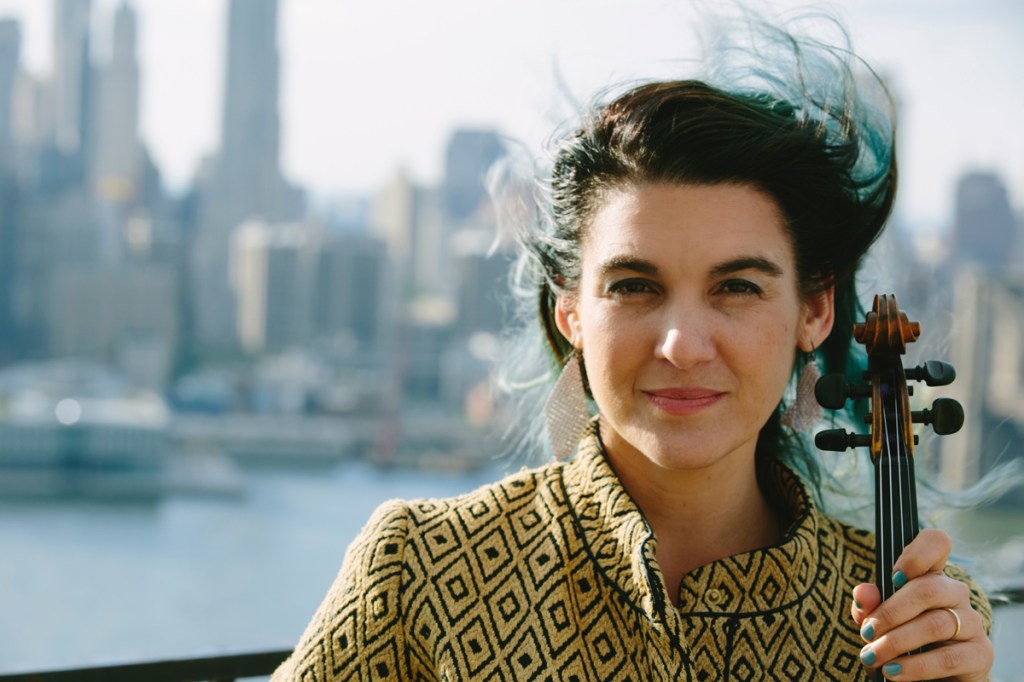
Bio: Alicia Jo Rabins is a writer, musician, and Torah teacher based in Portland, Oregon. “I Was a Desert: Songs of the Matriarchs,” her evening-length piece for choir and instrumentalists based around stories of Biblical women, premieres at the Museum of Jewish Heritage in New York City on May 23, 2024. Rabins holds a MA in Jewish Women’s and Gender Studies from the Jewish Theological Seminary and is the creator of Girls in Trouble, an indie-folk song cycle about Biblical women, and the author of three books of poems and essays about the intersection of spirituality and everyday life.
Discover more from Feminism and Religion
Subscribe to get the latest posts sent to your email.
 Feminism and Religion
Alicia, thank you for this post. I really love the point about the ambiguity that is allowed and brought out with the stories of women – I had never thought about that, but really appreciate it. It’s going to change the way I come to these stories now – I’ll be attentive to that for sure. Thank you!
LikeLike