

Moderator’s Note: This post is presented as part of FAR’s co-operation with The Nasty Women Writers Project, a site dedicated to highlighting and amplifying the voices and visions of powerful women. The site was founded by sisters Theresa and Maria Dintino. Part 1 was posted yesterday
Spiritualism began with two young girls, the Fox sisters, hearing knocking sounds in their home near Rochester, N.Y . They determined the knocking to be coming from a man who was murdered and buried under their home. The knocking was soon categorized into an alphabet out of which seances began. In seances groups of people gathered and put their hands on a table while asking questions of ancestors who made themselves known by rapping and knocking in response. Next, mediums in the form of young women speaking the answers of the dead as the bereaved asked them questions, emerged. Instructions were disseminated on how to be a medium and how to run a seance. The movement took off.
The movement was largely white, northern Protestants but other ethnicities were involved. The Black population may have influenced the arising of these practices with traditions brought with them from West Africa.
In fact, the Black population allowed the mediums and Spiritualism into their churches in a way the white Protestants did not. Spiritualist beliefs and practices could likely get one expelled from a white Protestant church. While the Spiritualists were abolitionists and professed freedom for all, there was a disconnect in fully understanding the intersectional nature of discrimination. Some white women in the movement ignorantly professed to be suffering oppression as bad as the enslaved Black population.
In her post on the Shondaland website, Dianca London writes:
“Untethered from the limitations of patriarchal dominance, the body became a conduit capable of bridging the gap between the seen and unseen”.
London’s post focuses on Black women spiritualists Sojourner Truth, famous orator and women’s rights advocate, Rebecca Cox Jackson, a free Black Woman who formed her own Shaker community and held seance circles in her home in Philadelphia, Harriet Jacobs, author of the 1861 book, Incidents in the Life of a Slave Girl and Harriet Wilson, trance speaker and writer.
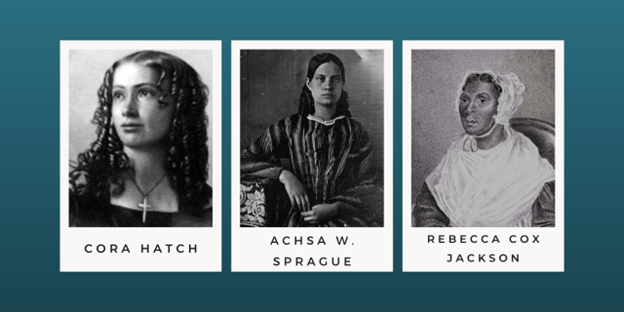
Radical Spirits informs us about Mary Fenn Love, a feminist and Spiritualist leader, Cora Wilburn, a Jewish woman feminist turned Spiritualist writer and Elizabeth Peabody and Georgiana Bruce Kirby, both Transcendentalists who became Spiritualists.
Spiritualism and feminism
The spiritualists were very clear in their views that the women’s rights issues must come first. They pushed their agenda often and were eventually shut down by the more “classical” feminist movement that eventually set its sights solely on suffrage.
“When Spiritualists applied their individualist convictions to women’s situations, they found a need for drastic changes to allow women to express their true natures as human beings. They found that the norms imposed by society dictated both an immoral theology and an immoral structure of relations between human beings. In response, they argued that women needed to be freed from limited education that restricted the development of their intellects, from unjust laws that denied them access to their property and custody of their children, from unequal marriages that subjugated them to men, and from economic restrictions that forced them into dependence”(56).
Spiritualists and women’s health
For the Spiritualists one of the pressing concerns was women’s dress requirements, including constrictive corsets and need to be heavily covered at all times. They encouraged bloomers and loose-fitting clothes. They argued against some of the practices in medical care of the time like bleeding and other “heroic” practices that “regular,” (allopathic) physicians, were providing.
Because many of the mediums were also healers, competition arose between them and regular doctors. Many people went to the Spiritualists for hands on healing. Spiritualists also embraced and promoted hydrotherapy. As they gained popularity, they were simultaneously attacked by the regular doctors and scientists as untrustworthy.
Above all, Spiritualists fought for women’s rights to their own bodies and lives. Many of the mediums’ practices were welcomed because they actually listened to women and offered a different kind of healing, one more subtle and less invasive.
Some created herbal tonics and other remedies gifted to them by the spirits, Lydia Pinkham being hugely popular. Many medical mediums became the first women doctors (149-150).
After the Civil War and Abolition
Spiritualism continued into the 1880s but it was drastically changed. Attempts to centralize power in the movement failed and those who wanted a more organized hierarchical structure moved toward Theosophy, headed up by Helena Blavatsky and Christian Science developed by Spiritualist Mary Baker Eddy.
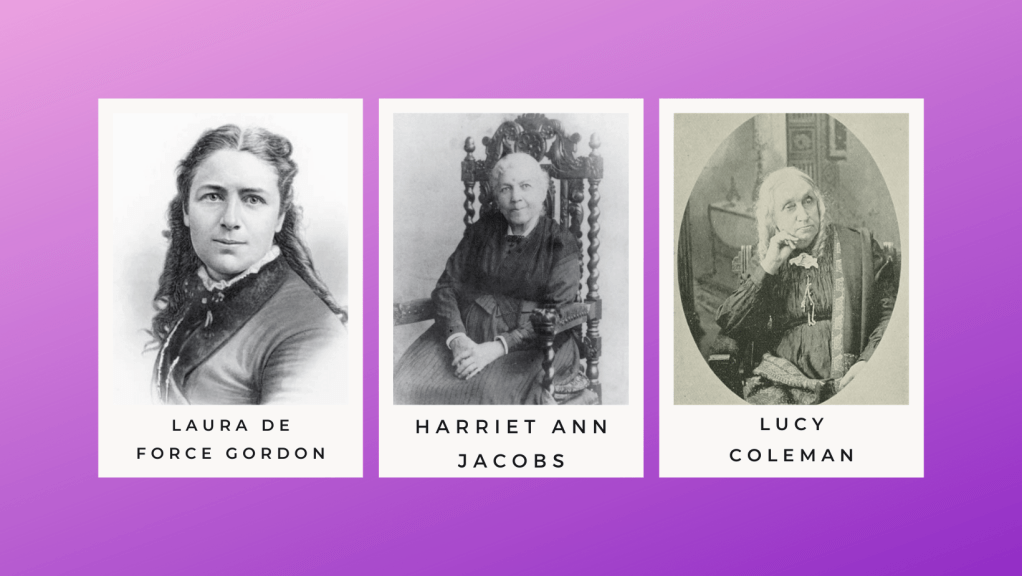
The radical feminist movement turned its focus to suffrage only and other causes were moved to other arenas. Spiritualist women who remained with the suffrage movement became some of their best speakers. In California many Spiritualists became the first women to present bills in favor of women’s rights to the California State Legislature. Laura de Force Gordon became the second female lawyer in California, also opening her own newspaper and working to amend the California Constitution to prohibit the state from disallowing women to practice any profession. Other women went on to form their own groups based on other causes.
In trying to appeal to the culture at large in their fight for suffrage, the feminists abandoned the Spiritualists in order to not be discredited by them, creating this split in women’s history.
Though they have always been an important part of the women’s movement and women’s history, women of spirit continue to be written out which implies that the two—feminism and spirituality—are not compatible when it is exactly the opposite.
The Spiritualists pushed women’s rights in the nineteenth-century far beyond where they would have been without them. They taught women how to speak, passed reforms and elevated the consciousness of Americans on matters unheard of then that remain important to this day. They should be remembered and celebrated for that.
©Theresa C. Dintino 2023
Works Cited:
Braude, Ann. Radical Spirits: Spiritualism and Women’s Rights in Nineteenth-Century America. Indiana University Press. 2nd edition, 2001.
Potts, Dianca London. “Holy Spirits: The Power and Legacy of America’s Female Spiritualists.” Oct 10, 2018. Shondaland.com
Discover more from Feminism and Religion
Subscribe to get the latest posts sent to your email.
 Feminism and Religion
Fascinating. Thanks for this history lesson.
LikeLike
If I teach background of women’s spirituality again, I will certainly include this. Thanks.
LikeLike
Wow, I didn’t learn any of this when I got my master’s in history with a concentration in women’s studies, nor when I studied feminist theology/thealogy at seminary. Thanks so much for this post.
LikeLike
Excellent co-operation, FAR and Dintino sisters. I was thinly aware of the role that 19th century spiritualism played in the advancement of women’s rights, as I studied Mary Baker Eddy’s movement from spiritualism to organized religion, branding it Christian Science, but this article further increased my knowledge of other contributors to women’s rights. It also highlighted the value of co-operation and, yes, I can, and will, remember and celebrate women speaking, reforming, and elevating consciousness. Thank you.
LikeLike