

I often find myself sitting in conservative Catholic spaces. My brother is a Roman Catholic priest in the Dominican order and I remain in support of his vocation. Every time, before a Mass officially starts, I’m overcome with a sense of: “You belong here…and you don’t.”
The part of me that has always felt at home in a Catholic setting is that love of the ritual and ceremony, the smell of the incense, the familiarity of the chants and songs. It was a Catholic priest, the late Fr. Ciaran O’Donnell, who taught me how to play the guitar and got me started with the healing practice of songwriting. When I sink into these associations, I feel connected to my Croatian ancestors and our Catholic faith. And there’s the other part of me—the queer feminist and an advocate for other queer and transgender people to live the fullest, most open expressions of themselves in all spaces of life, especially faith-based spaces. As a survivor of several forms of sexual assault and as a trauma specialist who has guided countless other survivors in their healing process over the years, I can’t sit in a Catholic Church and not feel uneasy about the legacy of abuse and silencing survivors within the church. Between my queer identity and dedication to supporting survivors, I feel that I don’t belong.

In those moments before the Mass, my feelings consistently swirl and compete with each other. I entertain the love I have for my brother, and the love that I have for many members of my queer family of choice who did not make it. Lost to suicide or addiction. Ever since my friend Jason Fair, a church musician, died by suicide in 2019 after a long battle with trying to accept himself and still work in religious spaces, it’s been hard to be around people whose chosen form of religion endorses mistreatment of LGBTQ+ folks. And yes, saying “we welcome you” but we can’t “say that your lifestyle is okay” is mistreatment. It’s just another version of the love the sin, hate the sinner trope that truly is tantamount to relational violence. Who we are and how we love is not a sin.
This is where my mind goes before every Mass. And I make the decision in those moments that to get through the Mass with this clash of feelings, I will sing with all of my heart. Literally sing. It’s the only way that I can keep from destructively dissociating and imploding during Masses where the patriarchy and all its glory is on full display. When I sing during Mass, especially at the solemn events where Latin Mass settings and scholas (choirs) are in use, it’s my way of saying, “I am a woman, and my voice belongs here too.”
I loved to sing in both churches I was exposed to as a kid. Having a Catholic mother, I learned the hymns in the blue Glory and Praise that was standard issue at Catholic parishes in the 1980s, followed by the Gather hymnal in the 1990s and early 2000s. With an Evangelical father, I absorbed an entire collection of “Praise and Worship” music, perfect for raising the hands and dancing; even though the theology of these songs never fully resonated with my soul. Whenever I’m in a church or faith setting of any kind, I’m singing right along. I do this in Jewish contexts where my friends invite me (as long as there is a version of the Hebrew transposed into phonetic English). And of course, chanting kirtan (call-and-response traditions of ancient India now popular in many yoga and meditation circles), takes me right to the source of learning about who I really am. All of these experiences have sealed a very important truth within me over the years: God is in the music.
During the summer of 2021 when my brother professed solemn vows as a Dominican, I chanted the Mass setting, Missa Jubilio, not missing a beat of the Latin. Having been a liturgical music director as one of my many jobs back when I worked in Medjugorje, Bosnia-Hercegovina during my service there from 2000-2003, I got quite good at reading it and singing it. And I love it; comfort reaches me through these sacred notes.
I felt very good after that Mass, being able to fully engage in the celebratory dinner for my brother because I had just spent close to an hour singing. There, one of my brother’s very traditional, conservative friends who sat near me during the Mass said, “Wow, you really sing Latin beautifully. I didn’t think that was something you would know how to do.”
Her tone said it all, and my stomach dropped a bit.
Maintaining my calm, I responded, “Well, I do have a background in liturgy, and singing has always been my favorite part of the Mass.”
She politely nodded, not really knowing what to say to that.
What I really wanted to say is, “Yes, queer, liberal, feminist, ‘non-religious’ people can love Jesus too. We can sing. We can talk theology. And maybe even with more gusto than you because we’ve actually used sacred ritual to embrace our human experience, not try to push it away.”
Yet I’ve usually learned that saying such things to people who don’t want to hear them only works me up even more. So I just sing anyway…
I experienced something similar this summer during my brother’s Mass of installation as pastor. This time the Mass setting was my favorite, Missa de Angelis. My family and I sat behind a row of religious sisters (nuns). I registered the look they gave me that seemed to say, “You are in a Catholic church wearing a sleeveless dress and you are full of tattoos. How can you possible sing these chants better than we do?”
“And the peace of Christ be with you to,” I said, as I leaned into the sign of peace ritual during the Holy Mass.
“I still belong here…God sees it. Even Jesus sees it, why can’t you?”
That’s what I really wanted to say. But it neither the time, nor the place. And the plea probably wouldn’t land the way I need it to.
Instead, I chose to just sing anyway.
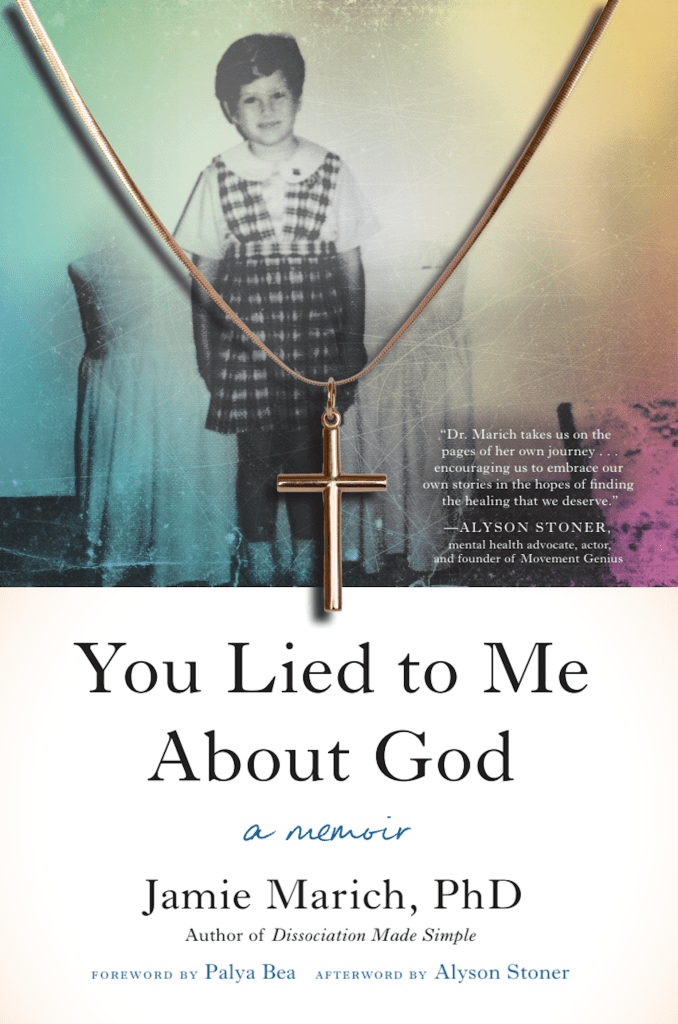
by North Atlantic Books.
For further information and to pre-order click here.
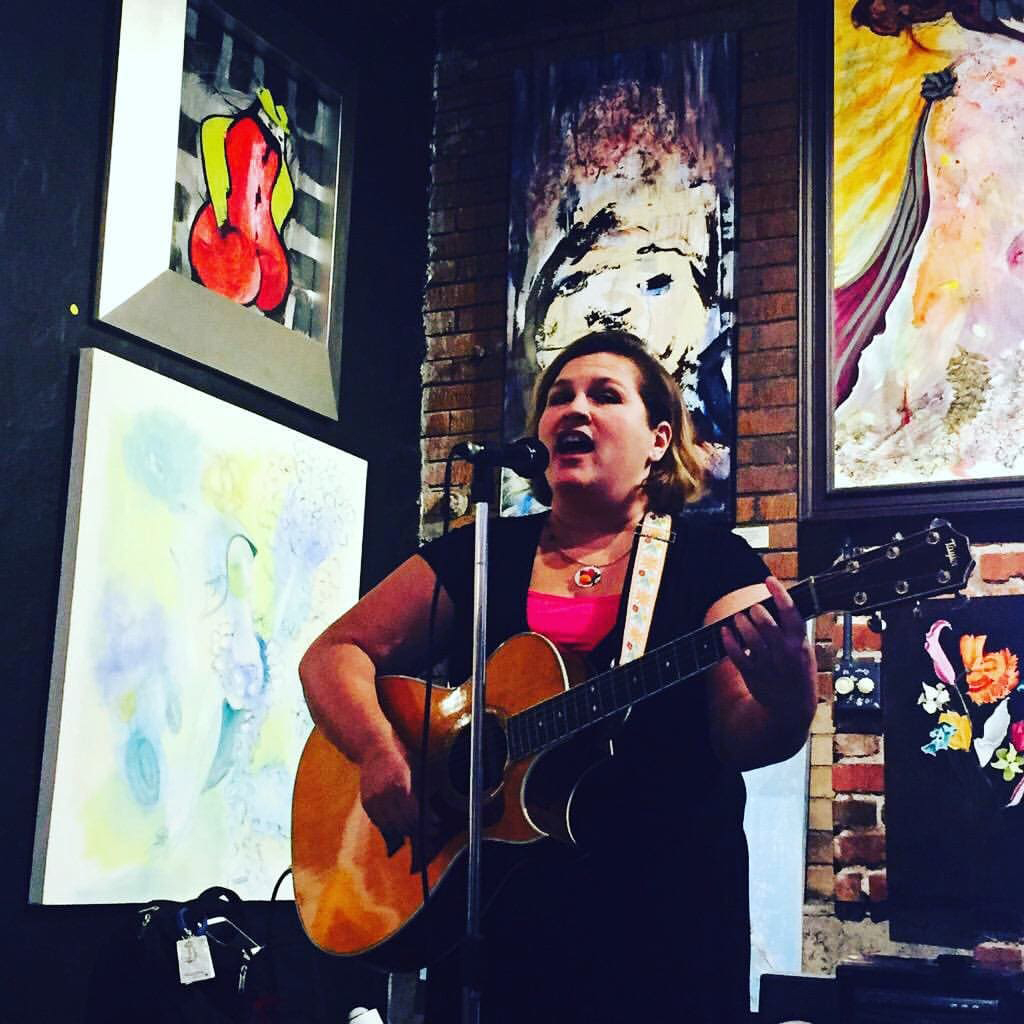
BIO: Dr. Jamie Marich (she/they/we), LPCC-S, REAT travels internationally teaching on topics related to trauma, EMDR therapy, expressive arts, yoga, and spiritual trauma while maintaining a private clinical practice and online education operations, the Institute for Creative Mindfulness, in her home base of Akron, OH. Marich is the author of over a dozen books and manuals in the field of trauma and expressive arts, including Dissociation Made Simple (2023), Trauma and the 12 Steps (2012/2020), and Dancing Mindfulness (2015). Her long-time publisher, North Atlantic Books, is releasing the memoir of her lived experience with spiritual abuse and religious trauma, You Lied to Me About God, scheduled for an October 2024 release. Marich grew up with one Catholic parent, one Evangelical parent, has a brother who is a Roman Catholic priest, and also survived a yoga ashram experience. Marich is on the wisdom council of Abbey of the Arts.
Discover more from Feminism and Religion
Subscribe to get the latest posts sent to your email.
 Feminism and Religion
Thank you for sharing this Jamie. It certainly strikes a note with me. I too come from a Catholic background and still enjoy visiting churches and sitting there for a sense of peace. The church is about the teachings of Jesus who preached love and never turned anyone away. I felt at home in the Sistine Chapel which had a lot to do with the art of Michelangelo. I don’t belong anywhere where dogma takes the place of love. Being in the Spirit of Christ is what counts, so keep singing.
LikeLiked by 1 person
This says it all: “I don’t belong anywhere where dogma takes the place of love.”
LikeLiked by 1 person
I
LikeLike
This is quite story – like you I loved the litany and the music (episcopal) but eventually had to go my own way ( a long time ago now) because I couldn’t make peace with the conflict I experienced being in any church or synagogue or mosque – totally human centered. I tired them all! I finally found peace when I began to write and celebrate my own ceremony following the old religions that merge with the seasonal round and where every living being – human or non human was recognized as being sentient. Finally peace.
LikeLiked by 2 people
It’s so moving to think of how you sing to connect with the experience of so many varied religious expressions. I’ve been thinking about the mystical power of women’s voices. Just this week the Taliban has banned women from singing at all in Afghanistan.
LikeLike