

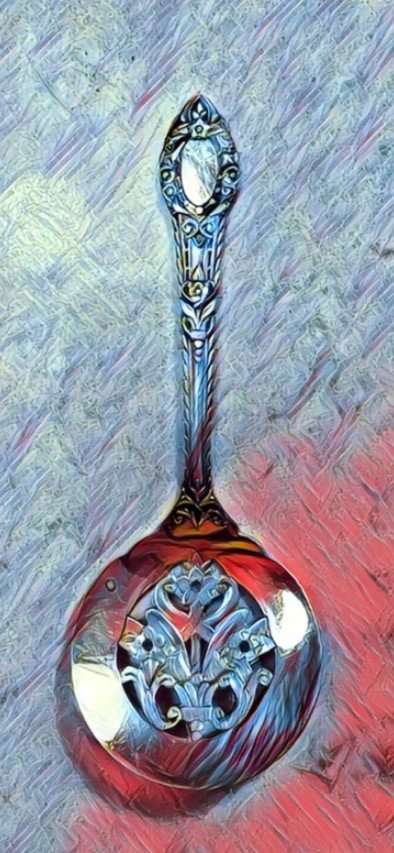
Dressed in filigreed art deco daffodils,
dainty and tucked among tailored leaves
held proudly — almost defensively.
Elegant and demure;
your shapely neck flares with grace.
You are such a small and lovely thing:
light as a feather and yet
you carry the weight
of an American woman’s silver-plated dreams.
Like her, you were designed to be admired –
fashioned to be lifted lightly.
Pretty and proper at the table and
placed just so.
Comfortable in your simple life of service.
Polished until your delicate silver skin
wore thin and the truth
within your copper heart could be revealed.
********
One day, as I was sorting through the jumble of my mother’s silverware collection, a tarnished silver-plated spoon caught my eye. Its base was round and filigreed, with an uncommon shape and a unique elegance of its own. As I polished it, I noticed, on the back of the narrow handle, the words Community Plate.
It was older than the more delicate Birks pattern my mother had collected and I wondered how it had come to be among her possessions. Was it originally part of a complete set that somehow became separated from the others? Was it perhaps brought as part of a pot-luck afternoon bridge party and then left behind? Or was it purchased separately and given to her as a gift?
In any event, it had been passed on to my mother and then to me where it lay forgotten and unnoticed for many decades. I knew I would probably never find out the exact path it had travelled to arrive in my hand at that moment, but there was something mysterious about it that called to me.
An online image search revealed that it came from a line of silver-plated flatware called Rendezvous or Old South, released in 1938 by the Oneida Company, just before World War Two began. Community Plate was an affordable silver-plated line of cutlery that had been produced by Oneida for many years. At that time, Oneida was known for its lavish full-page advertisements in publications such as Good Housekeeping and Better Homes and Gardens that spoke to the pre-war American woman’s dream of an elegant, romantic and traditional colonial lifestyle.


As I explored further, I also uncovered the intriguing story of the Oneida Community which was originally founded in the 1840s by John Humphrey Noyes, a would-be preacher who created his own brand of religion based on ideas such as the concept of “spiritual spouses” which evolved into “spiritual polyamory.” Noyes founded a commune on Oneida Creek in New York State where everyone lived together and apparently devoted their affections equally to all members. Imagine that!
A communal childcare system allowed all members to take part in various activities that sustained operations such as manufacturing animal traps, chains and silk items, and they pioneered the technique of silver-plating flatware. As is so often the case when “charismatic” men form their own brand of utopia, John Noyes’ ego eventually got the best of him and he was discredited and left in ignominy. Although the spiritual community fell apart at that point, the manufacturing business continued and was eventually transformed into a joint stock company, owned and operated by former members and still known for its fair labour practices.
There is so much more that could be said about some of the incongruities of the Oneida Company’s story, but perhaps I’ll simply conclude by observing the irony in the fact that a company that appropriated its name from a long-standing Indigenous tribe and that grew from a 19th century polyamorous communist Christian utopia would eventually produce a brand of flatware that encouraged women to aspire to colonial ideals and traditional gender roles!
For more on this interesting story, check out Lisa Hix’s, article The Polyamorous Christian Socialist Utopia that made Silverware for Proper Americans.
Image credits: Oneida spoon: Diane Perazzo; Oneida advertisements from eBay (public domain).
BIO: Diane Perazzo is a writer, editor, poet eco witch in Starhawk’s Reclaiming tradition who lives in Ottawa Canada — unceded original territory of the Algonquin, St Lawrence Iroquoian and Anishinabewaki, (ᐊᓂᔑᓈᐯᒃ) people. For many years Diane has written and edited resources to enhance wellness and improve health equity for those at risk of physical and mental health challenges. As she eases into her crone years, her writing has become more focused on crafting words that strive to echo the magical and mythic voices of the living land, especially plant beings. Her poetry and stories can be found at www.dianeperazzo.com.
Discover more from Feminism and Religion
Subscribe to get the latest posts sent to your email.
 Feminism and Religion
Thanks, Diane. I love this story, and your research behind it. The archaeologist in me says: what fun, to research the lives of our foremothers through their possessions. I remember Oneida ads from the ’50s (at least I think I do) encouraging curly-haired women to set perfect tables. My mother’s silverware may have been Oneida; it went to my cousin, who did not value it as it did not fare well in the dishwasher.
LikeLike