

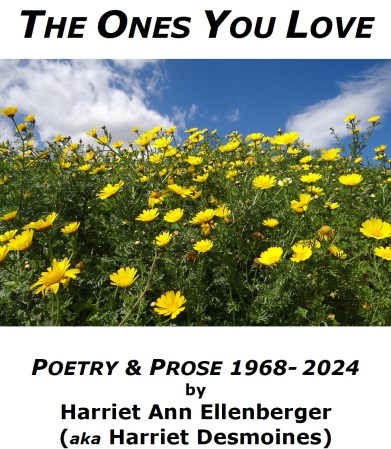

The Ones You Love, Poetry and Prose 1968-2024 is a half-century retrospective love letter from Harriet Ann Ellenberger to friends, family, and lovers; lesbian and overall feminism; lesbian feminist literature and theater; Nature; and those who have been victimized by war. Infusing the book is her overarching love of freedom, not only for herself, but for women, for humanity, and for the Earth. Harriet has been using her authorial and editorial gifts for her entire adult life to move our planet away from extinction into new ways of being, and has now collected her best writings, both prose and poetry, into a single volume. The book is both a brilliant, truthful, unglossed portrait of herself as well as a glimpse into feminism, and lesbian feminism in particular, over decades through one woman’s experience. She often notes in introductions to various pieces that she no longer completely agrees with what she wrote so long ago, but she does not edit out these views, (speaking of her “younger fiery-feminist self,” she says “I’m proud of her courage and proud of the work she undertook” (11)) which offers us a better understanding of both her own progression of thoughts and ideas as well as what issues and points of view were of concern at the time.
Of her most well-known achievement, she writes, “On July 4, 1976, the 200th anniversary of the American Revolution, Catherine Nicholson and I published the first issue of Sinister Wisdom, which has since become the longest-lived lesbian literature and arts journal in the world” (11). She explains the journal’s expansive perspective: “We exist in the interface between a death culture and the faint beginnings of a culture of — not humans — but life-lovers, a culture that embraces animals, plants, stars and those women who choose the future at the risk of their ‘sanity’ and security” (17). This is a vision she has carried with her ever since.
Harriet also explores the fascinating artistic expression of lesbian feminism through both literature and theater. “The point of Lesbian writing, insofar as I can perceive it, is with words, with language, to make the connections between women real to us, real in our own minds. And that process of making-real what is already under our noses amounts to a kind of exorcism of patriarchal politics” (27). Of lesbian theater she writes, “These are the languages of my heart. To hear them spoken, to see them bodied forth; to be spoken by them, to be seen in their embodiment: this is to be touched — and touched deeply — with amazing, empowering grace. This is what lesbian theatre can do” (74).
Some of her most both personal and perceptive pieces describe how identifying as a lesbian at the time saved and changed her life and how being a lesbian related to her feminism. “Being a feminist is for me a political identity, a tactic: it‘s a badge I wear to say that yes, I fight for the freedom of women… Being a lesbian is a related but whole other kettle of fish — a deeper identity, a strategy for living, close to the heart of what has kept me alive thus far” (34).
In fact, some of the most poignant and striking biographical poems are those that express her feelings about a “passionate but ill-fated transatlantic love affair” (90).
I TASTE YOU
and the moon becomes a lotus
ivory with rose core
violet along all her trembling verge
you rise in my sky
car of ecstasy
cry of light
my skull flies up
from the intricate
column of bone
my mouth falls
open
oh
(92)
Beginning in about 1992, Harriet’s work takes a turn from involvement in movements to more individual motivations and actions. She no longer identified herself as a lesbian because she had a relationship with a man, or feminist because she no longer considered other people’s freedom to be her mission, and she no longer believed that a “national liberation war” can be effective or that “starry-eyed dreamers” (131) are doomed to failure. At the same time, she also became disillusioned with the feminist and lesbian political movements “because of the way people in political movements treat each other.” (128). In her words, “I would like to feel certain than anything I might do from this point on be long-term useful to the circle of life, in no way fueling the escalating violence of human despair” (132).
In 2003, Harriet also began to focus on writing poetry. The book includes a selection of poems from 2003 to 2020 which “range over a wide and wild territory, and speak in many voices, from those killed by the US ‘shock and awe’ attack on Iraq to that of a wolf elder teaching young ones the art of long-distance communication” (157). Here’s is one from 2014 that is one of many pieces that reflect Harriet’s close and inspiring relationship to Nature:
DESIRE SPOKEN UNDER A NIGHT SKY
May the earth live,
May we live on the earth,
May love in our life flower,
May the transformation be realized.
May it be stone that we stand on,
May winds bring us fast-moving thought,
May our heart bathe in salt waters,
May spiral galaxies light our way home.
(164)
And one from 2012 about her vision for how humans can save ourselves and the Earth:
SUNRISE OVER THE USA
for Barbara Mor
In place of the old dream
and the old lies,
I wish for my country of origin
a new story,
one that goes like this:
We rode roughshod,
we drove pedal to the metal,
we blew our own cylinders.
We squeezed the life from all
we could lay hands on,
converted our kill into currency,
bowed low before the greenback god we made.
Then ― an inch from extinction ―
in the midst of brawling, bawling,
blowing each other away,
we woke from our nightmares.
Watched the sun rise.
Said this is a good day to live.
We started to share food
and keep house.
It was astonishing
how quickly the tall-grass prairie,
intricate forest that bends with the wind,
grew back.
Astonishing how quickly the milkweed pods shot up
and the monarchs laid ever more eggs on them
and the great butterfly migration strengthened.
Astonishing when legions of Canada geese flew south again,
barking and writing long flat V’s in the sky.
We woke,
and the earth under our feet
decided to live.
It was that definitive,
that clear a turning.
(160)
Still writing and working, Harriet was recently interviewed in Return to Mago e-zine and noted the following about her journey so eloquently summarized in The Ones You Love. “Through all these changes, I have been grateful that I was following my heart rather than a rigid ideology. For me, that was one of the best gifts of feminism — that it could be open-hearted and tolerant. I was most influenced by the lesbian feminist variety of feminism, however, and I still believe that it is essential for women to become free enough to at least imagine being lesbian and to see the patriarchy as heterosexist” (178). Her most recent contribution to this effort is making this pdf-format anthology available for free to all (please email Harriet at akadesmoines@gmail.com). More of her work can be found at http://www.harrietannellenberger.wordpress.com. In Harriet’s own words, “The power drawing me onward is my desire to be free of oppression and my desire for everyone else to be free too” (8).
Discover more from Feminism and Religion
Subscribe to get the latest posts sent to your email.

 Feminism and Religion
‘in the midst of brawling, bawling,
blowing each other away,
we woke from our nightmares.
Watched the sun rise.
Said this is a good day to live.
We started to share food
and keep house.
It was astonishing
how quickly the tall-grass prairie,
intricate forest that bends with the wind,
grew back.
Astonishing how quickly the milkweed pods shot up
and the monarchs laid ever more eggs on them
and the great butterfly migration strengthened.
Astonishing when legions of Canada geese flew south again,
barking and writing long flat V’s in the sky.
We woke,
and the earth under our feet
decided to live.
It was that definitive,
that clear a turning’.
I can barely read these words without weeping… I have known and loved Harriet and her writing stands before her as a beacon of hope at a very dark time.
‘and I still believe that it is essential for women to become free enough to at least imagine being lesbian and to see the patriarchy as heterosexist’
every time I read the above statement I wish EVERY feminist would embrace this perspective because it is a way through divisions and we need to make this jump…
I recommend this extraordinary collection of writing to every woman on the earth – and every man who understands what it means to be a male.
Thank you Carolyn for writing this most excellent review of Harriet’s work…
And please FAR – order this book!
LikeLiked by 2 people
What extraordinary strong poetry! Especially “Sunrise over the USA,” she says it all so succinctly. Thank you, Carolyn, for bringing this work to our attention and your wonderful review.
LikeLiked by 1 person
Thank you for kind words, Sara and Susan. It was an honor to review this book and bring it to everyone’s attention!
LikeLike
Beautiful! Thank you for introducing us all to Harriet Ann Ellenberger’s work.
LikeLiked by 1 person