

This was originally posted August 8, 2015

It has become my new routine during the first phase of my queer little family’s year-long journey. After completing my chores, I run along the trails surrounding Silver Lake and once I’m thoroughly drenched in sweat, I grab a book and push our enormous 15-foot canoe into the frigid waters of the little lake we’re calling home for three months. With a smile that has yet to wipe off my face, I paddle fiercely. I’m typically the only person on the lake.
It’s a steep mile hike from the trailhead, and we’re the only ones “living” here for the summer, so my giant green canoe ripples the silvery waters in solitude. Once I find the right spot, I stuff my life vest behind my head and cozy down into the belly of the canoe, book in hand, goofy grin still spread across my flushed face. In the warmth of the sun, I read. In the belly of the canoe, I drift into the history of the lake, the unwritten annals lapping alongside my rocking boat, the portions on record filling the book in my sun-warmed hands.
The author who wrote the history of Silver Lake, William Powers, hiked up with several autographed copies in his rucksack several days after our arrival. He’s a nice man who wrote a nice book. There’s nothing like reading about the history of a place while in the place. Hear me say this clearly: there’s nothing wrong with the nice book this nice man wrote. The stories of Frank Chandler feeling a call from God to build a place for religious camp meetings along Silver Lake’s shores are fascinating, an interesting part of the history of camp meetings that filled the Awakenings throughout the United States. But as I read about Frank Chandler and the various men who the logged roads hikers now hike and built the buildings that haven’t existed for years due to fire, I couldn’t help but notice who was missing.
Sure, Frank Chandler was married and his wife’s name is included in the history of Silver Lake. So are the wives and daughters of various other men important to this place’s history. The history book was written with copious notes, citations based on court records, marriage licenses, property purchases, taxes, and every other legal document on record. It’s the way history is usually remembered, recorded, and recounted.
Though I know semantics are incredibly important, that our language has power, and that subverting, shifting, gendering, and queering such language is a vital part of effecting change, I’ll be honest in saying that I’ve never really been one to use the term “herstory” instead of “history.” I’m not quite sure why. Perhaps it seemed a bit trite. Maybe because its etymological history has little to do with the semantic shift. Or it’s possible that internalized sexism still exists within me in forgotten places, in the places that only show up when you’re curled into the belly of a canoe, floating in the belly of the Green Mountains, womblike and cradling.
But as I read and floated and learned about the religious fervor of all these white men, I couldn’t help but think about how I was reading precisely what religious history—all history—is about: men’s religious fervor. There is no record of what Frank Chandler’s wife did at the religious camp meetings on Silver Lake because her perspective didn’t matter. We do get to read her name, though: Ellen Alden Chandler. As I completed this book, my eyelids heavy and my hands sun-kissed, it was true that, not only had I missed any stories about Ellen Alden Chandler, but the stories of the countless Abenaki women who had canoed, splashed, birthed, loved, laughed, and died in these chilly waters were not even mentioned. I say this, not to critique the author of the history of this small lake in the small state of Vermont, but to name how illustrative this “‘his’story” is embedded in the history of every place. Her voices are missing. The sacred voices of women are missing. And the sacred voices of women of color, in particular, are missing altogether. What is the “herstory” of Silver Lake?
Along with my enormous canoe and camper, I brought with me on this year-long journey enough to sustain me for a year of travel. Missing, however, are my paints and canvases. This may seem odd for an artist, but the choice was intentional. Since I’m under contract to create a coloring book of my Holy Women Icons with a folk feminist twist, I decided to dedicate this year to the medium of drawing rather than painting. So, as the lost women of Silver Lake called to me in the belly of the canoe—as they must have done for the decades that Abenaki women carved out canoes from birch trees and paddled them through the same waters that now envelope me—I knew they must be canonized as Holy Women Icons. Without my paints and brushes, however, I didn’t know if I could bear them proper witness. Even after the drawing is complete, I question my medium.
But I hope that, one day, when this coloring book is complete and a little girl or a little-girl-at-heart, sharpens her crayons and joins me—and all the brave women who have paddled through Silver Lake’s waters—in the co-creation process, that maybe a holy act of remembrance may occur. With the lake spilling out of her own belly, the belly that holds my green canoe in the Green Mountains, the hearts of Ellen Alden Chandler and all the nameless Abenaki women whose “herstories” we may never know, cry out to us:
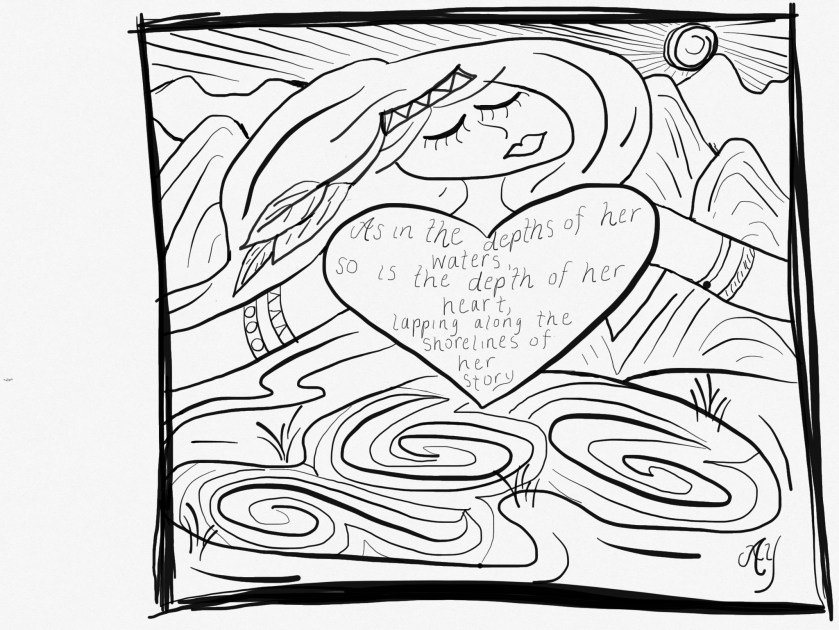
As in the depths of her waters,
So is the depth of her heart,
Lapping along the shorelines
Of her-story
Wherever you are, no matter how small or grand, remember the stories of the women who have paddled before you. And, if you wish, print out this drawing, and join me in coloring these memories into being.
Discover more from Feminism and Religion
Subscribe to get the latest posts sent to your email.
 Feminism and Religion
I love this post…” I couldn’t help but think about how I was reading precisely what religious history—all history—is about: men’s religious fervor.”
You nail it.
The frightening part of all this is that almost no one notices – religion was created by men for men…..
And we wonder why we feel invisible?
LikeLike