

Morgan le Fay is a popular figure for goddess-women and those interested in depictions of female spirituality, as well as a role model for some witches and pagans. Entire modern spiritual traditions such as the Avalonian tradition in Glastonbury have been created around her. She’s been portrayed in various ways in popular media and culture, and for many is more beloved than her mythical contemporaries, Arthur and Merlin. Which is interesting, because she’s a wholly fictional character, first encountered in the medieval Vita Merlini. Or is she?
While Morgan herself is, indeed, a fictional creation, many have seen echoes of ancient Celtic myth in her story. She’s a healer and magic worker, living on an Otherworldly island, sometimes with her eight sisters, guardian of Avalon with its magical apples and mists. In later iterations she’s a darker figure, an enemy of her brother Arthur, a witch and a seductress. A story we’ve all heard before.
Celtic mythology is rich in Otherworldly islands, many of which are tended by women, most commonly nine of them (this is also a common motif in Classical tradition). In the oldest poetry of Taliesin such as Preiddu Annwfn, and the native early Arthurian story Culhwch and Olwen, nine sisters/witches/ enchantresses guard a magical cauldron that is stolen by the ‘heroes’. There is rich symbolism and meaning here, which I’ve dug into a little in previous articles. Apples are also a common motif of the Otherworld. So, even if Morgan herself is fictional, she’s clearly drawn from the original myths.
But there’s more. Rather than being based on vague allusions to women around cauldrons, Morgan is also clearly at least partially based on an actual goddess, the Welsh Modron, whose name means Divine Mother, who is in turn descended from Matrona, a mother goddess worshipped in Iron Age Gaul and possibly in Britain. Matrona, too, means Divine or Great Mother. Stressing her divinity, she was also known as Dea Matrona, and in the Roman world shows clear similarities to the iconography of Demeter. There were also triple mother goddesses known as the Matronae, who may be Matrona in a triple aspect, and whose worship was widespread across both the Celtic and Germanic areas.
In Tongeren, Belgium, an altar dedicated to Matrona was found with an inscription that reads “To the mother goddesses and Matrona”. The Museum of Saint-Germain-en-Laye in France houses numerous inscriptions and artifacts dedicated to Matrona. These inscriptions depict her with attributes of fertility, such as baskets of fruit, again underlining her role as a maternal figure associated with the Earth, abundance and prosperity.
The Matronae statues are a collection of around 1,100 sculptures discovered mainly in the Rhineland of Germany, an area that was once part of the ancient Gaulish or Celtic territory. These sculptures typically feature groups of three goddesses, sitting or standing together. They hold various symbols, including, once again, baskets of fruit, cornucopias, and babies, symbolizing fertility, abundance and protection. Snakes may also be depicted, which suggest an association with healing, rebirth and the Otherworld.
Other than this last point, there is little similarity between the goddess Matrona and the character of Morgan le Fay. When we look at Modron however, it’s a different story.
One of the most famous tales in which Modron is first encountered is found within the Welsh Mabinogi, a collection of medieval Welsh myths and legends, which scholars largely agree contain elements of more ancient Celtic myths, consisting of tales that were first told in oral form. In the Mabinogi we encounter her in passing as the mother of the legendary hero named Mabon, whose name means simply Divine ‘son’ or ‘youth.’ His full title is often given as Mabon ap Modron, or ‘son of the mother.’ Scholars, particularly those of a Jungian slant, often see this as an indication that both Mabon and Modron are portrayals of the archetypes of the Great Mother and the Eternal or Divine Youth, which show up in mythology across the Western world.
In this Welsh tale, the Mother’s son is taken from her at birth and later saved and returned, illustrating themes of exile, separation and reunion between mothers and sons that echo through many other Celtic tales, particularly that of Rhiannon, a beloved goddess figure today. This has led to suggestions that Modron and Mabon are the inspiration behind these later medieval myths. Like his mother, Mabon also seems to be descended from an Iron Age god worshipped in Britain and Gaul and known as Maponus. As the Iron Age myths are currently lost to us, we may never know for sure.
Modron does show up in a myth of her own however, and it is here where we see the bones of the inspiration for Morgan le Fay. Triad 70 introduces her with: Three Heroic Bards of the Isle of Britain: Urien Rheged, Taliesin, and Modron daughter of Afallach. The Triads then tell us that Modron, daughter of Afallach, was the mother of the twins Owain and Morfydd by Urien of Rheged. Another Welsh manuscript fragment, known as Peniarth 147 then gives us a fuller story, which I have paraphrased here:
The ancient realm of Rheged was once ruled by the legendary King Urien, a wise and powerful ruler known for his prowess in battle and cattle-raiding, and his commitment to justice. Urien’s reputation extended far and wide, and his name was respected throughout the land.
One day, as Urien was traveling through his kingdom, he came upon a ford where it was said that all the hounds of the country often gathered to bark. No-one was brave enough to see what was causing the barking, except Urien himself. He approached the ford only to find a washerwoman kneeling, diligently washing clothes in the river. Her appearance was unremarkable, but there was something about her demeanor that caught Urien’s attention. She seemed to exude an air of otherworldly wisdom and mystery.
Approaching the washerwoman, Urien struck up a conversation with her, and seduced her. Afterwards, the woman blessed him and told him that she had been fated to wash at the ford until she should bear two children, a boy and a girl, to a Christian king. She then revealed herself to be none other than the daughter of Afallach, the King of Annwn, the Otherworld.
She foretold a son of great valor and a daughter of unsurpassed beauty and grace, and a year later Urien returned to the ford to collect his children. His son, Owain, grew into a fearless and renowned warrior, while his daughter, Morfudd, became celebrated for her exceptional beauty.
The Triads also list Modron’s father, Afallach, as one of the Kings of Annwfn, the name of the Brythonic, and particularly Welsh, Otherworld, which roughly translates as ‘deep place’ or ‘not-world.’ Afallach’s name means ‘place of apples,’ which also connects him with the Celtic Otherworld, as it was often associated with apples particularly as an island with orchards or magical apple trees. It is from his name that we get ‘Avalon.’
In Arthurian legend, Morgan is both depicted as the Queen of Avalon and the wife of Urien and mother of Owain – showing her in these respects to be identical to Modron – and as the Lady of the Lake at the head of the Avalonian barge which carries away Arthur’s body. She is associated with both death and sorcery, and in some tales is Arthur’s adversary (and sister) rather than guide, assisting in the final battle against him. Her epithet ‘le Fay’ indicates that she is a woman of the Otherworld. There are various renditions of the story of Morgan, and they become more detailed over time. She also often becomes more evil.
From goddess, to priestess, to witch. It’s a story many feminist theologians will recognise.
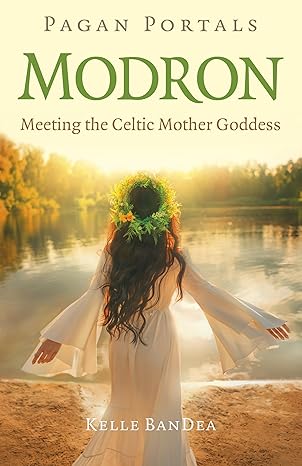
This article is partially extracted from my first book ‘Modron; Meeting the Celtic Mother Goddess’ published 28th January by Moon Books. You can get more information and purchase the book here.
Bio: Kelle ban Dea is an interfaith scholar and celebrant living in the UK. She has a DMin in Thealogy/Goddess Studies and is passionate about bringing knowledge of the Goddess back to the world to heal our fractured relationship with it.
Discover more from Feminism and Religion
Subscribe to get the latest posts sent to your email.
 Feminism and Religion
As a Jungian Analyst who no longer practices I can affirm that the archetype of mother/son is can be found in every tradition – goddess oriented or not.
The other point I’d like to make is that so many feminists focus on the Celtic tradition – I wonder about this attraction because no one mentions that the Celts were a warring people who conquered others and spread throughout central Europe. There are a lot of Celtic warrior figures (female and male) that leave me feeling very uncomfortable now because I see hidden evidence of patriarchy… perhaps as westerners this is the unconscious source of our attraction? When I first discovered the goddess tradition I used the Celtic calendar because it ‘fit’ this naturalist like a glove and gave me a kind of compass that I still use today. Then I studied world mythologies as well as Indigenous traditions and learned that the eight spokes of the year were endemic to all mythologies! It’s just that many other traditions are more fluid, less exacting. And this too – having to nail down the day is part of our westernized thinking.
LikeLike
Hi Sara
I focus on Celtic myth (there is no one ‘Celtic tradition’) because I live in Britain and am of Irish Traveller and Welsh Romani heritage. These are the stories I know and that have shaped the land I live on. Not because I am ‘unconsciously attracted’ to patriarchy. I am Roma/Traveller – two marginalised ethnic minorities.
Yes, the Iron Age Celts were a warlike people with highly stratified societies – although elite women had more equality than women from other European cultures at the time and many Celtic tribes were matrilineal. If you look at my work with the Mabinogi myths, including my other articles on this site, you will see I talk about the patriarchy and colonisation inherent in these so-called ‘hero tales.’ You might like my articles on Arianrhod, Cerridwen and Branwen in particular. I also work with Irish Traveller folklore. While obviously a ‘Celtic’ people, Travellers are an indigenous once wholly nomadic minority whose stories, like that of other indigenous peoples, reflect relationship to and reciprocity with the land. My book focuses on this also. There is not and has never been on single ‘Celtic tradition.’
Also, the eight spokes of the neopagan Wheel of the Year are not ‘Celtic tradition.’ It is a twentieth century invention by Gerald Gardner. Four of the spokes – the solstices and the equinoxes – were never celebrated by the Celts. The other four are specifically Irish not pan-Celtic and were not celebrated on the set dates that Gardner gave them but over days or even an entire lunar cycle – so not ‘exacting’ at all. Gardner appropriated the Irish Fire Festivals as they are known and forced them to fit his modern Wheel.
LikeLike
Interesting about the eight spokes of the year – I did not know this – fascinating – but either way Indigenous peoples have been following these spokes for millennia – we just don’t know because no one talks about this and because their ceremonies are so fluid – l learned that truth from my own experience as well as a ritual artist. No matter – these spokes ground me in the changes that are occurring – for example around what I call First Light the birds start singing their spring songs though we are deep in mid winter – if it’s mild the first bears will leave their dens for a bit – I could on here -this morning before dawn I heard and saw a croaking raven, then heard chickadee’s first spring song….These spokes are natural turning points in nature so they work for me. So it seems a bit absurd to me that Gardner “made them up” I have welsh roots as well as Italian roots so The Travelers are very familiar to me
LikeLike
Gardner made up the Wheel of the Year as neopagans conceptualise it today. Yes lots of cultures have celebrated various versions of ‘the spokes’ as you say but no culture celebrates all of them, on the dates and in the ways that Gardner conceived of them. Ronald Huttons ‘Triumph of the Moon’ is a good work on this.
With respect, saying you are ‘familiar with The Travellers’ because you ‘have Welsh roots’ is deeply offensive to me/us. Romani and Travellers are different peoples, which you would know if you were ‘very familiar’ with us. Irish Travellers are not Welsh. Romani are Romani and discriminated against in whatever country we settle. You are not ‘very familiar’ with closed Romani cultures because you ‘have Welsh roots.’
LikeLike
Thank you for this piece Kelle. I am so fascinated at the layers of Celtic mythos that you reveal. I look forward to reading your book. My attention is also drawn by the theme of the apple which is also prominent in the bible. The weaving of the webs are so filled with mystery.
LikeLike
I really enjoyed reading this piece and learned a lot. Thanks for sharing your knowledge.
I personally became very attracted to Celtic mythology around 13 years ago. For most of my life I’ve been interested in myth and culture, but before 2012 I had only learned about myth from many other parts of the world. Though I am an American, my ancestral heritage is Celtic. When I discovered Celtic myth I felt like i had come home and finally connected with my own indigenous roots, roots that are connected to Earth.
LikeLike