

This was originally posted on May 7, 2022
I’ve been blown away this Spring by the abundant beauty and sheer number of tulips planted throughout Roanoke, Virginia, a city I’m beginning to think of as “home.”
If I were to pick a favorite flower, it would be the tulip, yet I find it impossible to look at a tulip without being reminded of my religious upbringing regarding “salvation” as represented in the acronym of Calvinism’s “Five Points.” Each tulip displays five petals in its flower. Each petal stands for one point.
T=Total Depravity
U=Unconditional Election
L=Limited Atonement
I=Irresistible Grace
P=Preservation and Perseverance of the saints.
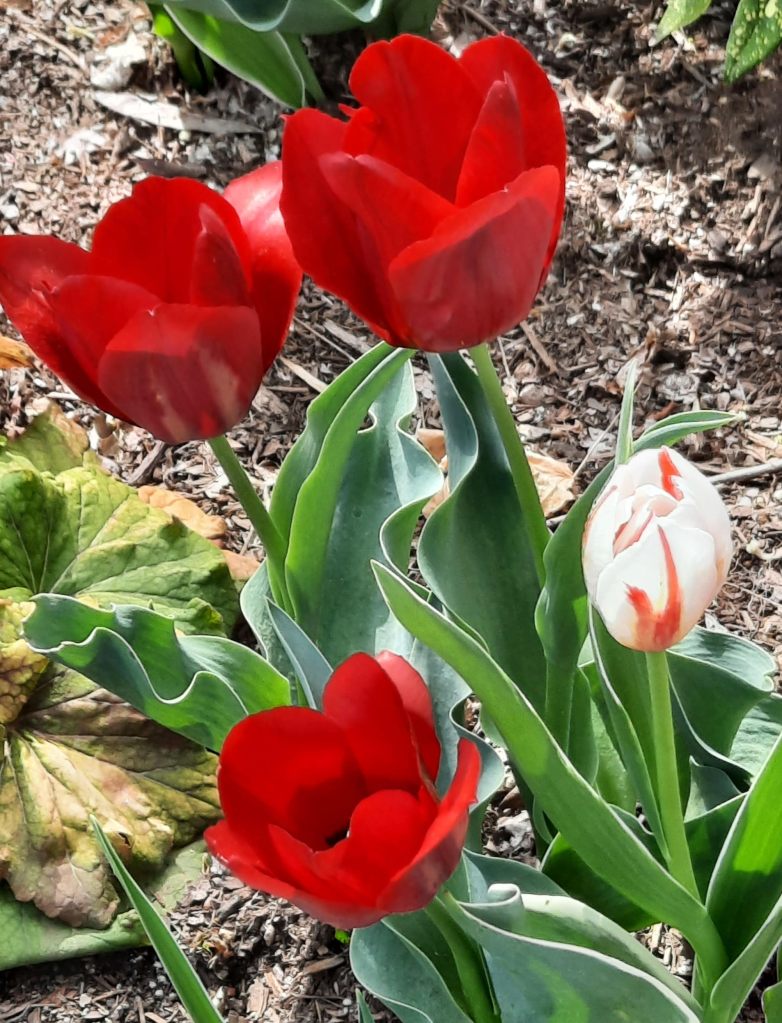
When my (now ex-) sister-in-law delivered her first baby one Spring, I gave her a pot of tulip plants, reminding her that T-U-L-I-P was the basis of our faith. The plant didn’t live to the following Spring, portending perhaps my future abandonment of T-U-L-I-P doctrine—doctrine being an interpretation of Scripture. T-U-L-I-P lays out an understanding of soteriology (doctrine explaining human salvation) hammered out by the French theologian John Calvin (1509-1564) and developed further by his Protestant followers.
Calvin had pushback to his five points from Dutch theologian Jacobus Arminius (1560-1609) and his disciples who disagreed vehemently with Calvin. Both Calvinists and Arminians claimed to be Christian, believing Christ to be the ultimate sacrifice for sin and necessary for blissful, eternal life. The discussion/debate remains an intramural one.
Seeing and engaging the world through a T-U-L-I-P lens does damage to the human spirit. It’s especially harsh on those people who have been systematically marginalized throughout patriarchal history—women, the LGBQTIA+ community, poor people, and Black/Brown people (especially in the US). After all, marginalized people have been considered “depraved” (first leaf of the tulip) by those who have power in our hierarchical society to develop and enforce doctrine that keeps the status quo for those in the upper echelons. But, I’m getting ahead of myself.
What is salvation? How does it happen? Who gets to be saved? Why are some saved and not others?
Today these questions don’t plague me as they once did. I find them curiously interesting, but not personally relevant. Nevertheless, these very questions and T-U-L-I-P, as a viable explanation for the human condition, used to hold me in their grip, crippling me while sucking joy from living in the here and now.

A brief explanation of T-U-L-I-P:
TOTAL DEPRAVITY—Not only have human beings inherited original sin (sin being the transgression of divine law), but are totally incapable of doing any good whatsoever without God’s intervention and help. Sin has infiltrated our thinking, emotions, and will. Only God can break through that murkiness before we can receive the free gift of salvation accomplished by Jesus’ death and resurrection.
(The following four points are dependent on the “truth” of the first point.)
UNCONDITIONAL ELECTION—God chooses who will be saved (the “elect”) for his own purposes, not based on anything an individual may or may not do. Nevertheless, we humans are responsible to see/believe the “truth.” (Huh?)
LIMITED ATONEMENT—Christ (the ultimate sacrifice for sin) did not die for everybody—only for those “elect” that God gave to Christ. Not everybody can be or will be saved.
IRRESISTIBLE GRACE—Those whom God “elects” to salvation cannot ultimately resist the offer or internal call of God’s grace for salvation.
PERSEVERANCE (AND PRESERVATION) OF THE SAINTS—Once Christians have been saved they cannot lose their salvation. God will see to it that the “elect” will persevere in the faith to the end.

So, why is this at all pertinent? Because our religious communities’ theological doctrines (handed down from our ancestors) have seeped into the social fabric of society. How often have we (those humans not “equal” to other humans) been told we don’t know things, don’t measure up, and will never achieve? We are lacking in countless ways and only our “betters” can enlighten and save us. (This is one way “total depravity” has worked into the interstices of society.)
T-U-L-I-P, Re-imagined:
Instead of Total Depravity, might we consider Total Perfection? We come into the world completely vulnerable and gradually learn to navigate our particular circumstances through the various communities we belong to. We express ourselves within the boundaries of our humanity. We love, hate, cry, get angry, and express joy. In much of Buddhist thought, these emotions are just that—emotions. We retain our perfection while being “angry Buddha,” “sad Buddha,” or “happy Buddha.” Emotions are not a moral issue. We are perfect in our humanity.
What about Unconditional Love, not Unconditional Election? What if we were to give ourselves and those who cross our path unconditional love? No judgment, no agenda to mold people into this or that—only acceptance of our perfect humanity?
Why not Limited Experience instead of Limited Atonement? We are human and bound by what we often call “laws of nature.” We fall at times. We forget what we need to be doing. Ideally, our family and community are supportive in ways that teach and encourage us, not limiting or withdrawing their support as we explore our environment.
Let’s talk about Irresistible Beauty, not Irresistible Grace. Beauty surrounds us. Beautiful art arrests us every day—both in the natural world and in the art humans produce. Navajo people focus on walking in beauty, meaning walking in harmony with all things—people, objects, animals, and life itself!
Pensive Perseverance rather than Perseverance (and preservation) of the Saints although the latter sounds good as long as “saints” refers to all people traversing the earth. Pensive (or critical thinking) Perseverance will enable us to flourish as we discover our own path.
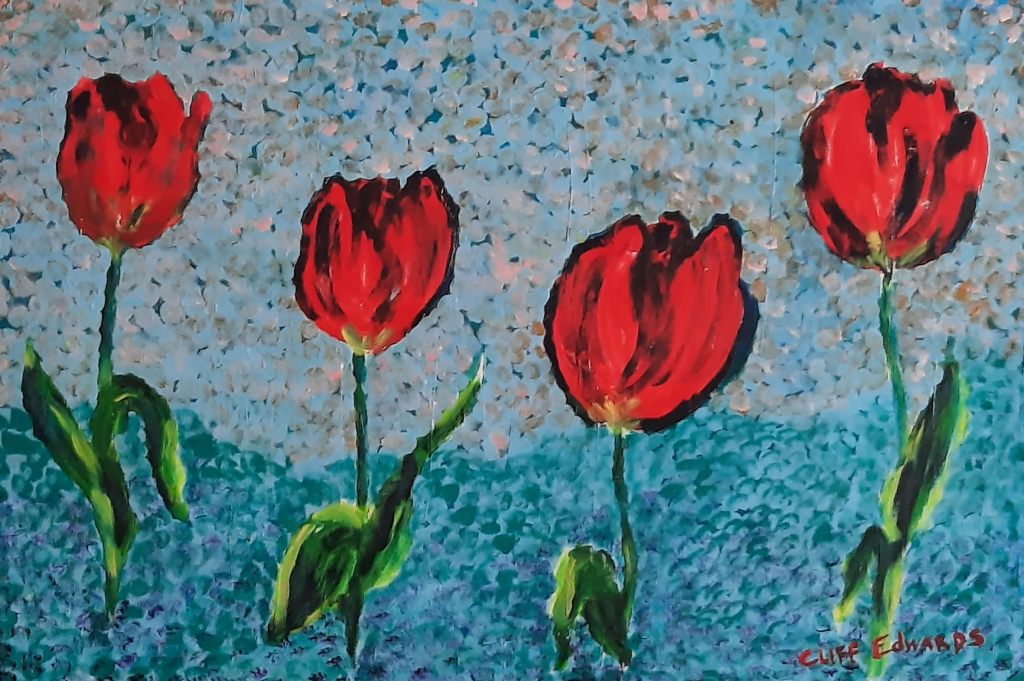
My revision of Calvin’s acronym doesn’t answer all of life’s BIG questions, however, I do think a revised version of T-U-L-I-P—one that doesn’t straight-jacket our humanity would better nurture and sustain us on life’s journey. Perhaps we can begin with contemplating, planting, and even painting the earthy, garden-variety tulips that flourish in the springtime!

BIO Esther Nelson is a registered nurse who worked for several years in Obstetrics and Psychiatry, but not simultaneously. She returned to school (Virginia Commonwealth University, Richmond, Virginia) when her children were in college and liked it well enough to stay on as an adjunct professor. For twenty-two years, she taught courses on Human Spirituality, Global Ethics, Christian-Muslim Relations, Women in the Abrahamic Faiths, and Women in Islam. She is the co-author (with Nasr Abu Zaid) of Voice of An Exile: Reflections on Islam and the co-author (with Kristen Swenson) of What is Religious Studies? : A Journey of Inquiry. She recently retired from teaching.
Discover more from Feminism and Religion
Subscribe to get the latest posts sent to your email.

 Feminism and Religion
THERE ARE NO NATURAL LAWS – OUR UNIVERSE IS EVOLVING!
YOU KNOW WE CAN’T DENY OUR CHRISTIAN ROOTS IF WE COME OUT OF THAT TRADITION BUT SO MUCH IS SO DESTRUCTIVE THAT I SIMPLY HAD TO LET THE WHOLE THING GO – I KEPT ST FRANCIS BECAUSE HE LOVED ANIMALS, THE TWO MARYS BECAUSE I LOVED THEM AND JESUS WHO WAS OBVIOUSLY A HEALER ALTHOUGH FOR AWHILE I HATED HIM BECAUSE I HATED THE CRUCIFIXION STORY – TO WILLINGLY SACRIFICE ONESELF ON THE ALTAR OF HELL SEEMED TOO GRIM – BUT THE GNOSTIC GOSPELS HELPED ME TO RECLAIM THE MAN AS A HEALER – I THINK I WAS FORTUNATE BECAUSE MY LOVE OF NATURE PRECEDED MY ENTRANCE INTO CHRISTIANITY SO I WAS ABLE TO RETURN TO WHAT I KNEW IN THE BEGINNING WHICH WAS NATURE’S NATURAL POWER – BUT WHAT IF IT HADN’T? THEN I MIGHT BE STILL RE- WRITING THE STORY TO MAKE IT MORE PALATABLE…. I WILL NEVER KNOW… BUT WRITING THIS MUCH OUT REMINDS ME HOW IMPORTANT IT IS NOT TO JUDGE ANY WOMAN’S STRUGGLE WITH THE RELIGION SHE WAS BORN INTO…. I WAS ALSO SO FORTUNATE TO HAVE FOUND ECO – FEMINISM WHICH CATAPULTED ME INTO CREATING MY OWN CEREMONIES..
LikeLike
Thanks, Sara, for commenting. I think a HUGE problem with Christianity is the sensibility in most of that tradition that their bible is inerrant and infallible. The branch of Christianity I grew up with rested on that premise so everything that had to do with how one lived one’s life came down to the “fact” that the bible was inspired by God and “true” believers were indwelt with the holy spirit who guided them. That “guidance,” though, always had to match what the hierarchy of the group decided was “biblical.” Getting out from under that burden is freeing. Part of that freedom allowed me to look at biblical text with fresh eyes. I don’t consider the bible to be authored by God, but I see it as a collection of ancient writings, I can have fun looking at different ways it can be understood. I don’t NEED biblical teachings to be a decent person.
LikeLike
ABSOLUTELY ESTHER – LOOKING AT BIBLICAL TEXT CAN BE VERY COOL AS LONG AS ONE REMAINS A BIT DETACHED! WE JUST HAVE TO BE CAREFUL THAT IT IS NOT STILL LIVING US UNCONSCIOUSLY…. LIKE FALLING INTO GUILT AND SHAME – PAYING CLOSE ATTENTION – I DO THIS ALL THE TIME BECAUSE IT’S OUT THERE EVERYWHERE AND WE ALL HAVE CHRISTAIN ROOTS!
LikeLiked by 1 person