

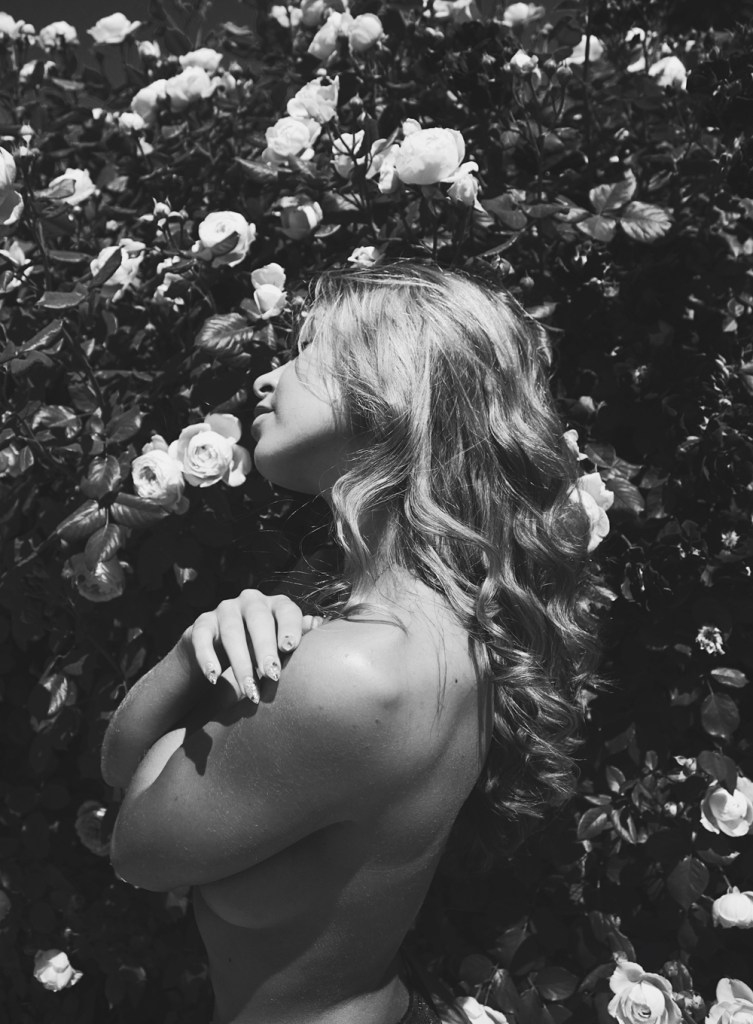
Blodeuwedd is often viewed as a Spring goddess, a personification of flower and bud and bloom. And why not; she is made of flowers after all; flowers and magic. It’s only when you read her original myth in the Fourth Branch of the Mabinogi that you realise how dark it is.
Of all the famous women – now seen as goddesses by many – in these ancient Celtic legends, Blodeuwedd is the only one who is not a mother, and therefore not seen as an aspect of the mother goddess, Modron. Bloduwedd cannot be a mother, because although she is made of flowers, she is a flower that will never bloom, that cannot reproduce.
In both ancient mythology and in the neopatriarchy we live in today, women who either cannot or will not be mothers (despite these being very different things; one a choice, one a lack of choice) are viewed with suspicion. As the opposite of the nurturing, fecund Mother, Bloduwedd instead brings betrayal and death to the hero of the tale. Yet, it was never Blodeuwedd at fault. She is created by the rapist magician Gwydion and given without her consent to be the wife of Lleu, the king, and our shining ‘hero’ of the story. Lleu has been cursed by his own mother to never have a human wife or children, so Bloduwedd is the best that Gwydion can conjure up, and he is celebrated for this marvellous feat of magic.
No-one, of course, bothers to ask Blodeuwedd what she might want.
Blodeuwedd goes on to fall in love with a man who is not her husband, and helps him to murder Lleu. Lleu does not die but shapeshifts, to be brought back by Gwydion. Bloduwedd’s lover blames her for seducing him, even though the murder was wholly his idea, and Lleu kills him anyway. Gwydion then curses Bloduwedd by turning her into an owl, who he declares is the most hated of all the birds.
Blodeuwedd, then, is the supposed villain of the tale. The seducer and temptress. Never mind that she was forced from flower to human form and married to a man she didn’t know; the fault of course is all hers. She is the archetypal seductress; like Lilith, the Semitic goddess also associated with the owl, she dares to fulfill her own desires and is cursed forever for it.
Or is she? Owls are often seen as unlucky, as harbingers of death, in various folklore, but in others they are symbols of wisdom and sagacity; of the Crone. Once turned into an owl, Blodeuwedd is free to fly away. If you ask me, she had a lucky escape. I like to think she flew off and finally lived her own life; in a different form but still, her own, no longer the property of the king and his magician.
Because although Lleu himself is a sympathetic figure, a good king who is sadly manipulated by the men around him from birth, Gwydion seems to me to be so clearly the actual villain of this tale. And in his attempt to create life without the Mother, without Nature, and to force life into a new and artificial form, I can’t help but see parallels to our techno wizards of today.
I am no technophobe; technology can and does save lives and this should be celebrated and pursued. But when we see egomaniacal tech billionaires pursuing goals such as colonising Mars while ignoring the threat of climate change to the precious planet we have; such as creating artificial intelligence which steals from human creativity and may soon pose an existential threat; such as cloning and gene selection which could bring back eugenics; such as, pursuing immortality for the rich through merging our consciousness with machines; is this not the spirit of Gwydion? Feminists for decades now have been warning us of the death spiral of neopatriarchy; how too much of our technological ‘progress’ is driven by the desire to create life without the need for the Earth, the flesh, the cycle of life, death and rebirth; and how this ultimately leads to horror. Without death there is no life; without birth, no rebirth. And just like the creation of Blodeuwedd, too much of this is happening without our consent, leading us into a dystopian techno-feudalism that no-one asked for or desired.
I don’t know the answers to these problems, but I do know that, at the very least, we need to leave the flowers alone to bloom where they will and to heed the wisdom the Owl offers us.
And for Goddess’ sake, someone needs to take Gwydion’s wand away.
Bio: Kelle ban Dea is an interfaith scholar and celebrant living in the UK. She has a DM in Thealogy/Goddess Studies and is passionate about bringing knowledge of the Goddess back to the world to heal our fractured relationship with it.

Kelle Ban Dea’s first book ‘Modron; Meeting the Celtic Mother Goddess’ waspublished 28th January by Moon Books. You can get more information and purchase the book here.
Discover more from Feminism and Religion
Subscribe to get the latest posts sent to your email.
 Feminism and Religion
I had to read this tale a number of times to absorb the complexity – it is not one that is familiar to me…I have such a peculiar background which includes the Celtic tradition. I was once drawn to some of the stories until like the Greek Myths the violence, murder betrayals etc finally unhooked me – too much patriarchy coming through the cracks – I do see the same trend here –
Not that there aren’t important messages to be gleaned that speak to what is happening… your comments on technology are an excellent example.
I wonder what would happen if we just let the tale be and not try to make it into a positive… after all this is a flower that does not bloom – however we may interpret it. I know that it’s hard maybe impossible not to interpret the story etc of us in our own way because we are the next story tellers and each of us comes in with our own bias – which is what I am trying not to do here! I like what you say that you don’t know the answers to these problems. Like you either do I, but it makes sense to me at the very least, that we need to leave the flowers alone to bloom where they will and to allow the owl to fly away… I’m not sure about heeding the “wisdom of the owl”.
As a mythologist I would say that I think it’s very easy to put a wisdom spin on the presence of the owl whose mythology is more about dark than wisdom – I am stuck by the beliefs of so many Indigenous peoples around the world who have very ancient mythologies – many of whom (the majority) fear the call/presence of the owl (most especially the great horned owl but a few others are also included) …. I think Athena’s owl gets stuck to her as wisdom figure because owl sees the dark – we forget to ask what it means to embrace the dark – Athena as a goddess caught the imagination of feminists – but we must recall that Athena herself sprang from Zeus’s neck – no embodiment here – so wisdom becomes suspect. I think owls are feared because they often more often or not appear at times of transition, death and as you say there is no life without death – this is the continuity we celebrate with the ‘great round’
Perhaps we can simply allow this tale to be what it is – a cautionary tale that has deep resonance for us during this time?
Like you I have no answers – I am only asking questions.
Thank you so much for sharing this essay….
LikeLiked by 1 person
I agree wholeheartedly with your point of view and would ask one more question…about who is to blame, what about the mother, Arianhrod and why she punished only one of the twins who fall out of her at a critical moment when she is supposed to be a virgin…what is THAT all about? Dylan becomes a god of the sea and Lleu can have nothing.
These myths, the first of the written information, were by an anonymous author in the 11th or 12th century, and relfect a fully-christianized Wales. The stories may or may not have some things in common with the stories the Druids told (I feel, not much). That the Druids left us with nothing was very wise…it would have all been distorted, and maybe the Mabinogion is proof of that distortion, since not one of the famous four is seen in a positive way. Three of them are helpless and suffering. One of them is distorted into being a witch who tries to kill the famous Bard, Taliesin.
Having written a trilogy telling a muse-given life of an Arthurian Druid Priestess (late 4th centure, CE, Wales) I learned a great deal about the differences in the lives lived versus the ones portrayed. I studied for a while with a Professor of Welsh History and Mythology. He told me the names of the Mabinogion Goddesses were likely not those of the ancestral Druids and checked character names for me. But he did say when I mentioned the contrast that the Mabinogion portrayed, “This is what happened to the Goddess after she met the Patriarchy.” During that same era, the famous Arthurian version with the love triangle of Arthur, Guinevere and Lancelot was written by misogynist Cistercian Monks for Eleanor of Acquitaine and the new fad of Courtly Romance. People think it’s history and it’s just an entertainment. Why do we love it so when all the women are negatively portrayed as being an adulteress or evil priestess?
It puzzles me, and I am glad to see you questioning this Goddess portrayal (and even the nature of the owl, the bird which rode the shoulder of Pallas/Athena). Thank you!!!
LikeLiked by 1 person
Exactly my feeling. The myth is wholly patriarchal: a man who creates a goddess, come on. She’s a male fantasy, nothing more.
LikeLiked by 3 people
I loved this! I consider reclaiming Goddesses from the grimy fist-prints of patriarchy to be sacred work.
In her book, Foxfire, Wolfskin and Other Stories of Shapeshifting Women, writer Sharon Blackie includes a story called Flower Face. In this telling, Blodeuwedd the Owl haunts Gwydion, creeping into his dreams and forcing him to see her and listen to her side of the story. She speaks of the power and wisdom of the Owl, and of the strengths and magic of the flowers from which she was created. I find it a charming feminist telling and it ends with her promising to haunt her ‘father’ every night to remind him of his wrong-doing.
I think his ‘wand’ must have been fairly dysfunctional to begin with as we never hear of his having fathered a child other than thru the rape of his sister, the Goddess Arianrhod.
Thank you for sharing this.
LikeLike