

For over forty years I have been researching women’s dance and folk arts. This quest has been inspired by Merlin Stone, Max Dashu, Vicki Noble, Mary Kelly, Marija Gimbutas and others, including my close friend Carol P. Christ, who encouraged scholars to examine ‘nontextual artifacts’ and ‘expand our notion of history to include records that are not written’. 1
Through extensive travels in southeastern Europe, North Africa and the Near East, I’ve learned to recognise the symbols and significance encoded in dance patterns, textile motifs, jewellery designs, healing practices, and other forms of women’s ritual arts.2 This experience has trained me to discern patterns and meaning beyond superficial interpretations – to look ‘with eyes to see’.
In this article I would like to offer a closer look at the ‘nontextual artifacts’ in the Christian Nativity story: the gold, frankincense and myrrh brought by the Magi. My lifelong interest in North African bridal jewellery leads me to suggest that the gifts of the Magi were meant for the mother, not the child. Not only that, this closer look reveals that the Magi were probably not three, almost certainly not kings, and very likely included both men and women.
The Magi, also known as the Three Kings or Wise Men, are generally depicted as three men from the East, grandly dressed, carrying small caskets of gold, frankincense, or myrrh. In traditional Christian exegesis, gold and frankincense represent Christ’s kingship and divinity respectively, while myrrh is seen as foreshadowing his death.
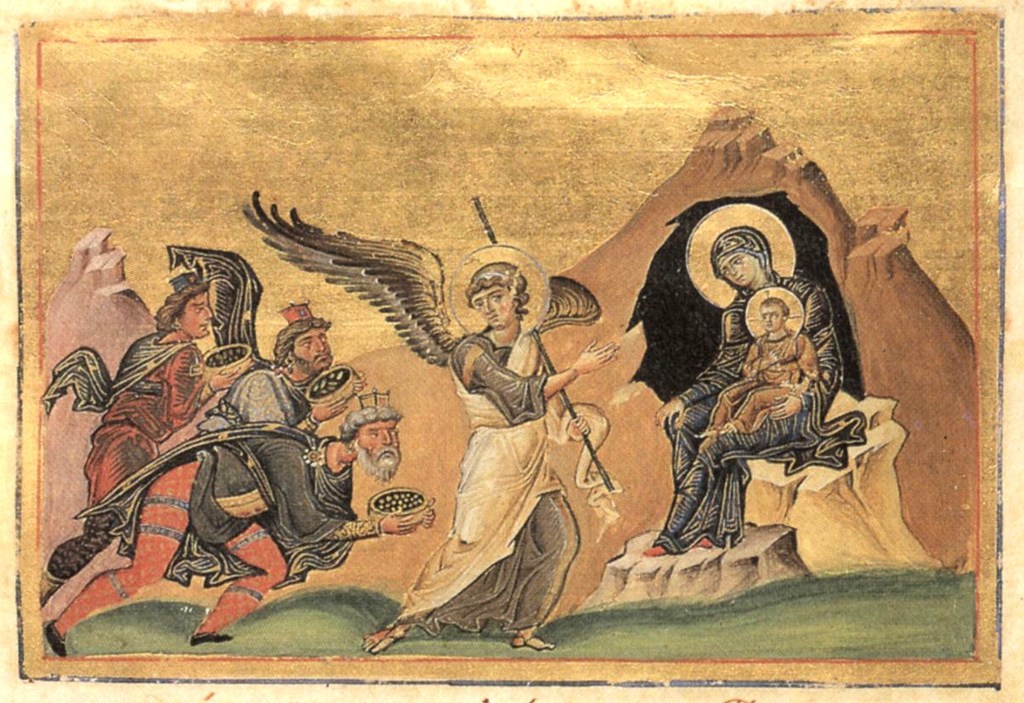
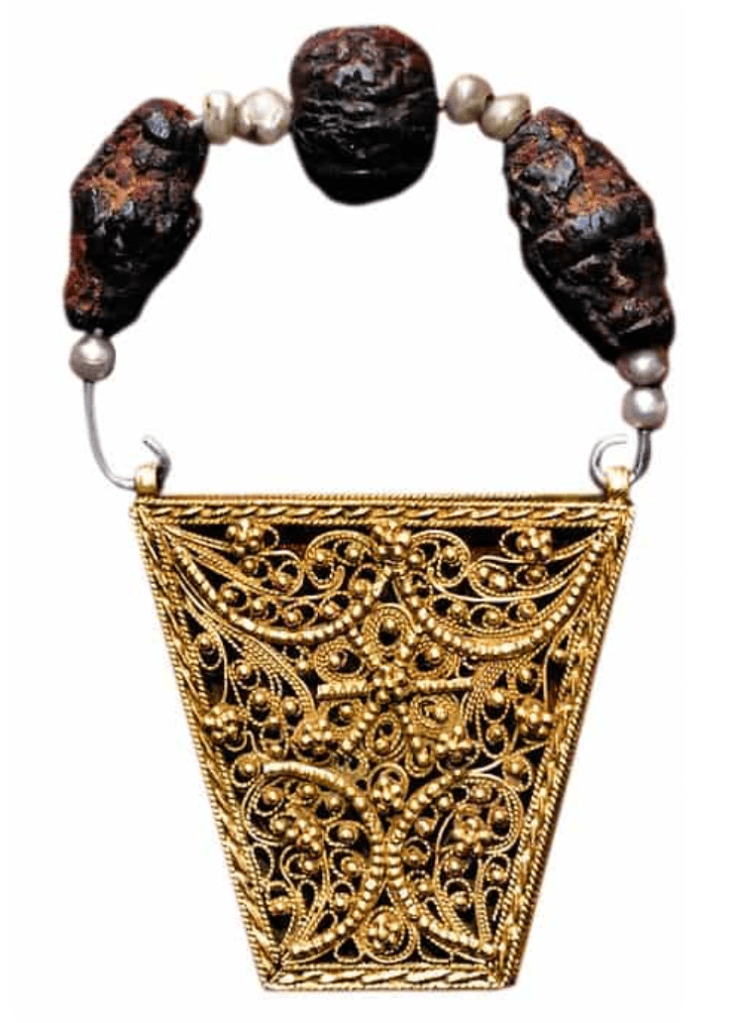
However, this is not the form in which the gifts were brought. The original Gifts of the Magi are guarded in the remote Monastery of Ayiou Pavlou on Mt. Athos in Greece. The gold consists of 28 small filigree plaques in rectangular, triangular, or polygonal shapes, while the frankincense and myrrh – blended together – are shaped into 62 oval beads about the size of an olive.3 Now separated into units consisting of one plaque and a few beads, beads and gold would originally almost certainly have been strung together – exactly the form of the North African bridal necklace known as meskiyah and skhab.

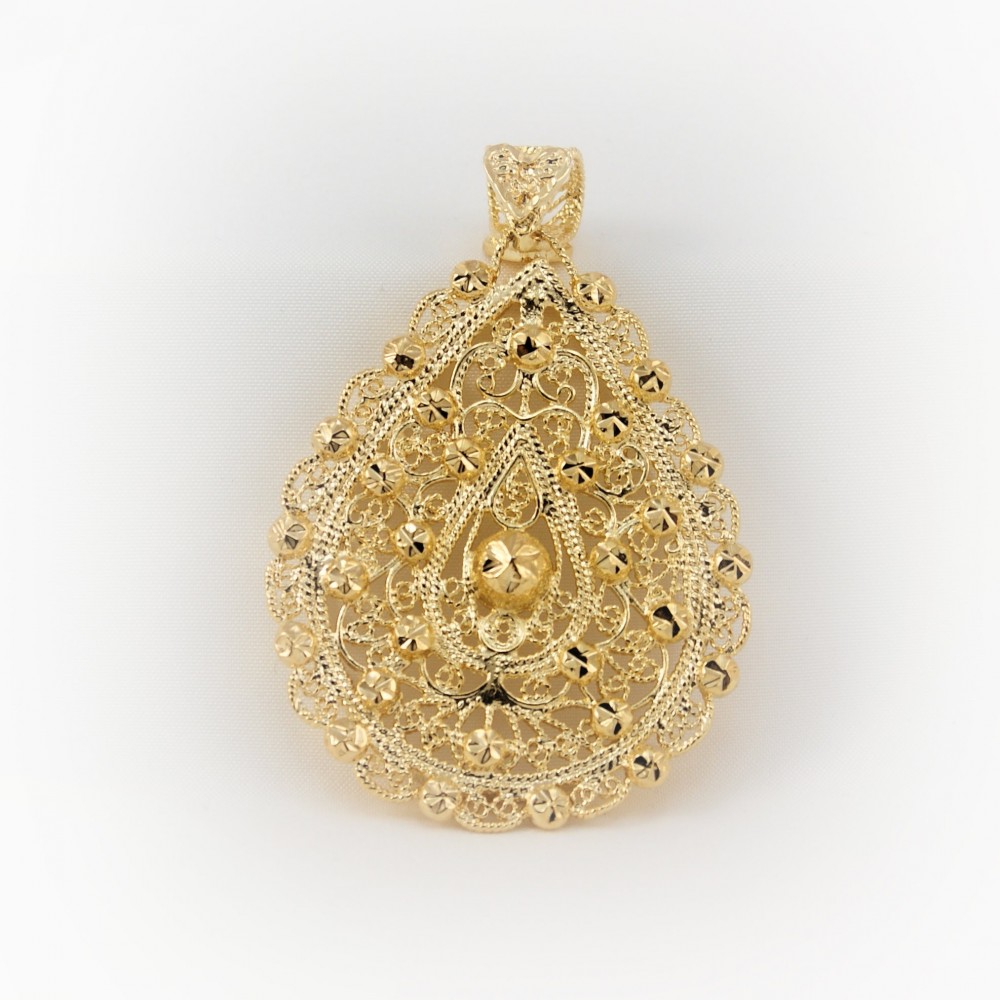
Meskiyah are flat lockets made of fine gold filigree in various shapes, designed to contain scented substances – specifically musk, from which they take their name. Their delicate openwork ‘lid’ allows the fragrance to waft out and perfume the wearer. Meskiyah are an essential item of bridal jewellery in North Africa today, particularly in Tunisia and Algeria, always combined with the aromatic beads called skhab.
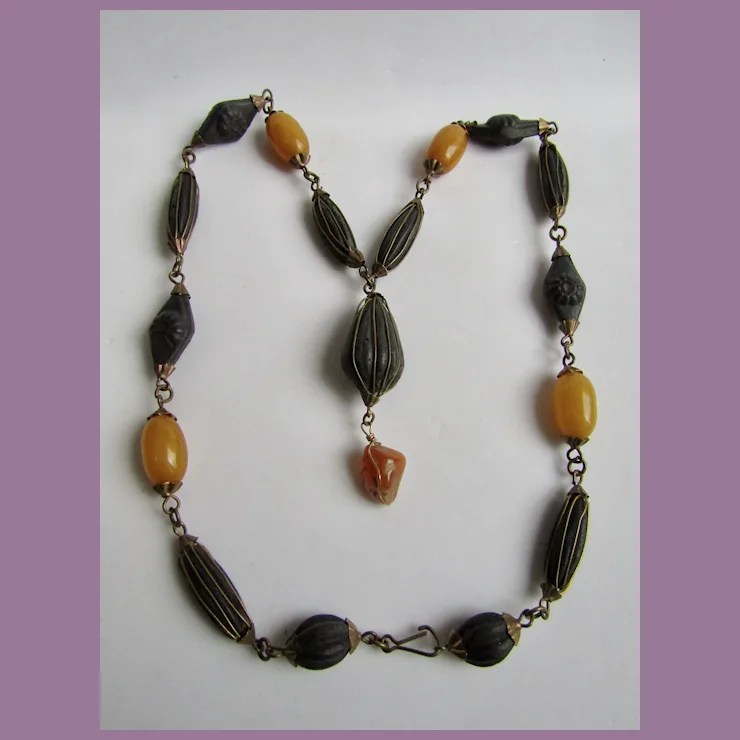
Skhab are homemade beads of scented paste, an ancient form of adornment found throughout the Maghreb and the Berber world. Spices such as roses, spikenard, cloves, cedar, frankincense and myrrh, are ground, mixed with rosewater and other elements, then carefully shaped and dried.4 The dark-coloured beads can be round or oval like the gifts of the Magi, or formed into different shapes. The lengthy process of their creation ‘was an entirely female affair’.5 Recipes differed by region, family, and availability of ingredients, but all skhab beads had a powerful fragrance lasting for years, even generations. Indeed, monks of Mt. Athos report that the beads brought by the Magi impart an ‘unmistakable fragrance…still potent to this day’.6
To complete the bridal necklace, strings of skhab are interspersed with larger beads or pendants of amber, glass, silver, or gold (such as meskiyah). Together, skhab and meskiyah bear an extraordinary resemblance to the gold plaques and fragrant beads given by the Magi at the birth of Christ. To me, this shows that the gifts of the Magi were most likely meant for the mother.
There is further evidence. While all skhab offer healing, protective, and even aphrodisiac effects,7 the blend of frankincense and myrrh specifically supports women after childbirth.8 When combined, they change their individual chemical constituents to produce pharmacological properties which neither resin possesses on its own. And what are these properties? Together, frankincense and myrrh relieve pain and anxiety in childbirth, reduce post-partum bleeding, stabilise the nervous system, and prevent post-partum depression9 – precious medicine indeed for a new mother.
Further medicine may have been contained in the gold filigree tiles brought by the Magi. As we have seen, these appear virtually identical to North African meskiyah containers for musk, a perfume extracted from the scent glands of musk deer. Medicinally, musk is known to soothe the nervous and circulatory systems, and help maintain muscle strength, bone density, and healthy sexual desire.
The word ‘musk’ or ‘muskroot’ also referred to spikenard (Nardostachys jatamansi) and sumbul (Ferula moschata). These aromatic medicinal plants relieve nervous stress, support the female reproductive organs and women’s hormonal cycles, and – like the blend of frankincense and myrrh – assist with labour and childbirth. It seems clear that whichever fragrance – musk, sumbul, spikenard, or another – may have been contained inside the gold jewellery brought by the Magi, it was meant for the mother, not the child.
Why did nobody recognise this resemblance before? Having previously encountered skhab and meskiya in Egypt, Tunisia, and Morocco, I could ‘recognise’ them instantly in the photos from Mount Athos. Only men can visit Mount Athos where the Holy Gifts are kept, while only North African women wear the skhab and meskiya – which they keep hidden from all men except their husband. Where would an Orthodox monk or male Christian traveller ever have seen a North African women’s skhab or meskiya to compare to the Magi’s gifts? And even if a man had seen such jewellery, he would have no reason to know the symbolic and medicinal significance it holds for new brides and mothers.
Let’s look now at the Magi themselves, those mysterious figures who came ‘from the East’, most likely Persia. A Persian magus (plural magi or magoi) was a type of learned priest trained in ceremony, astronomy, dream interpretation, and other esoteric subjects.
The Gospel of Matthew – the only book of the Bible which mentions the Magi – does not specify their number. The Western church assumes three gift-givers, from the three gifts, but in other accounts, the number varies: in Aramaic and Syriac Christianity, the Magi were twelve.
The Church also assumes that the Magi were male, but this assumption has no basis in fact: the Gospel of Matthew does not specify their gender. As noted by Rev. Benedict Thomas Viviano, the Greek masculine plural magoi or magi can include women, just like the English ‘men’ or the French ‘ils’.10 The grammar indicates that at least one of the Magi was male, but there is no textual evidence to support the idea they all were.11
On the contrary, it is perfectly plausible that there were women among the Magi. Women in ancient Persia enjoyed a high degree of autonomy and respect within their culture, owning land, conducting business, and travelling freely on their own. Women served as Zoroastrian astrologers and priests, and were healers and midwives, as elsewhere in the ancient world.12 Furthermore, as Sr. Christine Schenk points out, Joseph is absent when the Magi visit, yet Mary receives them. In that time and place, male visitors would not have been permitted to enter Mary’s home unless other women were present.13
The evidence gathered here supports my suggestion that the gold, frankincense, and myrrh were intended for Mary, brought for the new bride and mother by one or more women among the Magi. This new understanding of the Magi’s gifts places Mary and her pregnancy once again at the heart of the Nativity story. I hope these insights can help deepen our understanding of the Divine Mother, and offer renewed inspiration for contemporary worship.
This material was first presented online in ‘Dances of Light and Wisdom: Healing Music and Dance for Epiphany’ on January 6, 2024, and on April 29, 2025 in the ‘Wisdom of the Mothers: Celebrating Matriarchal and Matrilineal Spiritual Traditions’ Symposium of the Yerusha Academy & The Lilith Institute. A longer article with complete references is at https://www.academia.edu/129092794/The_Gifts_of_the_Magi_Were_Meant_for_the_Mother
- Christ, Carol P. (1997), Rebirth of the Goddess: Finding Meaning in Feminist Spirituality New York: Routledge. ↩︎
- Shannon, Laura (2019). ‘Symbols of the Goddess in Balkan women’s dance’, in Spiritual Herstories. Ed. Amanda Williamson. Intellect.
Shannon, Laura (2011). ‘Women’s Ritual Dances: An Ancient Source of Healing in our Time’, in Dancing on the Earth: Women’s Stories of Healing Through Dance. Eds. Leseho and McMaster. Findhorn Press. ↩︎ - Chrysopoulos, Philip (2022). ‘The Gifts of the Three Magi: The Most Precious Relics on Mount Athos‘. Greek Reporter, December 25, 2022. ↩︎
- Mecili, Meriem (2022). ‘Skhab‘. ↩︎
- van Roode, Sigrid (2024a). ‘Scented paste jewellery of North Africa‘. Bedouin Silver, Feb 16, 2024. ↩︎
- Chrysopoulos, Philip (2022). ‘The Gifts of the Three Magi: The Most Precious Relics on Mount Athos‘. Greek Reporter, December 25, 2022. ↩︎
- Opper, Maria-José (1990). ‘Scented Magic Beads in Africa Made of Aphrodisiac Paste: Tunisia, Algeria, Morocco, Mauritania, Mali, Senegal’. ↩︎
- Wenk, Gary, Ph.D (2021). ‘Frankincense and Myrrh: Useful Spices for Women After Giving Birth’. Psychology Today, December 3, 2021. ↩︎
- Bo Cao et al (2019). ‘Seeing the Unseen of the Combination of Two Natural Resins, Frankincense and Myrrh: Changes in Chemical Constituents and Pharmacological Activities’. Molecules, Sep 2019, 24(17): 3076. ↩︎
- Viviano, Rev. Benedict Thomas (2011). ‘A woman among the Magi?‘ St Louis Beacon. ↩︎
- Schenk, Sr. Christine (2016). ‘An Epiphany with Wise Women?‘. National Catholic Reporter, January 7, 2016. ↩︎
- Mark, Joshua J. (2020). ‘Women in Ancient Persia‘, World History Encyclopedia. ↩︎
- Schenk (ibid.) ↩︎
Discover more from Feminism and Religion
Subscribe to get the latest posts sent to your email.

 Feminism and Religion
Dear Laura, Your piece of writing HERe highlights and adds even further credence to how and why womyn’s role, place, position, power/potencia has been, is, and will always BE present. Silencing shrinks the silencers in equal measure. Transformative, grassroots, “underground” is forever germinating, sprouting, bursting forth.
Sawbonna,
Margot/Raven Speaks.
LikeLiked by 1 person
Yes Margot! The forms of these gifts were always present, even if invisible to us because of the millennia they have been locked away in their reliquaries. But they are becoming visible again now. Thank you for your comment.
LikeLiked by 1 person
Dear Laura What an amazing piece of research! It all makes total sense. Thank you! Much love from Suzannah
LikeLiked by 1 person
Thank you, Suzannah! I was able to recognise how the gifts resemble the classic North African bridal necklace because of having seen many examples of this type of bridal jewellery on my travels. If I hadn’t travelled, hadn’t seen such necklaces before, and hadnt already contemplated the tremendous value and significance such gifts carry for the bride, I would not have understood why the gifts of the Magi are in this form.
LikeLiked by 1 person
This was absolutely fascinating on every level imaginable. I have always LOVED the story of the three kings, so this was very convincing. Thank you!!
LikeLiked by 1 person
Thank you, Mermaid! I’ve always loved this story too, and have even made my own Magi for my home nativity Creche scene (you can see it here). Before next Christmas I will add a few women Magi too bearing a miniature necklace of skhab and meskiyah… though actually, since they don’t have beards, it’s possible that they might already be female…
LikeLiked by 1 person
What a great idea Laura with your own manger scene! We bought two manger scenes and then put the two Marys together, and took pictures. We had a little statue of our dog, so he got added as one of the animals in the manger. Your idea is the best yet, so I’m going to look for women with crowns around town and add them to the manger. Back in the day, we had our own neighborhood kid’s play where we dressed up as Mary, Joseph, the Little Drummer Boy, and shepherds and the three kings. I was assigned to be a Shepard the first year of our play. But then later on as it became a holiday favorite tradition, I lobbied to be a King bringing the baby Jesus gold. Our wise older girl director was just fine with it. I may read your article out loud to friends as a Christmas special event.
LikeLiked by 1 person
I struggle with the Christianity of my maiden years because it has a huge blind spot about the sacredness and transformative nature of motherhood. It seems to me that if God were truly leading the Church into all truth (John 16:13) about human flourishing among other things, God would have honored mothers rather than the opposite (Luke 11:27-28). So therefore I cannot trust that Christianity has true revelation from God about other things either.
For that reason, I also find it difficult to put the pieces together in a way that shows God moving in this story. If God did inspire the Magi to visit Mary and Jesus, whose idea was it to bring Mary these gifts? If God did inspire the Magi to bring gifts specifically for Mary, why did God neglect to inspire the Church to honor mothers at most other times? And even if the Magi honored mothers in general, if their revelation was about the importance of Jesus, why did they bring his relatively anonymous mother a gift instead of him?
It seems likely to me that, however the Magi were inspired to travel to Jesus and Mary, and whatever regard they held motherhood in, they brought the most portable, beautiful, and storable form of wealth they could for a gift: jewelry. It is my understanding that dowries and similar forms of women’s wealth were often stored as jewelry for many reasons, including that men are less likely to spend it irresponsibly, and less able to do so anonymously. So it’s a good investment for when women decide there’s a true emergency, such as divorce. And what better way to invest in a baby or small child than to invest in his mother, who is with him constantly, and whose financial security to do so (and peace of mind due to this security) is key to his development?
No baby deserves to live in poverty. I wish we could invest in the well-being of today’s babies by ensuring their mothers had the financial security to stay together with them, as most mothers and babies desperately want to do. A year of government-paid maternal leave and a generous baby bonus seem like the least we can do from the government end of things. And let us never forget the importance of non-governmental community support like childbirth education, midwives, doulas, bodyworkers, breastfeeding mentors, extended family help in postpartum, friends bringing meals, encouraging neighbors, and communities that welcome both parents and children to exist together in public. Mothers and babies are a dyad. If you want to help one, help the other together with them.
LikeLiked by 1 person
Thank you, Liriodendron, for your thoughtful comment. You are so right, mothers and babies are a dyad. I think this was better understood in the ancient world.
You are quite right too about the universal practicality of jewellery as a gift for women/mothers/brides. For me the revelation came through recognising the form of the Gifts as the form of bridal jewellery so common in North Africa, with such tremendous significances on so many levels: decorative, cosmetic, medicinal, symbolic, apotropaic, and marking life transitions – and so definitely, clearly, indubitably for the Mother.
Lots more food for thought in your comment! Maybe you would like to send in a possible guest post for FAR?? Blessings, xx, L.
LikeLiked by 2 people
I am in my 70’s. I say that because I am a late bloomer of life. I have recently learned of the benefits of Frankincense such as the healing process within the herb. I voiced this on FBook and it was taken down by someone voicing their displeasure over my opinion.
I believe the healing properties of the 3 herbs delivered to Mary were for her healing from childbirth. The baby most likely shared in the healing process of the herbs also.
LikeLike
This is so brilliant Laura. Thank you. And when I read it, it seems so very obvious and yet I have never heard anything like this before. It puts so much into focus. It makes me sad that we, as a culture, have been stripped of such knowledge over so many generations. And it is important that now it is rising again. Thank you esp. for your role in that.
LikeLiked by 1 person
Thank you, Janet! I appreciate your comment. How could any of us have heard of it when there is so very little overlap between the two groups involved – North African brides and Orthodox priests?? But as you say, knowledge is rising again. (And you are playing a role in that process too.) Bless you. xx
LikeLiked by 2 people
This is some outstanding research. Thank you for keeping alive the subaltern histories of our female ancestors. It’s almost like their sacred stories, contribution and power were eclipsed! /s
LikeLiked by 1 person
Thank you, esikie. Yes, it is indeed
almost like their sacred stories, contribution and power were eclipsed
But every eclipse comes to an end eventually.
LikeLiked by 2 people
O goddess speed!
LikeLiked by 1 person
Hi Laura,
I can’t convey the thrill I experienced while reading this wonderful post.
I was brought up with Baptist Church doctrine and although I branched out 50 years ago, it is only recently that I developed an interest in discovering ‘who was Mary and why was she chosen to be the ‘mother of god.’ I posted something about her on my Substack page as a result of some recent conversations and material shared about the high level of spiritual attainment she had proceeding the virgin birth.
Now I find this…and since I have been an Aromatherapist and once had a necklace of myrrh beads, I can relate to this necklace description and the aroma it carried. One Aromatherapist had posited the gift of myrrh for the baby because it was used to ease pain of teething…and even if it did, that didn’t sound quite right.
I love this time where the ‘before the church’ truths are being revealed. I had the blessing of ‘receiving’ an inspired look at the twilight of the Druids and the life of a Priestess. I learned as I wrote, and it was wonderful to spend time in a time where women were equal to the men.
As an Astrologer who began 50 years ago before it was ‘fashionable,’ I read the reference to 12 and thought, the zodiac. And then you mention the role of these women as astrologers. What a joy for me…you really made my heart sing with this post. Thank you! ✨❤️✨
LikeLike
Thank you so much for your comment, Shelliee. I do think you are right, Christianity ‘before the church’ was another thing entirely, and I also believe it was
a time where women were equal to the men.
Have you read the excellent book by Karen J. Torjesen, When Women Were Priests: Women’s Leadership in the Early Church and the Scandal of Their Subordination in the Rise of Christianity? When we realise that Christian priests also originally included women, it doesn;t seem to far-fetched to contemplate the possibility that the Magi also included women.
BTW, when I presented this research earlier this week at the ‘Wisdom of the Mothers’ Symposium of the Yerusha Academy & The Lilith Institute, there was a question from a participant about the astrology/astronomy of the time of the Nativity. Perhaps you have some insight about that you would like to share?
Blessings,
xx, L.
LikeLiked by 1 person
Hi Laura, thank you for your reply.
Another thing about me is I am an ADL Reverend and I mention this only because another of my fellow Reverends (in this highly but not exclusively female group) had done a lot of study about the origins of the Roman Church and when I had an interview show, she told me about the church originally having women priests. When you look up ‘did the Roman church believe in reincarnation’ or any other such, it is amazing how many councils they had where they were altering the translations and deciding what to leave in, what to leave out and what to invent (like Mary Magadalene being a prostitute).
As for the Astrology, I can’t help with chart information because we are not in possession of the actual date and time of this birth. While many have argued that shepherds would not be in the field at this time of year, we also have the fact that December 25th was part of the way to gain acceptance among the Celts by aligning with the prevailing Celtic celebration of the Midwinter Solstice (more like the 21st or 22nd). A popular Celtic image for this time is that of a Goddess either pregnant and about to give birth, or holding an infant, riding a white (earlier reindeer) horse throught the woods where she is being pursued by the hounds of a god of the underworld. It days several days but she makes it through and there is great celebration.
And all this is an alegory about the Midwinter Solstice and the 3 days the sun ‘stands still’ on the horizon at its farthest point south and when it moves again, it is heading north which will bring the longer daylight hours, etc.
But in looking at what others say about the ‘star’ that led the ‘wise men’…I found this article which I found quite interesting and you may, too. https://mormonheretic.org/2008/12/13/astrology-in-the-christmas-story/ and this does have some information about what that special star would be and when it took place. We were hearing a lot about that because we had a similar configuration not long ago.
Blessings ✨❤️✨
LikeLiked by 1 person
We have no date or even year. But the December dating was dreamed up later to fit with the pagan calendar, not only the Roman Saturnalia but also the winter solstice rebirth theme of the Mitra religion that the legions brought back from the Iranian borderlands.
LikeLiked by 1 person
Laura, thank you so much for this post. It validated so much that my gut told me years ago.
In the 1960’s I was privileged to be a Peace Corps Volunteer in Somalia, and I learned of the legend of the Goddess Arawello who worked in the frankincense and myrrh forests of northern Somalia. I also saw the astonishing gold jewelry that Arab artisans created from spider web thin strands of gold. I have long believed that much, if not all, of the gifts of the Magi came from northern Somalia, but I had no proof of such. You have gifted me such proof. Thank you so much.
And that at least one of the Magi was a woman– yes! yes!
MaryAnn, MaryAnnShank.com
LikeLiked by 2 people
Dear Mary Ann, how amazing to have lived in Somalia at that time. Yes, the goldwork is indeed incredible. In northern Africa the goldsmiths were often Jewish – I don’t know if that was also so in Somalia. It would be wonderful to be able to explore the gold plaques in the gifts of the Magi in more detail and perhaps learn more about possible provenance that way. The origin of the Magi and the gifts is not clearly specified in Matthew either, only that the Magi came ‘from the East’. Persian and Babylon are always suggested, but Somalia is east of Egypt also.
And I did not know about
I would love to learn more about her, and your other reasons for sensing
If you can recommend any particular links or sources I would be very grateful.
Blessings to you,
xx, L.
LikeLike
Another thought, Mary Ann: do you know if women make any type of scented paste bead necklaces in Somalia, or elsewhere in East Africa? I have heard that skhab are made in Tunisia, Algeria, Morocco, Mauritania, Mali, and Senegal, but necklaces of fragrant paste beads called “myrrh” are common slightly further afield, in Ghana and Nigeria. (These are actually made from the fragrant fruit of a tree called danq, Detarium microcarpum, not from drops of resin from the myrrh tree, Commimphora. Ruth Smith describes them in her book ‘Botanical Beads’ at this link.)
LikeLike
Laura, my apologies for not responding to your questions sooner. Sadly, my computer got infested with a bunch of bugs. First, the question about the necklaces. I do not recall seeing any like you describe, but I was in the southern region of Somalia, far from the Mediterranean shipping lanes. I do recall seeing plain brown round-ish beads on a necklace. I’ve scoured my pictures from back then, but just don’t see any. I have a good friend nearby. Although he is not a female with necklaces, he is in touch with many from the various Somali societies. I’ll let you know what he says. MaryAnn
LikeLike
Laura, ohmygoodness, I have given whole presentations on this topic to our adult learning community. Where do I begin? First, I am no scholar, and no linguist. If you are looking for “authority”, the only ones you will find are male. Somali men universally deny the existence of Arawello, and will snub you like an annoying bug should you inquire. But if you are a woman asking, a Somali woman will lead you to a gravesite where even today women leave small tokens of love — a flower, a bit of bright fabric. Arawello still lives, a real part of the soul of every Somali woman, and girl. There are many versions of the Arawello story, but they all contain a part where she went to the frankincense and myrrh forests of northern Somalia, where she gathered her army of women warriors. (fyi, after one lecture I actually had a Somali man verbally attach me for telling such fables.) My belief in the quality of Somali frankincense and myrrh is based also on tales told by a woman, by Queen Hatsephut of Egypt, a Queen as powerful as Cleopatra, but one who lived much earlier, and in peace. The Queen had heard rumors of the rich livestock and produce from the horn of Africa and sent her ships to investigate. They discovered world class cattle, sheep and goats, as well as papayas, mangoes and all manner of exotic fruits and vegetables. The explorers invited Somalis to return to Egypt with them, not as slaves, but as honored guests. The boats were over flowing with all the livestock and produce and peoples who returned to Egypt. The Queen was so impressed with these people of the horn of Africa that she had the journey depicted in her pyramid, with a notation that they were the kindest and most generous people she had ever met. Somalia was very tied into the sea route of the Silk Road, the shipping lanes reaching from the Mediterranean to China. While the Magi likely did not come from Somalia itself, the Gifts of frankincense and myrrh could very well have come from there. It was a highly respected, rich society. I don’t know much about the “Arabs” who created the gold jewelry. Today they are Moslem Arabs, but I haven’t run across anything that identified them two thousand years ago. I wrote about many of these events, and about Arawello, in “The Mystical Land of Myrrh.” If you would like to read it, please em me (maryannthewriter at aol) and I will be glad to send a copy to you. I also have some images and maps that may help shed some light on this part of the world. Rarely was I able to connect with Somali women, for my job was working predominantly with men. I do so wish I could know them better, for I am certain they could tell me many wonderful stories, stories that the men do not know. MaryAnn, MaryAnnShank.com
LikeLiked by 1 person
Hi Mary Ann,
As a teacher of aromatherapy, I always told the tale of the Pharoah Queen Hatshepsut and her decision to send an expedition to the land of Punt as it was called in the information I read…is this Arawello? And in this story, she had them bring back Frankinscense trees so they could ‘grown their own’. There were other Queens of Egypt but Hatshepsut was a Pharoah and the only woman that would ever be Pharoah. After her death they removed the beard on her images and basically removed her altogther or as much as possible. Patriarchy’s ‘dont try this again’ message.
And another thing that is said about Frankinsence is that it was only used by the Priests on the high holy days (reference to the Hebrews). And so that was said that the gift of Frankincense to baby Jesus was recognizing him as a Priest. Possible.
LikeLike
The Pharoah Queen Hatshepsut and Arawello are different people. The Pharoah Queen Hatshepsut ruled about 2,000 years b.c. as I recall. Arawello’s story is from the first century a.d.
Yes, I learned too that the Egyptians took the fragrant trees back to Egypt, along with all the produce and livestock, so it is possible that the Gifts of the Magi were actually grown somewhere else. Since the trees originated in the hills of Somalia, and Somalia was a huge trading destination, my inclination has been to place the Gifts from there. I have no corroborating proof to back up that feeling.
Thank you for that wonderful info on Pharoah Queen Hatshepsut. I would so love to visit her pyramid some day and see the story she told of the visit to the Land of Punt. O, the wonderful things you must learn as a scholar of aromas!
MaryAnn, MaryAnnShank.com
LikeLiked by 1 person
Thank you! I didn’t know if Arawello was a person or a place. ✨
LikeLike
Thank you, Mary Ann, this is so interesting.
Yes, the Silk Route trade brought gold and incense everywhere.
I would love to know more about Arawello – Max’s comments are illuminating also.
Very kind of you to offer to send me your “The Mystical Land of Myrrh”! I will email you separately.
LikeLike
Arawelo is a fascinating figure, remembered as a queen and liberator. “A long long time ago, a queen lived in the Horn of Africa. One day, her realm was attacked from all sides at once. She was able to escape her enemies by some miracle and took refuge in the northern mountains. There, in tears, she supplicated her divinity to offer her a precious gift to console her for the loss of her children and her lands. Then, everywhere that her tears had fallen, trees with fragrant resins began to grow up. [61]
Source: Histoire des croyances en Somalie : religions traditionnelles et religions du Livre, by Mohamed Mohamed-Abdi. Collection de l’Institut des Sciences et Techniques de l’Antiquité Année 1992
https://www.persee.fr/doc/ista_0000-0000_1992_mon_465_1
Mohamed-Abdi describes how women perform faal (divination) by using a precious necklace as a pendulum while intoning the invocation “Maryama of God, speak the truth.” Women also speak with crows, who are considered intermediaries between the great birds (like vultures) and the little ones, and listen to their answer. (Crows were also divinatory birds in Ireland and other places).
He also describes lot-casting, using patterns known as mother-womb/matrix and daughter-womb/matrix (matrices) (pp 27 ff). The Mooro patterns are described as “heart of the womb/matrix.” (Not sure from the French matrice what the original sense was in Somali, but the whole layout is described in a matrilineal idiom _mothers, daughters, granddaughters — so I’m going with “womb.”
These Mooro patterns are very evocative of Ifa layouts of the Yoruba tradition, even though the mathematical basis and layout forms differ. (It’s worth noting that Odu, the foundation of Ifa, also means “womb.”)
Laura, you may be interested in the photo from my post on this: https://www.facebook.com/photo.php?fbid=10158224013528321&id=333661528320&set=a.423118913320 which shows flowers and pendants sewn into cloth (and maybe resins, can’t tell) that Somali women used in their saar (zar) ceremonies.
LikeLike
This is indeed very interesting! I was not aware of Mohamed-Abdi’s book. I am intrigued by the mention of divination ‘by using a precious necklace as a pendulum’ while invoking Maryama, (e.g. Maryam, Mary). Also, at that link on your FB page, the quote from ‘Culture and Customs of Somalia’, about women’s divination methods including ‘smoke from burning incense’, which I have seen elsewhere in N Africa and SE Europe. And of course it makes sense that for women the divination tools include textiles and jewellery.
Thank you for these suggestions. So much to explore!
LikeLike
Laura, I love the work you’ve done highlighting the skhab and meskiya. What they bring to mind for me are the ornaments on the necklaces of Iberian women (where a Punic influence, from Tunisia, is quite visible). I’d attach an image but no option to do that here, so look up La Dama de Elche, she’s wearing them. I have thought of them as amulet cases, containing blessing essences, but you point to the resins, which is an important angle. The Romans also had children wear protective bullae, hollow metal pockets, with who knows what inside them. Discussions of Punic culture emphasize the Phoenicians, but the North African substrate is there, and I don’t recall seeing Phoenician women wearing such ornaments (maybe they did). The source for frankincense and myrrh of course being Arabia, another possible point of origination.
LikeLiked by 2 people
Thanks, Max, that means a lot coming from you!
I had not thought about the Damas de Elche and Baza, but of course you are right, their fabulous necklaces are similar, with flattish tiles set among round beads. All their jewellery is so ornate and detailed. 4th C BCE? Their association with the Goddess Tanit would definitely link them to Carthage and Tunisia.
Now that I look more closely, I see that the round beads in 2 of the 3 necklaces worn by the Dama de Elche have longitudinal ridges on them, just like typical Tunisian skhab beads today. In examples I’ve seen, aometimes these lines seem decorative and sometimes it seems that the indentations between the ridges allow the beads to be held in place by wires rather than being strung through the middle, as in the Tunisian necklace photo above. Since resin beads would have disintegrated quickly I doubt many have been discovered in archaeological excavations, but there may well be clues in the jewellery which did survive.
The pendants could well be amulet cases as you suggest, possibly containing written blessings like Islamic amulet pendants today, or perfumes (which would have been considered to provide protection and blessing as well as fragrance), and I suppose they might have been either permanently sealed like flattish versions of the Roman bullae you mention, or with filigree tops (hard to tell from the sculpture) like meskiyah, allowing fragrance to waft out. Or the thin flat rod visible at the top of many of the pendants could be a hinge for the user to open and close them like lockets.
Re Phoenician women, a quick search just now led to this:
Phoenician women were greatly devoted to the use of personal ornaments. It was probably from them that the Hebrew women of Isaiah’s time derived the “tinkling ornaments of the feet, the cauls, the round tires like the moon, the chains, the bracelets, and the mufflers, the bonnets and the ornaments of the legs, and the head-bands, and the tablets, and the ear-rings, the rings and nose-jewels, the changeable suits of apparel, and the mantles, and the wimples, and the crisping pins, the glasses, and the fine linen, and the hoods, and the vails,”23 which the prophet denounces so fiercely. The excavations made on Phoenician sites have yielded in abundance necklaces, armlets, bracelets, pendants to be worn as lockets, ear-rings, finger-rings, ornaments for the hair, buckles or brooches, seals, buttons, and various articles of the toilet such as women delight in. https://phoenicia.org/dress.html
Aha, I note ‘pendants to be worn as lockets’!!!
The quote is from Is. iii. 18-23 (KJV) I wonder what ‘tablets’ might mean in this context. Other translations mention ‘perfume boxes’ or ‘perfume bottles’.
Lots to explore! Thanks so much. Please let me know if you think of other clues and connections.
xx L.
LikeLiked by 1 person
What a fascinating discussion. Thank you. I can add to the bible translation part. The word that is translated as tablet in the KJV in Isaiah 3:20 is perfume bottle in other translations. The word is actually nephesh (Strongs 5315).
Here is from Strongs Concordence:
Definition: Soul, life, self, person, heart, creature, mind, living being
Meaning: a breathing creature, animal of, vitality
This brings up so many interesting layers. The power of scent and how it functioned in rituals and in healing rites. The idea that our breath is part of our “soul”.
In my own translations of Hebrew I look at each letter in the root of the word which in this case is nun [n], pey [p], shin [sh]. Letters in Hebrew also have meanings as well as sounds.
Nun is a sprouting seed. Pey is an open mouth, and Shin has two meanings, first is front teeth and second is that it is the candelabra which represents flame. If we look at this as a rebus or picture puzzle, I think that adds even more layers of meaning but the one that strikes me first is the element of chanting. The seed is rising, and this is enhanced by the open mouth with teeth, the human mouth with flame adding the vitality, the passion that underlies life itself.
No wonder Isaiah railed against it.
LikeLike
Wow, Janet, thank you so much. This is so interesting. Yes, connections with breath, soul, scent, and song. The ‘flame’ aspect of the letter shin makes me think of the incense being burned as well as the vitality/life force aspect you describe.
The scented paste of skhab beads is also commonly pressed into flat plaques or ‘tablets’ in the shape of a hamsa, triangle, crescent, and so on.
Can your Hebrew scholarship add to our understanding of the Biblical Magi, who they were, where they came from, and the nature of their gifts?
Thanks and blessings to you!
xx, L.
LikeLiked by 1 person
I think it is unlikely that the work I do with Hebrew would translate to the Magi. I don’t work that much with the New Testament and when I do it is through others since I don’t know much about the Greek language. My interest tends toward what has, in my opinion been mistranslated. Working through the Hebrew is a huge job on its own. If you do have anything from the Hebrew bible, I’d be happy to take a look.
Love the idea of using scented paste. Odor is such an important part of the spiritual experience.
LikeLike
So, having revised away from the Phoenician hypothesis, I’ll have to return to it! Well done!
LikeLike
Coincidentally, I was in the New Acropolis Museum in Athens a couple of days ago and spotted this figure:
Seated female figurine with necklace, 6th C BCE, New Acropolis Museum
at https://www.dropbox.com/scl/fo/3qtv3tmd5y3290zeslxbj/AHXbKmOuX_LHTJl_AuwMZWw?rlkey=zu3k5ycv6qmvu0a04jyya49ci&st=h2as5owi&dl=0
I must have walked her by many times on previous visits but never noticed that her necklace is so similar to those worn by the Ibero-Punic women like the Dama de Elche! This got me very excited. And the fact that this and other similar figures were partly mold-made suggests production in quantity.
I am wondering, where did such jewellery originate? As you know, Influence is easier to trace than origin, so which way did the influence flow?
Thanks again for your insights. xx
LikeLike
Hard to say. I looked through my digital Archives for Lebanon (Phoenicia), Canaan / Israel / Palestine, Syria (esp Palmyra where jewelry is prominent, but no bullae-types, only more delicate forms), Cyprus, and Carthage. Nada in the sculptures and figurines, with exception of one LBA Canaanite figurine wearing a bulging pendant.
I haven’t made a special study of jewelry, with a few exceptions like the Amazigh / Tuareg silver amulets, but don’t remember noticing the Iberian type elsewhere, though somehow I got the idea that Phoenician influence was in play.
Searching for Phoenician jewelry just now, I found a lot of gold filgree, multicolor glass beads, but also this necklace from Kition with hollow gold shapes, gems, and carved bone beads: https://journals.openedition.org/archeosciences/2135
Another is all gold pendants, that don’t seem to contain resins or other substances: https://www.ipernity.com/doc/laurieannie/24665987
The Iberian examples seemed unique after searching all those folders. But lo, I found a close correlate to the Iberian Damas in Etruria during the same period! https://upload.wikimedia.org/wikipedia/commons/d/d2/Femme_%C3%A9trusque_%28Terracotta%29.jpg
And this does suggest Phoenician influence, which was very strong in Etruria before romanization set in. Those sea traders colonized much of the central and eastern Mediterranean (after Cyprus, first), and there’s a lot of stylistic interplay (between Cypriot and Iberian limestone sculptures for example) including the Greeks from their Archaic period onward.
LikeLike