

Moderator’s Note: We received the devastating news yesterday that Joyce has died. (She was born on July 16, 1949, and passed on June 11, 2025 during the full moon.) She wrote bravely of her diagnosis of glioblastoma multiforma from Feb 2022. She survived far longer than her diagnosis would suggest. Joyce is a long time contributor to FAR, writing many brilliant pieces along the way. We’ve been so lucky to have been a platform for her writings. We are posting this one today in honor of her. It was originally posted on Jan. 20, 2022 and has special poignance given the situation happening now in the Muslim/Jewish world.
 Tobie Nathan’s panoramic novel about Jews and Muslims (and Christians) in early twentieth-century Egypt, A Land Like You, revolves around one central image: two infants—one Jewish, one Muslim; one male, one female—peacefully nursing at the breasts of a young Muslim woman, Oum Jinane (“Mother Paradise”).
After the birth of her long-desired daughter Masreya (“The Egyptian Woman”), Jinane travels from her poor Muslim neighborhood to a poor Jewish neighborhood to help another young mother whose long-desired infant son is languishing because she has no milk. “It’s a miracle, a great miracle,” the Jewish boy’s relatives declare:
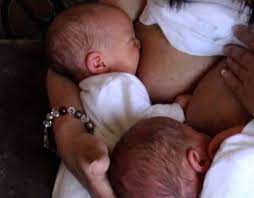
Never had any neighborhood in Cairo been so excited by a baby’s nursing. Until bedtime, the child nursed three more times at the breasts of abundance. He took hold of one nipple, little Masreya another, and the two children’s hands sometimes touched. You would have thought they were two lovers entering Paradise as they held each other’s hands.
Masreya, the Muslim girl, and Zohar, the Jewish boy, indeed grow up to become passionate lovers. Their transgressive (because incestuous) love is ultimately rooted in their kinship, the fact that they are “milk twins,” nursed at the same breasts and thus indissolubly bound.
When I first encountered it, I marveled at Nathan’s creation of such a striking symbolic image to express the deep intimacy between Muslims and Jews in pre-partition Middle Eastern and North African culture.
To my surprise, though, in the course of researching and teaching an online class on Arab-Jewish Literature last fall, I discovered that Muslim and Jewish milk twins appear again and again in both the literature and life of the region. For example, early in The Dove Flyer, Eli Amir’s expansive novel about the final days of Iraq’s Jewish community in the late 1940s, the teenage protagonist Kabi (also called Sa’id) suddenly recalls his idyllic childhood in Baghdad’s el-Mazzam neighborhood:
It had been so long ago: before the Farhud, before Zionism and the State of Israel, before the Muslims and Jews had gone crazy and stopped living peacefully together.
Specifically, Kabi remembers his friendship with his Muslim neighbor, Ismail. Born two days apart, the two boys were both their parents’ first sons,
[Ismail’s mother] Hairiyya and my mother shared nursing the two of us, “Fidwa, ya ibni, ya Id,” [I would sacrifice myself for you, my son] she would sing to me, shortening Sa’id to Id, the Arabic word for holiday.
A similar relationship plays a central role in Jessica Jiji’s Sweet Dates in Basra, also set in 1940s Iraq. One of the main characters, a Jewish boy, Omar, shares a close friendship with his Muslim neighbor, Shafiq:
[Shafiq’s] mother’s milk had run dry, but Salwa, who was nursing her own little Omar, saved Shafiq’s life … Salwa famously told Omar, ‘Make some room for your brother.’
The Jewish protagonist of Egyptian Jewish writer Jacqueline Kahanoff’s Jacob’s Ladder wonders if her sense of loyalty to the Egyptian people isn’t attributable to the fact that “her wet-nurse had been an Arab.” As her grandfather insists, “a child [takes] after the woman who gave it her milk.” And the early twentieth-century Algerian Jewish writer Elissa Rhaïs, in Le marriage de Hanifa, relates the story of a Muslim girl, born out of wedlock, fostered by a Jewish woman. She remains a Muslim, yet she celebrates Passover and Yom Kippur and lights candles on Friday evening.
It is tempting to read these recurring images of milk twins in Arab-Jewish literature as no more than a symbol, albeit a powerful one, of the profoundly intimate “brother (and sister)hood” of Jews and Muslims in the pre-partition cultures of the Middle East and North Africa.
But the image of “milk twins” is much more than a metaphor or a symbol: it represents a reality. For it seems that many Jewish and Muslim women, living side by side as they did, had in fact regularly nursed one another’s children.
Writing about the inspiration for her novel, Jiji recalls that her Iraqi Jewish father “had a Muslim best friend he referred to as a ‘brother’ because they both nursed at the same breast.” And in a recent New York Times article, the young Jewish writer Jordan Salama reports a conversation with an elderly Iraqi Muslim man in New York:
“As a baby, I nursed from my Jewish neighbor when my own mother could not give milk,” the elderly man tells Salama. “Her children were my brothers and sisters too.”
It may be difficult for us today, inured as we have become to the “Arab-Israeli conflict,” to imagine such profound, life-giving intimacy experienced as a matter-of-course, as a well-known and common fact of Middle Eastern and North African life. Nursing at the same breasts, it seems to me, is an even more resonant expression of the bond between members of the two religions than friendship or sexual love or marriage might be: for without that shared mother’s milk, the infants would die. And the intimacy of the mothers who help each others’ children to survive also speaks volumes about a now-lost physical and emotional intimacy that grew out of shared lives.
Along with a deep love for the land (often imaged as a nurturing mother), so many novels and poems by Arab-Jewish writers–from Algeria, Morocco, Tunisia, Egypt, and Iraq–offer a striking, poignant vision of formerly intertwined lives, and of women’s role in literally fostering that intertwining. One additional such image may be worth mentioning here: of the nineteenth-century Moroccan Jewish Saint Sol Hachuel, known as Suleika, revered by Muslim and Jewish women alike for her refusal to renounce her Judaism after a love affair with a Muslim man. Ruth Knafo Setton uses Suleika as an organizing figure in her haunting novel The Road to Fez.
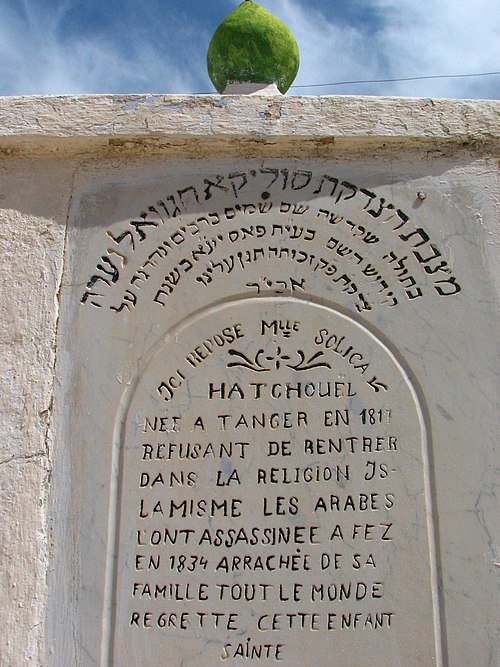 Aside from Setton’s recent version, there are multiple stories of Suleika, some insisting that she had first converted to Islam, others claiming that she never gave up her Judaism, but all concurring in the fact that she was beheaded in Fez by the Sultan in 1834. What also remains indisputable is the fact that Suleika has served as an inspiration for both Muslim and Jewish women, who still take pilgrimages to her gravesite in their quests to become pregnant. I like to imagine that the infants born after such pilgrimages will also nurse at the same Muslim/Jewish breasts.
Joyce Zonana is a writer and literary translator. Her most recent translation, Tobie Nathan’s A Land Like You, a novel about Egypt’s Jews, is available from Seagull Books. Her memoir, Dream Homes: From Cairo to Katrina, an Exile’s Journey was published by the Feminist Press. She is currently at work on a translation of Edmond Amran El Maleh’s Mille Ans, Un Jour, a novel about Arab-Jewish life in Morocco.
Discover more from Feminism and Religion
Subscribe to get the latest posts sent to your email.
 Feminism and Religion
Oh, Joyce, we will miss you. May your journey to the realms of the ancestors be swift and smooth, and may you be joyfully welcomed there by those who have gone before. May your message of peace between religions and nations flourish in these dark days. Rest in peace and power.
LikeLiked by 2 people
So moving. Rest in peace, dear Joyce.
LikeLiked by 1 person
What a sad loss for FAR and the world. Joyce was wise, compassionate, brilliant, and so creative. You will be deeply missed, Joyce, but we know that your spirit still dwells here at FAR in all the wonderful posts you gifted us. May your soul soar free.
LikeLiked by 1 person
Joyce was such a bright spirit, so much heart and wisdom, so brave with her diagnosis. Rest in peace, Joyce.
LikeLike
Fly free, dear Joyce, beautiful bridge among so many cultures.
LikeLike