

This piece was originally posted on August 14, 2014, over ten years ago; add immigrants and Latine where it reads young black men, boys, or women, and it is as if I wrote it for today.
The current U.S. regime gives us more and more to rage and grieve over every single day. It is indeed important to grieve and to give ourselves the time to really feel what is going on under our watch so that we can then move into action with more resolve and efficacy. I invite you then to read, grieve, and then take action. Every day, do at least one thing – make a call to the president, your governor, senators, and representatives; engage in mutual aid; show up to a protest – and choose not to be a bystander. Oppression is systemic, indeed, but it is also a people, it is us. The system is people and we are the system.
~~~~~~~~~
Oppression is systemic. Injustice is systemic. It pervades the whole – it seeps into everyday actions and becomes habits and patterns that function as default. As a result, the actions that fall within these patterns hardly need justifying. If anything, the questioning of them is what is put on the defensive. And those who stand against injustice must usually do so in the face of militarized policing, before vast forces that serve to preserve the status quo.
I can’t help but see the similarities between the everyday existence of young black men, of boys in this country, and that of women. The lack of safety in public places; the need to always be aware of one’s surroundings; the lack of trust in the intentions of another; living with the knowledge that people like you experience violence at much higher rates than others. It is a racist, violent, patriarchal world we live in. And, yes, it is also other things, good and beautiful things, but sometimes the hard reality of everyday life blocks out that light.
In my first semester of theology school, in my Hebrew Bible class, our professor was discussing the Book of Psalms. This biblical book includes many different kinds of poetry, but I was particularly distressed by the violent character of some of the psalms, ones that wished violence and revenge against their enemies. There are aggressively worded psalms that call for the demise of another. I remember asking my professor why this was ok. Why would there be psalms which so often function as prayers that include such language and content? He took his time in responding – I remember the moment well – and he said that the best reason he can think of is that there are times when people are in such overwhelming grief, are experiencing such crippling injustice and pain, that all they can do is cry out in anger. That the words that come forth are necessarily uncensored, they are deep groans from within the soul. It must be ok to express that – it is necessary to yell out our truths to god, to cry out to the heavens with our grief in all its rawness. He said it is a vital aspect of one’s turn toward justice and the desire for a different world.
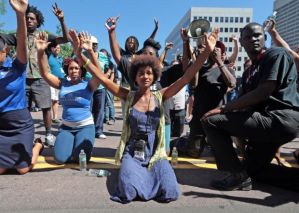
I see the pictures of the protesters in St. Louis and my heart cries out with theirs. I see the anger of the fires burning and I recognize the rage of their pain. For how many times have I not cried out in such overwhelming pain and anger because one more of my sisters was violated? How many times? So it is not hard for me to hear their cries, the cries of so many black sisters and brothers whose black sons cannot safely walk down the street.
I cannot see another act of systemic violence as an occasion for remembering the victim with “reflection and understanding.” Instead my heart cries out in lament, it recognizes that this violence is systemic and it affects us all, and the experience of it is overwhelming. So it is right to be angry, to cry out, to go to the streets.
Anger is part of the work of love. Beverly Harrison tells us that “Anger is – and it always is – a sign of some resistance in ourselves to the moral quality of the social relations in which we are immersed.” It tells us that things are not well. And, indeed, things are not well. There is a lot to be angry about. May we use our anger and direct its energy toward the work of justice and love and the social change that they call forth.
Xochitl Alvizo is a feminist Christian-identified woman with a Ph.D. in Practical Theology from Boston University School of Theology. She loves all things feminist, womanist, and decolonialista. She often finds herself on the boundary of different social and cultural contexts, and works hard to develop her voice and to hear and encourage the voice of others. Her work is inspired by the conviction that all people are inextricably connected and what we do, down to the smallest thing, matters; it makes a difference for good or for ill.
Discover more from Feminism and Religion
Subscribe to get the latest posts sent to your email.

 Feminism and Religion
“I can’t help but see the similarities between the everyday existence of young black men, of boys in this country, and that of women”.I would add Indigenous peoples especially women to that list….It is critically important to EXPRESS our anger/grief so it doesn’t turn inward – but the question remains, how to do this most effectively. This isn’t the 60’s and protesting may not be the most effective way to deal with insanity…. since violence is endemic to this culture – and one extreme will eventually constellate the other….
LikeLike