

I’ve often thought that we (in the USA) have been somewhat, albeit reluctantly, willing to discuss and perhaps even change our minds, behavior, policies, and laws when confronted about the long-lived presence of racism in our local and national institutions. However, when it comes to misogyny—not so much.
Shirley Anita Chisholm St. Hill (1924 – 2005), was an American politician who, in 1968, became the first black woman to be elected to Congress. “Chisholm represented a district centered in Bedford-Stuyvesant, Brooklyn, for seven terms from 1969 to 1983. In 1972, she became the first black candidate for a major-party nomination for President of the U.S. and the first woman to run for the Democratic Party’s presidential nomination. Throughout her career, she was known for taking ‘a resolute stand against economic, social, and political injustices’ as well as being a strong supporter of black civil rights and women’s rights” (Wikipedia).
Chisholm noted that “…she had faced much more discrimination during her New York legislative career because she was a woman than for her race” (Wikipedia). Why are not more of us aware of Chisholm’s confession?
This past Sunday I listened (via zoom) to a sermon delivered by Dr. Jim Taylor, an elder at St. Andrew’s Presbyterian Church in Austin, Texas. Jim has been a long-standing member of NOW (National Organization for Women), a feminist organization founded in 1966 that advocates for women’s rights. NOW works “to eliminate discrimination and harassment in all aspects of society, secure reproductive rights, end violence against women, and fight against racism, sexism, and homophobia…[using] grassroots activism, intersectional efforts, and a multi-issue approach” (NOW’s website).
Jim Taylor has had a 40-year-long teaching career—even taught one of Auburn University’s first courses on Black history (1970-71), bringing in Rosa Park’s attorney, Fred Gray, as a guest speaker. For his sermon last Sunday, though, he focused on women, noting that over 50% of white women voted for Trump in this past election even though many of these women confessed to being horrified by his behavior and really not liking him. When asked why they voted for him anyway, many of them replied, “Well, that’s just the way men are.” Jim Taylor attributed this response to double-consciousness.
What is double-consciousness? W.E.B. Du Bois (1868 – 1963) was an American sociologist, socialist, historian, and Pan-Africanist civil rights activist. He introduced the concept of double consciousness in his 1903 work, The Souls of Black Folk. In essence, double consciousness creates a sense of “twoness,” where individuals feel a constant tension between their own identity and how they are perceived by those who have greater status within a racially-prejudiced society. The result of this tension inevitably causes internal conflict between one’s identity and those external perceptions and expectations placed by the dominant society on individuals, often leading to internalizing negative stereotypes. Du Bois suggested that this sense of “twoness” can give one a kind of “second sight,” making it possible for individuals to view the world as well as the dominant culture more clearly than those not part of a marginalized group.
Leila Ahmed, Egyptian-American (b. 1940) author of A Border Passage, described her father similarly saying he had a “colonial consciousness.” She meant that her Egyptian father, constrained under British rule, revered all things British, thinking them to be superior to all things Egyptian. Elder Jim Taylor thought this sense of duality resulting in internalized “love of the oppressor” applies to women in patriarchy as well.
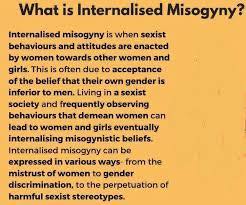
This internalized misogyny is often clear to me when I talk with women—especially those with some maturity and experience under their belt. I think the caricature of men (often seen on TV and other popular media) as being clueless, bumbling fools, and family mascots stems from men not seeing women as peers, equals, and as human as men believe themselves to be. (I’m reminded of Animal Farm, a book authored by George Orwell (1903 – 1950) containing the line, “All animals are equal, but some animals are more equal than others.”) In a misogynistic society such as ours, men don’t need to have a clue. Men are given more “equality” than women. Men’s survival and thriving doesn’t depend on understanding the perspective of the “other.”
Feminists (and feminist allies) began to make a dent in the assumption that men belong at the top, calling the shots. Notice the pushback, though, with the subsequent chaos, and weepy men who are angry because women don’t want to date them. Our present regime with its ravenous misogyny is attempting to get things back to what they consider “normal,” a place where powerful men get to be in charge. Currently, there’s a push to increase the birth rate and to defund Planned Parenthood—an organization that works with women to take charge of their reproductive health. Many women (predominantly white women) support what many consider to be a huge backward step. Why do so many women vote against their own interests? Same reason (probably) that some Black people, some queer people, and some poor people do—an internalization of the dominant culture’s desire.
The term narco-femicide sprouted from the context of feminist activism and scholarship in Mexico, specifically in response to violence against women in the country. The phrase originated as a way to address the connection among drug-related violence, organized crime, and the murder of women. Narco-femicide refers not simply to the killing of women. It uses political violence to control and assert dominance perpetrated systematically and strategically—often with the complicity of the state.
I see this scenario played out regularly in my work at a local women’s clinic. Women travel great distances to us—often fearing for their lives. Sometimes their fetus is not viable. They’re afraid the state where they reside will require them to carry a dead fetus to term, exposing them to infection, hemorrhage, and mental anguish.
Women, living in the Trump regime, seem to be an expendable commodity, and that expendability so often is facilitated by women themselves!
Discover more from Feminism and Religion
Subscribe to get the latest posts sent to your email.

 Feminism and Religion
You said it.”Our present regime with its ravenous misogyny is attempting to get things back to what they consider “normal,” a place where powerful men get to be in charge”.
Internalized hatred by women towards women is also a threat that must not be underrated….
I have just come through TWO nights of horrific BOMBING by stupid men who believe it’s just fine to blow up the neighborhood – yesterday morning not one bird was singing – all of us in shock – and this is what these assholes call ‘Fun’/
LikeLike
Thanks for reading and commenting, Sara. We women are taught early on that we are not good enough, talented enough, pretty enough, thin enough, etc., etc. We are never quite enough. Once you’re stewed into that kind of soup, it’s difficult to swim your out.
LikeLiked by 1 person
always lacking in something – it’s no wonder women struggle…
LikeLike
Than you for this insightful post. It’s hard to see straight when you’re seeing double. I suspect many of us have such trouble with our vision. Thanks for a clarifying lens.
LikeLike
I agree, Elizabeth, that many of us DO have trouble with our vision. However, once you see, you really, really see!
LikeLike
This explanation makes sense, unfortunately. It sounds like gaslighting on a societal scale.
LikeLiked by 1 person
Yes. Good way to phrase it–“gaslighting on a societal scale.”
LikeLike
You got it Ester, great article! The thing is, until about fifty years ago women could not really work, they just got to fill spots while the boys were away at war and then they were booted out when the boys returned, so in effect girls who become women have been raised with the belief, they need a man to get what they want and yeah most women see men as, the means to their survival. Look at the trad wives, talk about moving back to the fifties, it’s nuts right! I just read Ann Barings book, THE FEMININE FACE OF GOD, it is about time! She decided to wake people up to the truth before leaving the planet she claimed, it is a must read for sure!
LikeLike
Thanks, Cate, for your comment and the book recommendation. This says a lot: “…women have been raised with the belief, they need a man to get what they want and yeah most women see men as, the means to their survival. Look at the trad wives, talk about moving back to the fifties….” The social system–patriarchy–insists that men dominate and women must be grateful for men’s “protection.” It’s appalling! But, it’s where we are. Sigh….
LikeLike
We will be grateful when men stop raping women. So much for men’s “protection”, when women are afraid to walk streets alone at night. “Protecting” us from other men, what next!
LikeLike
Thank you for your post, Esther. I recently attended the (fantastic) anti-racism training called A Long Conversation, and the African American men leading it spoke about the primary thing they were encountering as not actually racism, but sexism. It is so entrenched that we don’t even see it. I have womanist colleagues who agree with Chisolm, that ultimately, sexism trumps racism. At the end of the day, no matter what ethnicity we are, men have power over women, and all power can be abused. I’m deeply grateful for the courageous, long slog work of feminism to bring these things to light and work for healing and justpeace.
LikeLike
Great Tallessyn, Thanks for your comment. When I was still teaching, I did note that many of the students were interested in discussing racism, but not when it came to misogyny. As you note, “It is so entrenched that we don’t even see it.” I’m discouraged with the current political trajectory in the U.S., though.
LikeLike