

Moderator’s Note: This piece is in co-operation with The Nasty Women Writers Project, a site dedicated to highlighting and amplifying the voices and visions of powerful women. The site was founded by sisters Theresa and Maria Dintino. To quote Theresa, “by doing this work we are expanding our own writer’s web for nourishment and support.” This was originally posted on their site on July 13, 2021. You can see more of their posts here.
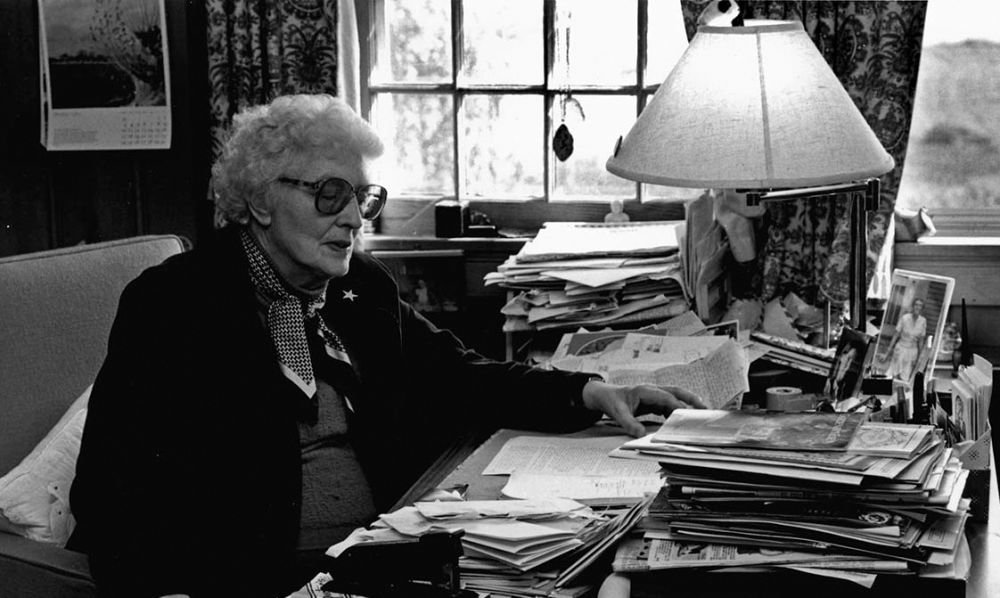
Spending summer 2021 in New Hampshire, I drive through Nelson quite often these days. Each time I do, I think of May Sarton, her years here, who she was, her art, and all she accomplished. I always glance down the road at the cemetery where she now rests.*
This post is one I wrote about May two years ago and it feels right to run it again since I feel so close to her these days. Enjoy!
May Sarton: Leaping the Waterfalls
I’d been duped. The gray-haired writer who moved to the small town of Nelson, New Hampshire in 1958 was not who I imagined. I only discovered this when I began work on this post. Far from the tranquil woman in my mind, May Sarton was an enigma, even to herself.
At forty-six, May Sarton purchased her first and only house, attempting to extract herself. In a destructive relationship, struggling to reign herself in, she sought to settle, to live where only those she wanted to see or those who really wanted to see her would visit. Plus, the dramatic move would provide fresh writing material.

May, high school graduation, Cambridge, MA 1929
She and her parents were Belgian exiles and from a young age, May lived the fullest of lives, an extreme socialite frequently traveling abroad where she had numerous and notable connections.
May passed up Vassar for theater, acting anywhere and everywhere possible, eventually starting her own theater company, both directing and acting. May thrived on this energy; she was magnetic, attractive and attracted. At the pace she moved, it’s astonishing she didn’t crash and burn early on in her glamorous life, but quite the contrary, she became remarkably prolific.
After several frenzied months, May confesses in a letter to a close friend,
“I cannot explain the desarroi [disarray] in my heart at having to change plans so often. I was really in a wild state – and instead of crying and crying I went to the other extreme. I flirted with everyone – something I never do unless I’m temporarily mad…My darling, I really have a daemon you know. And I do realize that it is this, this “genie de l’mour” as Jean Dominique calls it which is the one thing which might keep me from doing good work”(Peters 111).
And it was indeed this “genie de l’mour”, genius of love, that would constantly cause turmoil, yet provide inspiration for much of her life and craft.
May’s biographer, Margot Peters, explains,
“May confused art with healing because writing poems kept her sane. She was tormented by guilt, not because she loved women but because she spread her dragonfly affections thin – “an excess of love, giving the same thing to too many people.” She might rationalize her need to repeatedly conquer by love, but was not quite blind to the pain caused by her promiscuity”(168).

May picnicking with friends, France, late 1930s
What intense conflict follows when the endless pursuit of love both burns and soothes. The love interests who got away, not before prolonged, persistent chase, became her Muses, her avenue to art.

May lecturing, early 1940s
Although theater was a passion, at heart, May was a poet. These two desires merged marvelously later in life as May traversed the country lecturing and reading her poetry. Margot Peters reveals,
“She discovered that she was a knockout speaker. Her strong, classic beauty magnetized people. She galvanized audiences with her energy and conviction, her physical élan. Her powerful contralto voice irresistibly conveyed both authority and deep feeling. She read poetry magnificently, her own best of all”( 133).
With fifty-three books from which to choose (albeit close, this woman never crashed and burned!), for this post I read her groundbreaking novel, Mrs. Stevens Hears the Mermaids Singing (1965), revisited one of her journals, Journal of a Solitude (1973), composed when she lived in New Hampshire, and devoured the only biography available.
Mrs. Stevens Hears the Mermaids Singing is a novel involving two journalists who set out to interview an elderly writer, F. Hilary Stevens, Mrs. Stevens. Unsure what to expect from this reclusive, notable writer, they discover a complex woman still heavily battling her demons.
Mrs. Stevens, rattled by the impending interview as well, is thrown into an emotional state, a place where her younger and older-selves strive to process persistent conflict. She says to herself:
“You can’t break the mould and also be consoled for breaking it, old fool! Be realistic – every book you published must have caused them embarrassment and dismay. Yet the cry that escaped her lips, as she searched for the handkerchief in her pocket was, “Mother! Father!” Does the mourning for parents ever end? she asked herself, blowing her nose, and resting her eyes on the quiet green light in the room. Searingly, excruciatingly private, this pain, yet she suspected that it might be the universal condition. Children have to hurt their parents or die, have to break themselves off, whatever the cost, even though the wound never heals.
“Nevertheless, young Hilary reminded old Hilary, you have not after all done too badly, old thing. You did not break down like Aunt Ida; you kept going; you have worked hard, and you have made a garden, which would have pleased your mother; and once in a while you have even been able to be of some use to another human being – Mar for instance. Now pull yourself together! Make like a genius (young Hilary enjoyed using that slang) and get some armor on.”(72).
Here we spy the author May herself, an only child whose parents were often emotionally and physically distant. May expended much trying to please them without sacrificing herself, all while managing her anger and bitterness, especially toward her father. The love she held for them was great, as was her love in general, but animosity lingered too.
May’s biographer remarks, “But to May her parents never died. She saw herself as a vessel containing their divine sparks. Like George, she was selfish, vital, and persistent. Like Mabel, she was empathizing and giving. These warring impulses never let her rest”(209).
Back to the novel: during the interview, Mrs. Stevens would periodically excuse herself to process thoughts and emotions before delivering her answers, being forced to revisit and reconcile so much of life as a creator, a writer:
“Jenny and Peter exchanged a look. She was going to submerge again, clearly.
“There was so much anger, that is what was terrible. Every one of the poems in that book had to be fought through out of violence, rage. I was sick with it.” She shook her head as if she were shaking off leaves or thick fog, and it occurred to Jenny that she had never in her life seen a person in whom thought became such a total process; thinking for this woman was a physical involvement. It added to one’s sense that she moved always surrounded by invisible presences. Things unseen were as powerful in her ambiance as anything visible. It made her words about becoming the instrument of powers which one does not control believable, authentic”(160).
Mrs. Stevens ponders the unique challenges of being a woman and creative with her interviewers:
“The problem for an American woman with any real power seems to be that we are all haunted by Thurber’s cartoon of the huge threatening and devouring emanation over the house…and, alas, it comes too close to the American man’s fear of women. Do you agree?”
“They are to be stuffed if possible on top of the bookcase?” Peter laughed.
“Well, you know what I mean…Powerful women may be driven to seek the masculine in each other. The men have been frightened off.”
“Your man was not afraid, I take it?” Peter asked.
“Oh!” She laughed, “He loved women. He understood them. Besides, he was French”(173).
As the interview continues, the journalists question Mrs. Stevens about living alone, her relationship with solitude:
“There is a difference between solitude and loneliness, as I need not tell you, and people who live alone come to know them both intimately.”
“Yes,” Peter said, “but do define them each, if you can?”
“Well,” Mrs. Stevens clasped her hands together. “Loneliness is the poverty of the self; solitude is the richness of self. Will that do?”
“Thank you,” Peter said, and quickly made a note on his pad.”(183).
Continued, tomorrow.
Discover more from Feminism and Religion
Subscribe to get the latest posts sent to your email.
 Feminism and Religion