

Rhea, mother of Demeter, is coming down upon the seven mountain ranges of her Crete. Ariadne, granddaughter of Rhea, is coming up from her ten thousand perfect caverns inside those mountains with clear water in her arms. They have been quiet a long time, but they are not quiet now. Between them comes Demeter across the wide plateaus where her stones and soil are being stripped for profit, where her bees are dying from pesticide use in their hives, where her grain and oil are sold out from under her, the farmers who grew them cheated by countries with fatter economies and shinier marketing schemes.
They are gathering on Mt. Juktas and Mt. Dikti and Mt. Ida and on Papoura Hill, on all the old holy mountain places where nereids and kouretes were born, where midwives danced, and the dead were buried, and the priests and queens held night-long vigils to take divinations from the procession of the stars. From those divinations they turned the wheel of Crete’s festivals so that they continued year by year as precisely as Earth turned around her axis, so that Earth knew that she and her gifts were respectfully received, and truly loved.
The goddesses pour out cool water where there is conflagration, and they call out for their sisters, the swallows and falcons and martens, the snakes and honeybees and dolphins, and they call out for their long-lost lovers, and they call out for their sons, and they call out for their daughters. And so their sisters and lovers and daughters and sons are coming to kneel with them again, and dance with them again, and sing with them again in defiance of the greed that is trying to swallow the world.
For several years now, it has seemed to me that Crete herself is protesting the construction of the new Kasteli airport. On Google maps, it’s an enormous barren gash, right at the base of the sacred Dikti mountains. The toll on trees, soil, birds and water has been immense. The deep bedrock drilling required to create its foundations very possibly caused the strangely shallow 2021 earthquakes at Arkalochori which almost entirely leveled the village. I was staying nearby at the time, and have never experienced anything like it in my life, with aftershocks persisting for more than 24 hours almost without cease. (I wrote about it in this essay.)
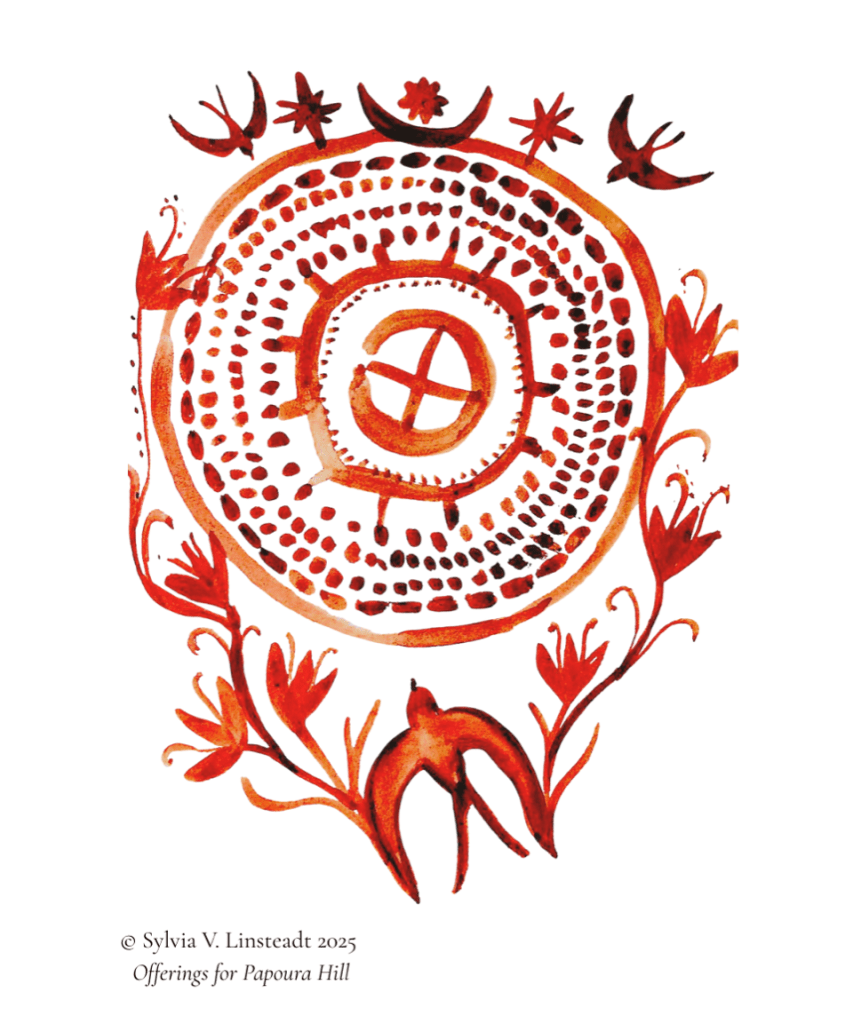
Last summer, more land-leveling on Papoura Hill to build the airport’s radio tower led to the discovery of one of the most extraordinary Minoan archaeological sites yet uncovered. My watercolor above shows you the shape of this site from a bird’s eye (swallow’s eye) view— it’s the closest to an actual Minoan-era labyrinth ever discovered on Crete, and shows clear signs of having been a communal site of ritual, feasting and offerings from around 2000 BCE. (See this piece by historian Dr. Jack Dempsey for more about the site).
Just this past week, despite protests on the island and in Athens from both ordinary citizens and archaeologists, the construction of the radio tower was given the green light. Crete revealed one of her longest-held archaeological secrets, only for it to be sacrificed on the altar of mass tourism and a bigger airport that I can promise you, most of the people I know who live and work in Crete, and are from Crete for generations, do not want.
Here, Crete said, let me show you something of unspeakable beauty, age, and holiness, so that you might think again about what you intend to build upon me. Let me show you how my people have always loved and honored me. Let me show you what Ariadne knew.
But the money behind the airport will not listen.
I am praying for a miracle, not just because of the precious Cretan heritage in the earth there at Papoura that should be honored, studied and preserved, but because of what decisions like these mean more broadly. Papoura is an emblem of all of this, to me. There are other devastating plans currently being pushed through by big German companies to fill Crete’s western and central mountain ranges with windmills and electricity pylons to produce green energy for much of Europe.
There are ten thousand reasons why the people of Crete and the mountains of Crete and the waters of Crete and the birds and animals of Crete do not want to bear the burden of Europe’s need for more electricity, even under the banner of “green energy”— but it’s not green if it decapitates whole ecosystems. We are missing the point when we think that this is the way forward. That this is virtuous energy. Maybe we can’t, after all, have everything we want, every new AI scheme and bot, every shiny new upgrade to our machines. Maybe green energy means less energy. Maybe Crete never wanted a new airport, but slower and deeper ways for foreigners to visit, and her people to be supported in their work and lives.
Every time the interests of big business win over the wild beauty of Earth, and our souls, and our souls love for this Earth and Earth’s love for us, it breaks my heart. I feel like blood has been drained from my veins. But often, for me, when I feel that breaking and that blood, my body’s immediate response is love-words. I am compelled to pour out beautiful words, like water, onto the wounded places. I have to believe that such words matter, and are heard by life itself, and every last bird, and that one day all our words and prayers and offerings will weave spells strong enough to make the businessmen go crazy, and lay down their wallets and their contracts, and run outside naked to watch the swallows arrive in spring.
Right now I can hear Crete saying, please, sing love words to me. Do not take more from me, but sing to me of how you love me. Bring vessels full of honey and wool, milk and grain, clear water and truth to all of my mountains and miraculous underground springs. If you cannot bring them physically, bring them with your words. If you do not know me, Crete says to those of you reading, bring those love gifts and love words to the place you do know and care for— to forgotten marshes or paved over burial grounds, to mountains and hills and mounds and woodland places that have made you happy. All of them are lonely for our love. Go tell them, go show them, go tell the creek that’s full of chemical run-off that you know their beauty, and remember them, and are listening. It matters. It really, really does. It matters mutually. I’m not certain about very many things, but this is one thing I know for sure.
Tomorrow, an excerpt from Sylvia Victor Linsteadt’s new novel in process.
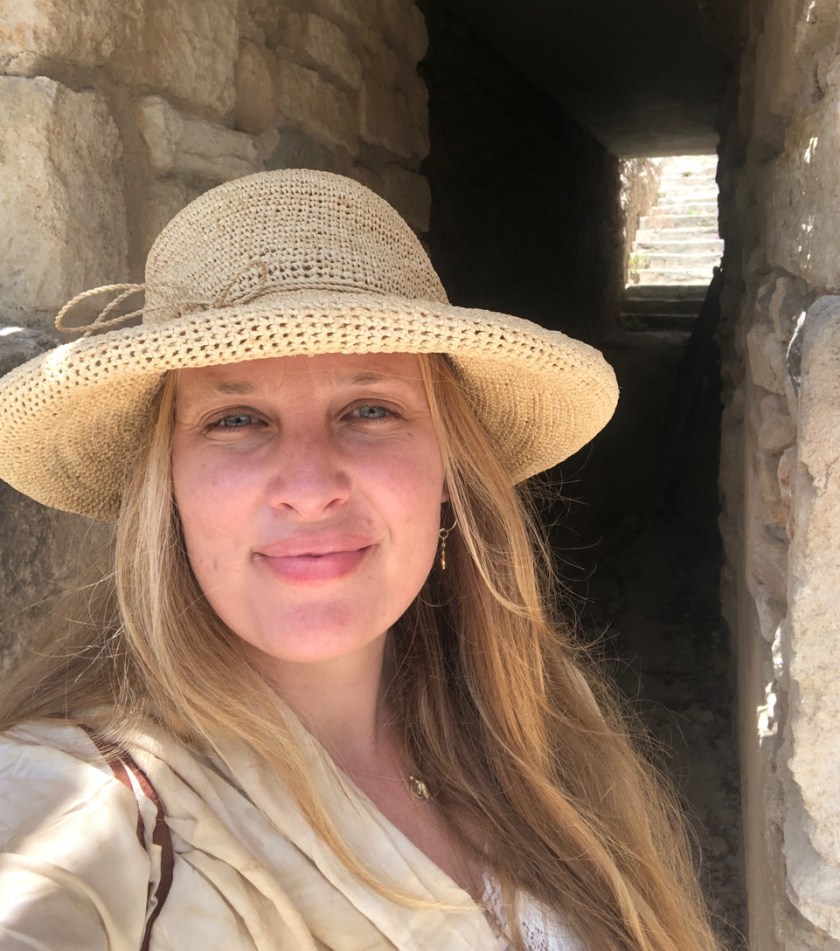
BIO: Sylvia Victor Linsteadt is an author, a scholar of ancient history and myth, and certified wildlife tracker. She studied Literary Arts and Ancient Studies at Brown University, and is a friend of the Institute of Archaeomythology in Northern California.
Sylvia’s writing—both fiction & non-fiction—is rooted in myth, ecology, feminism & bioregionalism. She has a special devotion to the history, earth, language, music and mythscapes of Crete, where she lived for most of 2018-2021 and where she continues to visit and study. Her latest collection, The Venus Year (2023) traces the beginnings of this ongoing love story in both poetry and mythic prose.
Her other books include the short story collection Our Lady of the Dark Country (2018), two novels for young readers, The Wild Folk and The Wild Folk Rising (Usborne, 2018 and 2019), and the folkloric novel Tatterdemalion (Unbound 2017), with painter Rima Staines. Her works of nonfiction include the award-winning Lost Worlds of the San Francisco Bay Area (Heyday, Spring 2017), Wonderments of the East Bay (Heyday, 2015), as well as numerous essays. She is currently working on a forthcoming title for September/Duckworth, to be published in summer of 2026.
Sylvia is also the creator and course leader of When Women Were the Land (link: https://advaya.life/teachers/sylvia-v-linsteadt), a seven-part lecture series through Advaya exploring the pre-patriarchal lineages and mythologies of Europe, inspired by the work of Lithuanian archaeologist Marija Gimbutas.
Discover more from Feminism and Religion
Subscribe to get the latest posts sent to your email.
 Feminism and Religion
These beautiful words are a love poem to Crete in themselves. Thank you so much.
LikeLike
Thank you Annelinde! That’s lovely to read.
LikeLike
“I am compelled to pour out beautiful words, like water, onto the wounded places. I have to believe that such words matter, and are heard by life itself” So true. Thank you for these words.
LikeLike
You are so welcome, thank you for reading! xo
LikeLike
Trying again to post this—-Thank You so much, my dear friend Sylvia, for such a beautiful work of art (I think it’s the first I’ve seen in Papoura Hill’s honor!) and for such powerful thoughts and words about the needless and criminal intrusion of the Kastelli airport project and its depredations against the landscape of Minoa Pediada. Short of direct brute action to protect this sacred place I don’t know what can be more important than lighting up people’s minds and hearts about it—as you have done here!
LikeLike
Wonderful to receive your message here my friend! Thank you so much, and thank you for your writing about Papoura that first led me to know about this deeply important site. Standing together with you xx
LikeLike
Sylvia! How lovely to see your gorgeous writing here on this wonderful blog. I know your relationship with Crete is deep and complex. Thank you for sharing it with us! xo
LikeLike
How nice to see you here too Diane! Thank you for your lovely words.
LikeLike
This is incredibly beautiful and so very moving. I couldn’t help but tear up as I reached the end. As a Cretan Greek with great love for this island, I appreciate your loving, healing words. :)
LikeLike