

Sylvia’s discussion of Papoura Hill was posted yesterday; read it here.
I have so many words I want to pour out of my vessel of milk and honey upon Papoura Hill, on the big scar in Crete’s earth where the airport is being carved, on all the places slated for the construction of electricity pylons, and into so many other scars left by millennia of conquest and occupation, but for today what follows is just one song to her. These words are not full of fighting rage or defiance, but of praise, and softness, and memory. Of motherlines that cannot die, and fatherlines almost lost, but not quite. These words come from the beginning of a novel that I began writing during my first season living in Crete almost seven years ago now, a novel that has metamorphosed with me across these many years, shedding skins and growing new ones— both me, and the novel. The book is still in process, close to being born, but here is one of her many skins, laid at the center of the labyrinth on Papoura Hill with my love.
Moonrise Over Old Crete
an excerpt
The earth tilted toward dusk.
Along the shores of Crete, the Aegean turned for a moment to gold.
Women flocked down to the sea like dark birds to pour jugs of oil and wine into the water. Amphitrite of the cockle crown, they murmured, Aphrodite mother of vessels, mother of the foam and deep, bring our men home safe. The sun lowered under the edge of the world, leaving the last light along the coast. Threads of it pooled in sea-caves and in the inlets where fishermen kept their summer boats. The old storytellers said that in lost times, when the queen was called the Ariadne and her king the Bull, the women of Crete could gather up the last light from the sea onto their distaffs and take it home to spin golden thread for their skirt hems and finest vests.
That was when the old language was still spoken, and letters had come only recently from the birdskin bag of Hermes to human beings. That was the time when a word spoken in the secret way could bring milk from a mountain stone, or seed to a barren man, blossom to the olive grove after an unseasonable south wind, flight to a hunting falcon’s broken wing. No one knew all the letters now, and those that were still known were not wholly understood, even among the most secluded of the old motherlines still unbroken from the time of the Ariadnes. They were few now— at Praisos in the east, high up Dikte above the Lasithi Plateau, and west at Eleutherna in the foothills of Mt. Ida— and they had only a handful of the letters still alive among them.
So the threads of sun stayed simply ripples on the darkening sea, and the islands of the Aegean settled, exhaling like a herd called in at dusk by the shepherd’s pipe. Fishermen came to shore with the day’s catch shining in their nets. The women finished their prayers, putting the first of the late winter petals— anemone, narcissus, iris— where the oil and wine had been poured, beseeching the sea to be petal-calm, gentle as rosewater. Bring him home safe, Mother, bring him home.
Meanwhile, the moon was rising over Anatolia. It touched the great plains of Thrace where Orpheus’s songs still moved like horses across snow. It touched all the smaller islands one by one, from Samothrace to Lesbos, Ikaria to Andros, the volcanic crater of Thera to the barren outer rocks of Crete: Dia where Ariadne once waited for Theseus but met her Dionysos instead; the Dionysades where women became nymphs to dance for him among the stones, and the falcons from Africa nested in spring.
At Knossos, the stone walls and thresholds of the great temple-palace, buried now on the hill above a newer city, thrilled under the moon’s touch. It ran like milk through the ground, waking old alignments laid a thousand years before, when the place was a living calendar and the seasons rose and set with the moon and stars through its doors, closely observed by priestesses and priests. The old Neolithic baetyl stones at Knossos and Malia, at Gournia, Mochlos and Palaikastro, at Zakros and Phaistos rang softly for just a moment, like embers blown briefly to light.
They were remembering when Crete was woven whole by the lines that ran from stone to stone and mountain to mountain, laid along the hidden paths of underground streams where Tethys grandmother of the waters ruled. Women, led by their queens, once danced those lines across the island at the end of winter—the women called Amnisades from the region of the river Amnisos, the Dionysades from the eastern coves, the Meliai from Mt. Ida, the Thyiades from the pines of Dikti, all waking the winter god to green in their own corner of Crete. It was said that such a woman could call the bough of a fruit tree down to touch the earth with a single word from the old language during the ritual of the dance.
But the language and the traditions of the stones had fallen when the great old houses of the queens of Crete fell to the warrior-kings from Mycenae, who fell to famine, and to fiercer Dorian warlords. With each fall, more was lost. Now, old words survived only in pockets, in the places where no one paid much heed anymore—in the weaving rooms of women, in their lullabies, out under the olives where they gathered the black fruits by hand into nets, by the hearth and the clay cooking pots, in birthing chambers where the great midwife Eileithyia was still invoked with sweet burning juniper and rockrose resin, in midnight corridors where breastfeeding mothers paced, by the beds of the dying and the newly dead.
Rising higher in the dusk light, the moon came to Crete’s tallest peak, snowy Ida, beholding the island from above the clouds as no human would do for thousands of years yet, and then only briefly: how it soared up from the sea, mountain after mountain, horned and knife-sharp, and yet with the promise of endless water in the spring thaws, and bee-filled thyme in summer, plains full of fruit trees, dittany blooming on cliff edges.
“I make a garden for you,” sang a woman on a high ridge above the city of Eleutherna, in Ida’s foothills. Her black hair was tied up in a saffron cloth. Still much of it fell down her back, shining. “A garden I make for you in my heart.”
She sang for the daughter in her womb who was yet unborn, and for her husband to return from a mainland war. One hand rested on the great mound of her belly. She felt her child wriggle and kick. Heavy gold amulets pressed into her breast beneath winter furs, warming her with their weight. They were the amulets of her lineage, which all the women of her motherline had worn before her since the time of the Ariadnes.
Behind her Ida glowed with snow. Before her was the now darkening sea, just visible beyond sweeping plains of olive and fruit trees and low oak woodland. Below her to the east down a steep footpath, lamps of Eleutherna were being lit in windows, the fires stirred. Down another footpath to the west, through orchards where the trees were still bare, the dead slept in a necropolis of many generations. All of her grandmothers and grandfathers. Sheep moved somewhere out of sight far below. She could hear the copper bells at their necks tolling.
“Little fish,” she murmured to her daughter, smiling at the kicks. “Little fish, shall we go down to the sea with your father come summer to swim? He’ll carry you on his back, and you will hear the cicadas singing for the first time, like they were heard at the beginning of the world.”
For a moment, despite everything she could not know and everything she could not control, she felt peace, entire, settle over her body.
The moon swung on, casting a growing pearlescence across the Libyan Sea. The glow moved south over the camel hair tents of Berber kings and then east along the Nile’s green and silt, over the lands of turquoise and gold and Taweret’s prophylactic face.
For a moment, the mountains of Crete remembered the coastline of Africa, how they’d lain there in another eon, an eon from which only birds remained, bringing word back and forth as between lovers.
The island sighed. Fires in the hearths across the mountains and down the coasts flickered. Women stopped over their cooking pots, remembering what it felt like to fall in love for the first time. I remember you, I remember you, I remember you.
Then the fires settled. The women took back up their cooking spoons. Moonlight deepened outside.
The night went on, and the stars came out one by one.
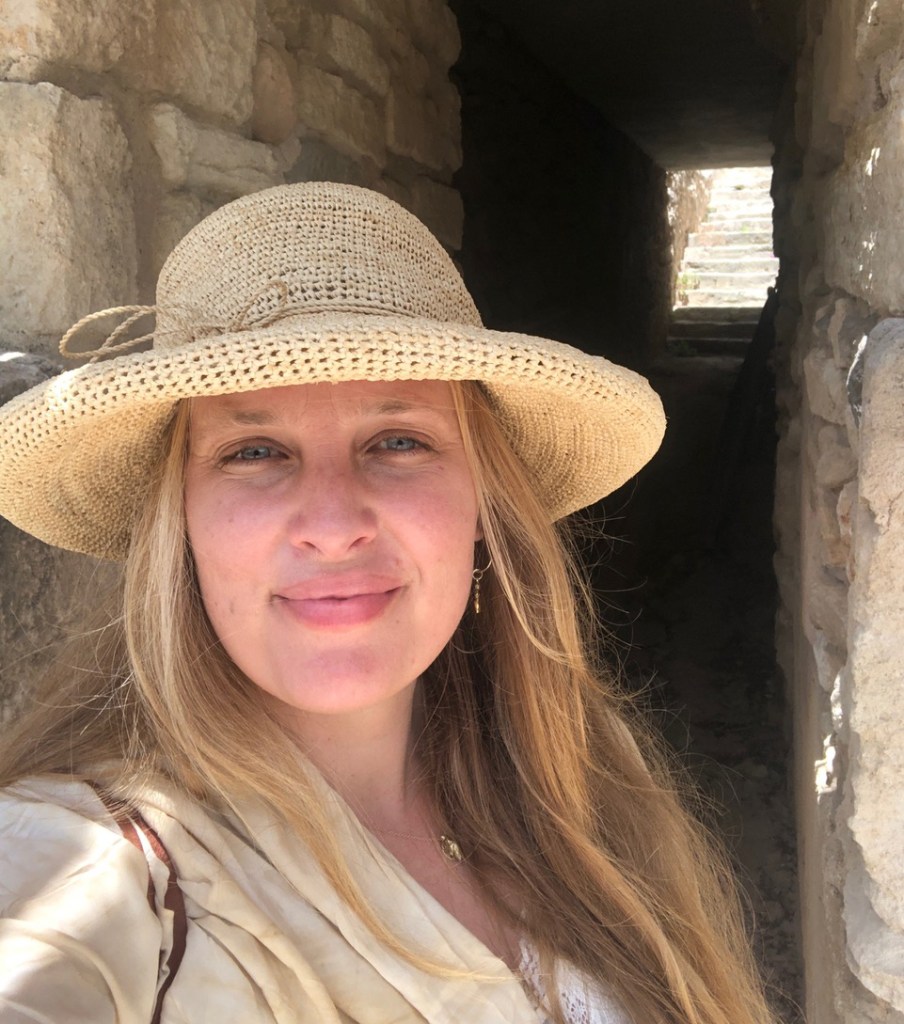
BIO: Sylvia Victor Linsteadt is an author, a scholar of ancient history and myth, and certified wildlife tracker. She studied Literary Arts and Ancient Studies at Brown University, and is a friend of the Institute of Archaeomythology in Northern California.
Sylvia’s writing—both fiction & non-fiction—is rooted in myth, ecology, feminism & bioregionalism. She has a special devotion to the history, earth, language, music and mythscapes of Crete, where she lived for most of 2018-2021 and where she continues to visit and study. Her latest collection, The Venus Year (2023) traces the beginnings of this ongoing love story in both poetry and mythic prose.
Her other books include the short story collection Our Lady of the Dark Country (2018), two novels for young readers, The Wild Folk and The Wild Folk Rising (Usborne, 2018 and 2019), and the folkloric novel Tatterdemalion (Unbound 2017), with painter Rima Staines. Her works of nonfiction include the award-winning Lost Worlds of the San Francisco Bay Area (Heyday, Spring 2017), Wonderments of the East Bay (Heyday, 2015), as well as numerous essays. She is currently working on a forthcoming title for September/Duckworth, to be published in summer of 2026.
Sylvia is also the creator and course leader of When Women Were the Land (link: https://advaya.life/teachers/sylvia-v-linsteadt), a seven-part lecture series through Advaya exploring the pre-patriarchal lineages and mythologies of Europe, inspired by the work of Lithuanian archaeologist Marija Gimbutas.
Discover more from Feminism and Religion
Subscribe to get the latest posts sent to your email.


e gain clarity and perspective. Thank you for the invaluable guidance!
LikeLike
Absolutely gorgeous! Thank you for this textual, evocative offering.
LikeLike
Oh, I can’t wait to keep reading! xo
LikeLike