

Mermaids have captivated our imaginations worldwide for thousands of years. Across cultures, mermaids are depicted in differing ways—as a dangerous seductresses like the Greek sirens, or as one who could grant immortality like the Japanese ningyo.
Celtic Ireland, with its abundance of fairies and magical beings has its own kind of mermaid, the Merrow. This term derives from the Gaelic word, “murúch,” which translates as “sea maiden.”
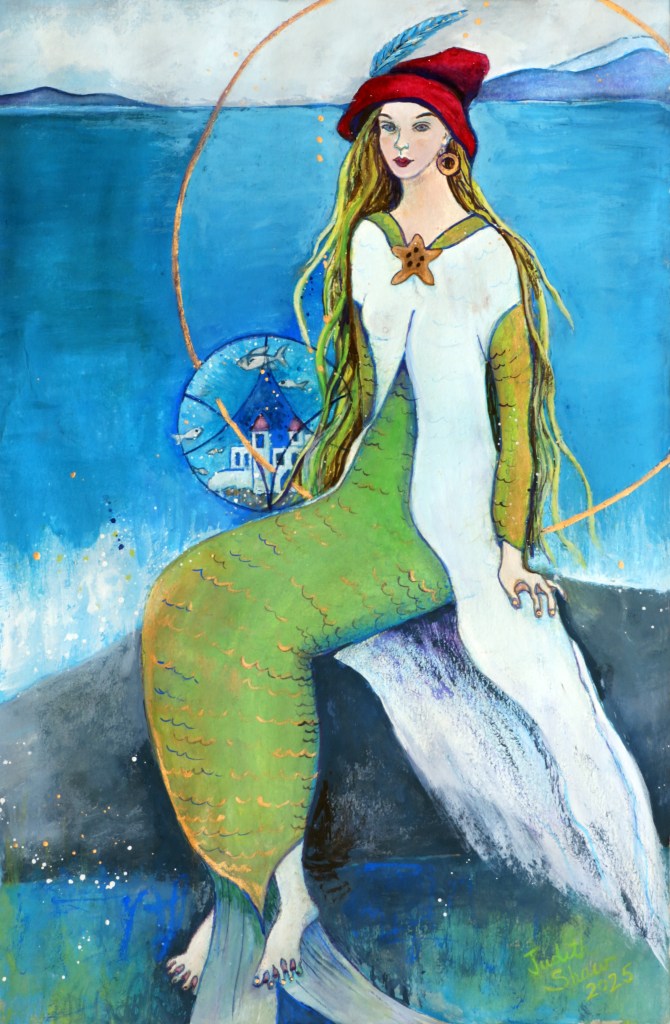
Merrows, considered mystical sea beings with human and fish characteristics, are unique both in appearance and in character. It is said that they reside in the Otherworld, Tír fo Thuinn, the Land Beneath the Waves. There are many Otherworlds in Celtic mythology, which all connect the people with the natural world, sacred beliefs and the ancestors. Water is one of the gateways to the Otherworld.
The original legends depicted a Merrow as a beautiful, slender, graceful woman with webbed toes and fingers for better swimming. Envisioned with pale white skin as a result of living underwater, the Merrows have long, green, seaweed-like hair and usually wear a green or blue dress made of fish scales or seaweed. After the legends were put in written form, Merrows were often depicted with a fish tale.
But, whether seen with a fishtail or webbed toes, a Merrow always has her magical red cap, called a “cohuleen druith,” which allows her to travel between the deep water and dry land. The red cap is seen throughout Celtic mythology as a magical tool with transformative powers, facilitating personal growth, change and new beginnings. If this magical cap was taken from her, then she was stranded on land, no longer able to grow and change with life .
Merrows are credited with a wide variety of talents. Often associated with good fortune, they can control the weather and the tides. They are often sweet and loving, granting wishes to those who treat them kindly. But if mistreated or if the sea is dishonored, then Merrows can be vengeful and seek retribution.
The Merrows are believed to have healing powers. Their enchanting melodies can calm the mind, soothe turbulent waters and capture the heart. Merrow tales allude to the beauty, mystery and dangers of the sea. Their songs evoke a sense of yearning for the wild, boundless depths of the sea.
With their mystical beauty and ability to bring good fortune, men often coveted Merrows as wives. Additionally they were believed to be wealthy beyond imagination, with underwater palaces filled with splendid treasures from shipwrecks. When a man married a Merrow he also gained access to her sea treasures.
It was widely known that without her red cap she could not return to her home under the sea. When she was spotted on the shore, a man would steal her cap, leaving her stranded on dry land. Then he would offer her protection as his wife. With no way to survive on land, she agreed.
Sometimes it’s the Merrow who first falls in love. One legend tells of Benowen, a Merrow who fell in love with a fisherman and chose to live on land with him. But even though it was her choice, her need for the sea proved too strong. Eventually she returned to her deep water home, leaving her fisherman behind, heartbroken.
The Merrows, with their enchanting songs, enthralled men, drawing them irresistibly to the sea. Some might be seeking vengeance for a wrongdoing, in which case he would find himself in the embrace of death at the bottom of the sea. But most often, the man is entranced to love and follow the Merrow, who wanted a human husband to live with her in her underwater home.
The many legends of Merrow relationships with humans are often bittersweet, revealing their dual nature. Though she might come to love the man and children born of their union, she could never lose her longing for the sea. Ultimately she finds her red cap and without regret, returns to her wild home under the sea.
Merrow tales reveal our eternal longing for the sea, the original source of all life on land. They explore themes of love, sacrifice, transformation and our enduring connection to the natural world,
Merrow men are described as ugly and ferocious. There aren’t many tales of Merrow men, though when mentioned they are generally viewed as a dangerous foe. It was commonly believed that Merrow women preferred human men because their own men were so ugly and dangerous.
Some legends depict Merrows as guardians of the sea and protectors of both the many sea creatures and fishermen. One tales tells of a Merrow whose haunting melody rescued a sailor from a wrathful storm. Enchanted, he followed her song through the pounding waves. When dawn came, instead of being drown beneath the waves, he found himself washed up on the shores of his home, saved by the loving embrace of the Merrow’s song.
The sea gives life and it takes it away. The Merrow is the embodiment of this duality, appearing as both a protector and a threat, as a lover and a predator. These tales illustrate the Celtic worldview—one which does not seek to tame nature but instead respects, reveres and also fears the mysteries of the natural world.
The Merrow/human relationship also reveals our complex and dual nature—the drive for civilizing comfort and the longing to return to the wild state from which we emerged.
The Merrow represents the liminal space we find ourselves in during times of change. She can be found in the waves that wash over the shore only to then recede back to the depths. As an intermediary between the mundane, everyday world and the Otherworld of the divine, she symbolizes transformation, the lure of the unknown, and the danger of temptation. The Merrow serves as a reminder of the untamable nature of the sea—a potent warning in our time of climate change.
Next time you find yourself on the seashore, feel the pull of the depths; squint your eyes, and you just might see a Merrow beckoning you to embrace the transformation we so desperately need.
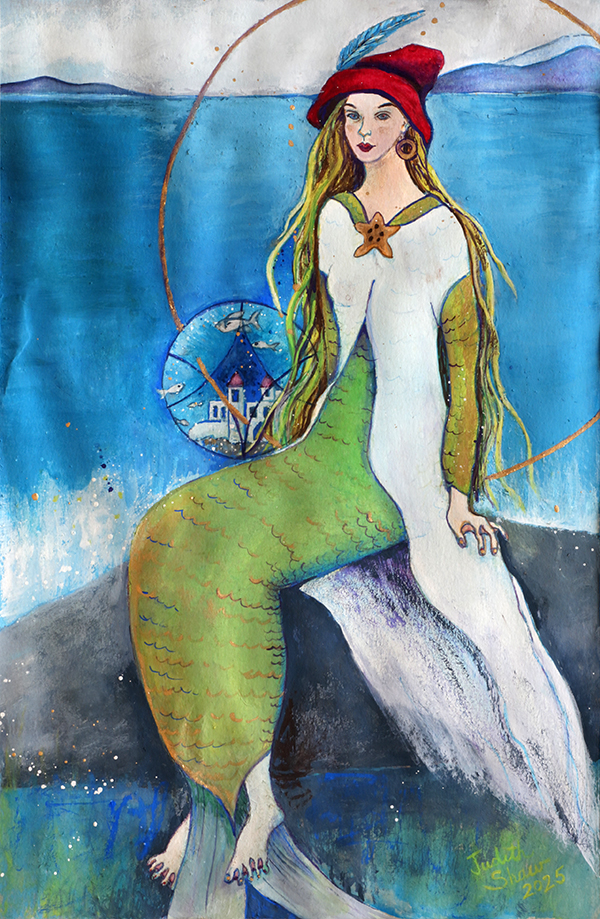
A Merrow Longs for the Sea by Judith Shaw, gouache on paper, 12″x18″
I am excited to announce my newest offering:
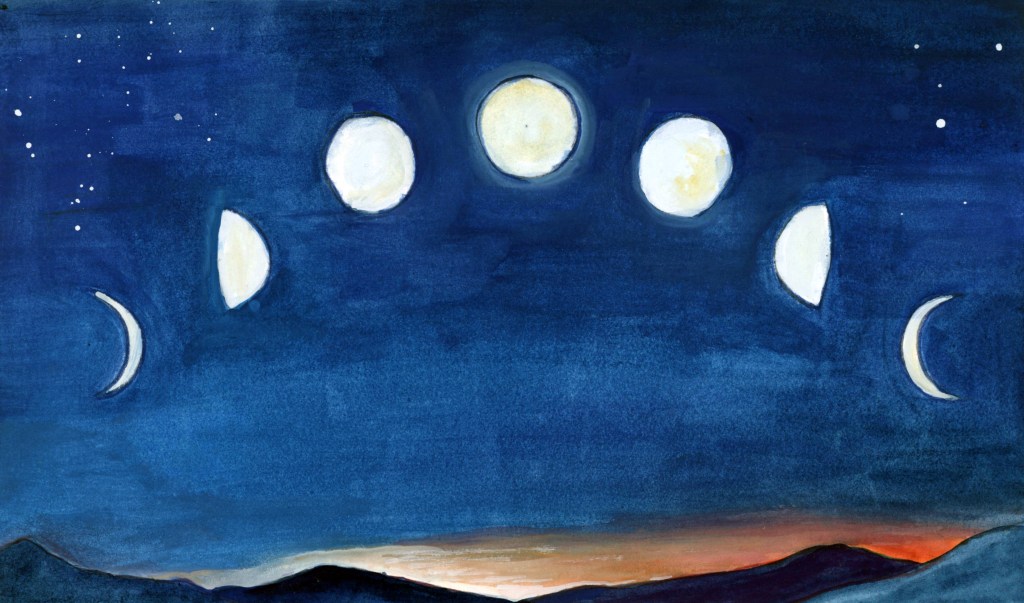
Join the Women’s Creativity Moon Circle!
Embark on a transformative journey of
creativity and connection with our
Women’s Creativity Moon Circle, starting with the New Moon on Friday, August 22, 2025, and continuing through the Full Moon on Sunday, February 1, 2026. Whether you choose to join us for one moon cycle or commit to the entire six-month lunar experience, this is your opportunity to explore your creative potential in a supportive community of women, while working with the cycles of the moon.
Click here for more info and to sign up.
View Judith’s art on her website. Click here.
Find Judith’s Celtic Goddess Oracle deck on her website. Click here.
Discover more from Feminism and Religion
Subscribe to get the latest posts sent to your email.

 Feminism and Religion
Interesting story – not family with this version – but this goddess supports all animals…
LikeLiked by 1 person
Thank you Judith as always for your exquisite paintings and well-researched mythology – a timeless piece for referencing shapeshifting sea-land-creatures! I love the red cap, hadn’t come across that before! I’ll certainly return to this essay over and over again…
LikeLiked by 1 person
Eline, Yeah you have to be looking deeply into mermaids to find reference to the Merrows, unlike Selkies who are pretty well known. There are of course lots of parallels between Selkies and Merrows, but I find it interesting that the Merrows are always women, just magical women with powers of transformation. allowing them to live under the sea with all the other sea creature. But the stories of love and loss and so very similar…
LikeLiked by 1 person
Beautiful, Judith! I had known about Selkies but not about Merrows. I am glad to know that the stories include invitations to their lovers to join them in the sea, even if they are not as adaptable as the sea maidens. Gorgeous painting as always!
LikeLike
Thanks Elizabeth,
Merrows are not well known and I too was happy to discover them as I continue along with my fascination with the Sea, Mermaids and Sea Goddesses
LikeLike
A fascinating, magical post, thank you. It surprised me how similar some of the story is to the Selke. A difference is there is no mention of vengeance from the Selke, just the heartbreaking return to the sea. I encountered the broken-hearted mermaid appeared in the tale by Hans Christian Andersen early on. Then heard of the sirens in the greek myths and their luring men to their deaths. Emotional intensity in general seems to be the province of the Mermaid, still, such an alluring, enduring, romantic image.
LikeLike
Shelli,
There are a lot of similarities between Merrows and Selies for sure. Originally I pointed that out in my article but that part got edited out due to length. My understanding of the Merrows is that they might seek vengence, but only if mistreated or if the sea is dishonored. I don’t think there are stories in which they seek vengence against the man who was their human husband.
It’s interesting that the male Merrow is very different from the male Selkie. There are not many stories of the males of either creatures.
Male Selkies are very handsome and seduce dissatisfied wives into love affairs. But they are only visiting lovers, maintaining their home underwater. It is believed the woman can call her selkie lover by shedding seven tears into the sea.
But the male Merrow seems to be depicted as a terrifying foe, too scary for even the female Merrows to deal with.
Your comment “Emotional intensity in general seems to be the province of the Mermaid,” rings very true for me, especially as emotions are symbolically associated with the sea.
LikeLike
Thank you for your reply and more interesting information. I was inspired by a Muse who was a Druid Priestess in lat 5th Century Wales. She wanted to convey her life story (a trilogy as it turned out!) as of course, the Priestess was portrayed in such negative ways in the Arthur legends. And I was surprised at what I was told, and one of the surprises was during her training in the elements. Apart from the head Priestess, her teacher for water was a male Selke. He told their story and why they mate with humans. There is an exchange of benefits but one can easliy see why the love of a Selke brings such heartbreak. Decades before the book I was receiving a few Bardic poems and one was about a man’s love for a Selke. When I was doing performance poetry, men asked for this one. I guess it rings for men who’ve loved and lost at some point in their lives.
Again, thank you so much for this post and reply.
LikeLike
The trilogy you mention sounds really interesting. What’s its title, as I am called to read it.
Yes the love of a Selkie or a Merrow is likely to bring heartbreak as that which is wild can only be tamed for so long or it withers and dies. That’s very interesting that men requested your poems about a man’s love for a Selkie. You’re probably right that it touched them because of having loved and lost in their own lives. I also think that we are so drawn to these stories because something inside of us longs for the wild we were part of before civilization came along and brought us all its comforts.
Apparently there is a big resurgence in interest in mermaids these days. Maybe as the world breaks down around us, we are all longing for a return to a more natural way of living.
LikeLiked by 1 person
I totally agree.
And thank you for your interest. It’s on Amazon. The Revealing the Druid Legacy series. Book One is The Last Priestess Book Two is Priestess of the Realms and Book Three is Priestess of the Prophecy. It’s self-published because the agent I had decided to pitch it as a romance novel and wanted me to take out all the teaching. I couldn’t do that…it’s a big part of why it’s been written. There is an Author Note at the back of the book that you might like to read before you begin so you will know how this came to be.
I’ll be happy to hear your thoughts.
LikeLike