

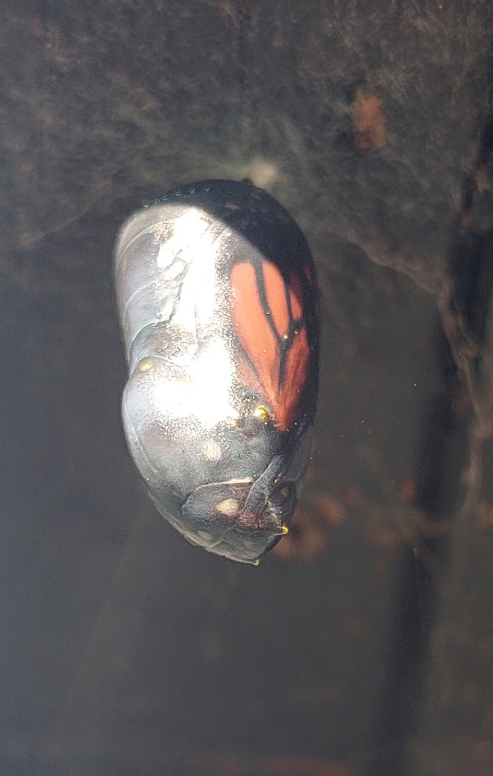
When my ‘good neighbor’ sent me the photo yesterday morning I could see the outlines of the butterfly, so my little dog Coal and I walked up to see for ourselves. It was hot – very hot though only around 9:30 AM. The capsule was already twisted and turning though not even the lightest breeze was in evidence. The outlines of the monarch were clearly etched through the now blackened but still translucent chrysalis.
Standing under the porch overhang that the caterpillar had chosen for transforming, a miracle was in progress. Before our eyes the capsule split as the butterfly emerged head-first, feelers extended and waving from the bottom of a rapidly shrinking chrysalis that had so recently been lime green tipped in gold. The wings were still quite small, but the butterfly was already pumping fluid into them readying for first flight. As the wings expanded before our eyes I cried out like a child exclaiming in my joy and excitement – “oh a miracle, a miracle”, and of course it was, the birthing of new life.
Now she* was drying her wings and had become motionless. Such a bittersweet late summer sienna or burnt umber brightening to flaming orange. This is the intrepid monarch that will hopefully make the arduous trip to the mountains of Mexico for the winter to journey north to lay the first eggs before dying in the spring. The only monarch that lives approximately nine months. Completing the Circle of Life. Oh, how we wish her safe journey to Mexico and beyond.
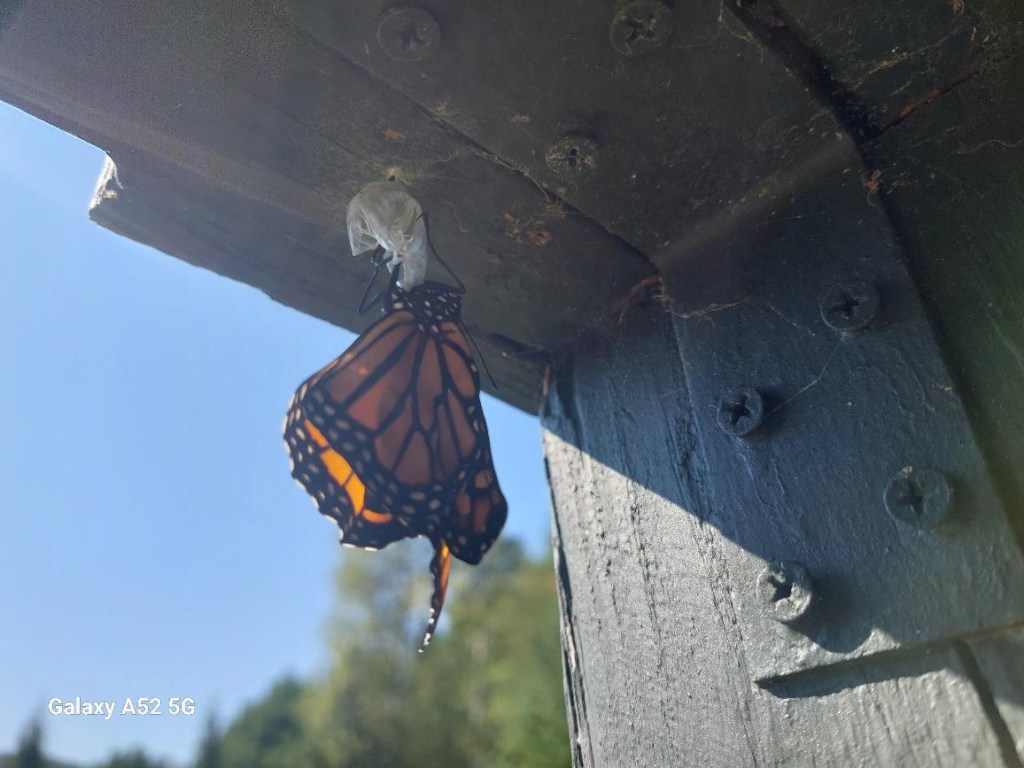
I have witnessed this miraculous ‘becoming’ throughout my life having watched many monarchs make this transition but yesterday was spectacular for another reason.
My sixty nine year old friend had never seen this process before – and her wonder and disbelief matched my own filling my heart with even more joy (yes, I still feel a sense of disbelief/wonder at every butterfly emergence I have been privileged to witness). Sharing this birthing with my friend will stay with me forever…
When Coal and I finally left the monarch was hanging motionless under the searing heat of the sun star. I calculated when I would return for first flight.
Observing nature’s processes throughout my life I had learned that it takes a while for the butterfly to finish pumping fluid into her wings. During this period, she remains motionless upside down, allowing her wings to dry.
But not this time!
Just after I left my friend went into the house for a moment and when she returned the butterfly was gone!
Wow! Immediately I thought about the intense heat. Insects are cold-blooded and can’t take either too much heat or cold and my guess is that Nature had speeded up the process of emergence so the butterfly wouldn’t be harmed.
One more lesson for the resilience of Nature in dire extremes: Supremely adaptable, these insects are intelligent and know just what to do to maximize chances for their survival. Literally, wisdom lies in butterfly intelligence, DNA, and the Butterfly Field that surrounds and informs each species.
The story began a couple of weeks ago when I discovered a caterpillar on good neighbors’ milkweed, the only one I have seen this summer, despite the fact that I have a field full of these plants. When I showed the creature to my friend’s grandchild, she discovered another tiny caterpillar working on a different plant leaf…
We all have been keeping watch ever since. At first the caterpillar was predictably munching away every day increasing in girth and length and then suddenly, disappearance.
By this time ki* had grown a whole lot. I assumed that this gorgeous black, yellow and white banded creature had decided to pupate. Where? Only the caterpillar knows where to go. We had no idea.
Meanwhile, the baby disappeared almost immediately. A week or two passed and then my friend discovered another medium sized caterpillar on the same milkweed. I had taken enough pictures to recognize that this one was not the original caterpillar but a second one who was much smaller. The infant?
When my friend’s daughter discovered the bright green capsule under their overhanging porch we wondered if it was the original caterpillar we had been watching from the beginning. I’ll repeat, only the insects know just where the best places are to pupate, one reason is it critical not to try to move any chrysalis you find.
Just after the newly hatched monarch flew away my friend saw another It must be said that none of us have seen more than a few. Monarchs all summer.
As of yesterday, no sign of the second caterpillar so who knows where that one will end up pupating if ki hasn’t already. Of course, birds, wasps ants etc – too many predators to name – could have eaten that caterpillar for dinner. We did see a tussock moth munching down the milkweed leaves on the milkweed where the others were seen, but this fuzzy orange character is part of the milkweed ecosystem who feasts on the same plant.
We know so little about the mysteries of our intelligent, interconnected web of life. In my opinion our job as humans is to leave butterflies and all other wild creatures alone.
Becoming an Observer, allowing nature to teach us is the way to develop relationship and intimacy with all our non – human relatives – one by one (We even share 20 to 40 percent of our DNA with these insects). Learning from nature is a joy that will sustain a person throughout her lifetime. This has been the way I have lived my life, and it has served me well as a naturalist, ecologist, ethologist.
One stark truth is that Nature routinely demonstrates her willingness to communicate through actions and is only too pleased to converse with those who indicate their curiosity or others like me that simply love her…
*I say ‘she’ but actually have no idea if this monarch was male or female – the primary difference between the two is that the male has a spot on ki’s hindwing and I never thought to look.
* Distinguished author, speaker, activist, scientist and Native Elder Robin Wall Kimmerer coined the word ki to personalize what otherwise would be an ‘it’ in nature. English automatically ‘its’ any species other than our own effectively separating humans from non -human species. Like Kimmerer I ask – would you describe an encounter with another person as an it? Here is an example: I remember my grandmother; it was old and wise? (Butterflies are no more of an it than humans are).
Postscript: It wasn’t until I finished this story that I realized that women made up every facet of this birthing story from beginning to end. I also thought about the ceremonial Butterfly Dance that the Hopi and Cree do to celebrate the Harvest. The women become butterflies, and some seem to spread their wings as they dance with their shawls. These Indigenous peoples are honoring not just the Harvest but the precious pollinators that support the web of life.
Discover more from Feminism and Religion
Subscribe to get the latest posts sent to your email.


thanks for reminding me as i sit watching the unfolding of this new day that i re-emerge each morning, stunned but determined to do my worship to the sun, feet on the earth.
LikeLiked by 1 person
Thank you for sharing this miracle, Sara! I feel closer to seeing what I have never yet seen, though milkweed is abundant, and I do see monarch butterflies in many wild meadows. What a beautiful witness!
LikeLiked by 1 person
Thanks Elizabeth – this is the kind of joy that has no parallel – we have had so few butterflies this summer that I am deeply concerned – hoping it’s the dryness dominating
LikeLiked by 1 person
More and more do I read about humanity being so divorced from nature. I didn’t know we shared DNA with butterflies!
LikeLiked by 1 person
This really is a miracle of Nature and Evolution
LikeLike
When we take the time and learn to observe, there is no end of wisdom being shared by the many different players that make up nature.
LikeLiked by 1 person