


This post was originally published on March 10th, 2014.
In recent years monotheism has been attacked as a “totalizing discourse” that justifies the domination of others in the name of a universal truth. In addition, from the Bible to the present day some have used their own definitions of “exclusive monotheism” to disparage the religions of others. Moreover, feminists have come to recognize that monotheism as we know it has been a “male monotheism” that for the most part excludes female symbols and metaphors for God. With all of this going against monotheism, who would want to affirm it?
In response to some or all of the above critiques, many modern pagans define themselves as polytheists, affirming at minimum, the Goddess and the God, and at maximum a vast pantheon of individual deities, both female and male, from a single culture or from many, including divinities with animal characteristics. Other pagans define themselves as animists, affirming a plurality of spirits in the natural world. A group of Christian feminists have argued that the Christian Trinity, the notion of God Three-in-One, provides a multiple and relational understanding of divinity.
While also rejecting exclusive monotheism and male monotheism, Jewish poet, ritualist, and theologian Marcia Falk provided a definition of inclusive monotheism that I find compelling.
Monotheism means that, with all our differences, I am more like you than unlike you. It means that we all share the same source, and that one principle of justice must govern us equally. . . It would seem, then, that the authentic expression of an authentic monotheism is not a singularity of image, but an embracing unity of a multiplicity of images, as many as are needed to express the diversity of our individual lives.*
The notion that there is a unity underlying the multiplicity of life in the universe appeals to me.
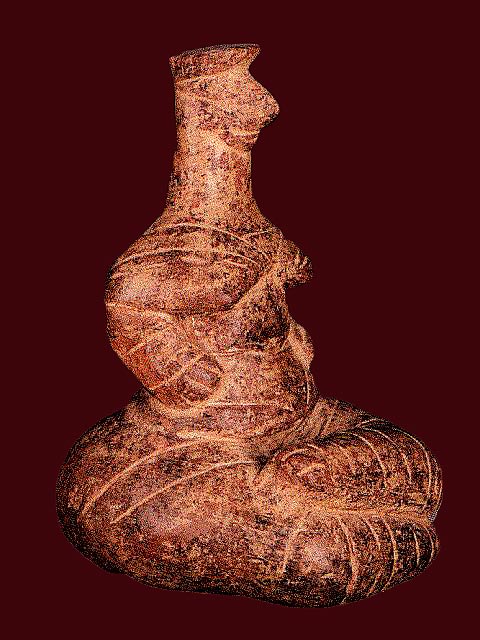 I experience “the Goddess” in multiple ways–as a voice that whispers in my ear, as arms that comfort me in my sleep, as a conscious presence that understands me, and in all the beauty of other human beings, animals, and the whole of the natural world. I experience the Goddess through a plurality of stories and images—in the small figurines from the Paleolithic and the Neolithic such as the Venus of Willendorf or the ancient Cretan Neolithic Goddess with beaked face and snake-like body pictured here, in the stories of Demeter and Persephone, including the one told by Barbara Ardinger on FAR, and in contemporary paintings such as those of Judith Shaw and Jassy Watson that have graced FAR.
I particularly resonate with images that are not exclusively human, but that have bird, snake, or other animal characteristics, because, while I do experience the Goddess as a personal presence, I also experience the world as the body of Goddess. I sometimes joke that I have never found an image of God as male that I like, but I recognize intellectually that the divine power can and must also be imaged as male. I am not interested in reviving any of the male Gods associated with conquest, war, or domination, but I am beginning to open my heart to the Green Man.
At the same time, my favorite prayer song, as I have discussed on FAR at other times is:
As we bless the Source of Life,
So we are blessed.
While I invoke the Goddess through a multiplicity of images, I also experience all of them pointing to a single Source of Life. Archaeologist Marija Gimbutas spoke of the powers of birth, death, and regeneration found in all life forms, while my friend Judith Plaskow speaks of a power of creativity that underlies and supports life.** I experience the powers of birth, death, and regeneration which are found in all creative processes, physical and spiritual, to be grounded in a unity of being that underlies everything.

Marcia Falk’s re-creation of Jewish prayers is an expression of what Judith Plaskow and I have defined as the “immanental turn” in feminist theology. For Falk, God is found “in” the world, not “outside” or “beyond it.” While in her earlier prayers she invoked the Source of Life as an individual being, in her recent prayers “God” is more and more immanent in the world.
Though Falk does not add the word “immanent” to her term “inclusive monotheism,” I think the “immanental turn” is what can make monotheism inclusive. If God is understood to be “outside” or “beyond” the world, then it is likely that God will be defined in ways that exclude aspects of the diversity and difference in the world. On the other hand, if Goddess is fully “in” the world, then her images must include all of the diversity and difference in the world.
I suggest that unlike transcendent exclusive monotheism, “immanent inclusive monotheism” is not likely to become the kind of “totalizing discourse” that justifies domination or disparagement of others.
If polytheism and animism also affirm the unity of being behind the diversity and difference of the world, then their difference from immanental inclusive monotheism may be matter of semantics*** or of emphasis or degree. I am not so sure that Trinitarianism can be defined as fully inclusive of all the diversity and difference in the world so long as it affirms that God was more incarnate in Jesus than in Martin Luther King, Sojourner Truth, or you or me, or the birds and bees.
*See my Rebirth of the Goddess, 111.
**In our forthcoming book Goddess and God in the World.
***In Rebirth of the Goddess I argued that insofar as polytheism was defined by monotheists as a false belief in contrast to their true one, the meanings of both terms need to be rethought.
Discover more from Feminism and Religion
Subscribe to get the latest posts sent to your email.

 Feminism and Religion
THANK YOU! This reminds me of why I miss my dear friend Carol every day…
LikeLike
As usual Carol always strikes a poignant chord and if possible I miss her more now than I did when she was alive. She had such a grand vision that was so grounded in a reality that doesn’t leave me out – this morning her words bring me deep comfort… “I particularly resonate with images that are not exclusively human, but that have bird, snake, or other animal characteristics, because, while I do experience the Goddess as a personal presence, I also experience the world as the body of Goddess”. I too see the goddess as the body of the world that includes every living being…. last night I came away from a woman’s writing gathering feeling so alone. Many beautifully crafted words – but all human centered – plants were mentioned once – animals not at all – except for my piece about cranes as spirit messengers(but also the oldest bird in the world that lives in community) – was cut off by moderator -‘your time’s almost up’ when attempting to ground essay with a couple of practical points. Since I timed the whole thing beforehand I knew the moderator was just bored. Afterwards I went outside to let my dog out and heard owls calling a number of times in response – this after complaining out loud to the night that there was never any room for other than human beings and my words were not heard… but that wasn’t the whole story. Then I hears a coyote. Nothing unusual about coyotes they sing around here most nights, but NOT this coyote. This coyote was keening – there is just no other word that describes the anguish that animal was conveying. Left out – Invisible – just like me. Thank you Carol for your great generosity of spirt and your visioning..
LikeLike
Hm I think pantheism or panentheism is a better label for some of this.
LikeLike