

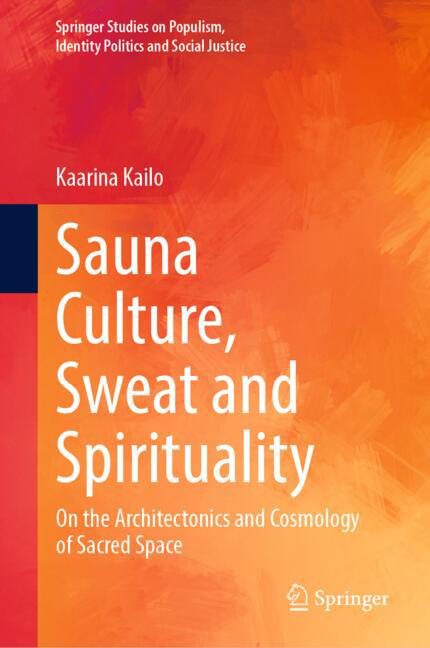
Living as I do in the midst of both Finnish immigrant and Anishinaabe cultures, and where the two merge in the many here who identify as “Findians,” I was intrigued by the description of Kaarina Kailo’s book, Sauna, Culture, Sweat and Spirituality, as a comparative exploration of Indigenous sweat lodges — madoodiswan in Anishinaabemowin — and Finnish saunas.[i] As an outsider to both cultures, I have no ancestral or traditional knowledge of either saunas or sweat lodges and I wanted to learn more about both. Kailo’s book did not disappoint. What I hadn’t expected and was delighted to discover was that Kailo connects both with ancient goddess religions, contemporary feminist spiritualities, and ecofeminism.
Kailo’s book is a widely and deeply researched cross-cultural comparative study of the elements, practices, intentions, and spiritualities of sweat cultures ranging far beyond various Native American sweat lodge practices – Delaware Great Houses, Anishinaabe sweat lodges, Pueblo kivas – and the Finnish sauna,to Iberian/Galician saunas, Irish sweathouses, and Old Europe. As Kailo herself says, the value of such cross-cultural studies is the way they help to expand our thinking, enabling us to see things we might not have otherwise. She repeatedly says that she is looking for the “affinities” among these various sweat cultures, rather than focusing on their differences, and she finds many. In the process, she reveals the role of sweat lodges, sweat houses, and saunas as sacred spaces of healing, restorative balance, connection with the spirits, rebirth and regeneration, women-centered spirituality, and Great Bear religions. Infiltrated throughout are her reflections on how reviving the widespread use of sweat cultures and saunas, and the woman and life-centered spiritualities at their heart, would provide an antidote to the current economic, ecological, and political threats to the world.
Her first few chapters focus on comparing and contrasting patriarchal notions of the sacred and profane, resulting in profound othering of women and subaltern groups (“profane” coming from pro-fanum – those kept outside the temple), with the inclusive, egalitarian feminist spiritualities in which no separation between the sacred and secular exists and divinity is immanental – the whole world. Here she also incorporates the work Marija Gimbutas, Riane Eisler and others whose work uncovered the ancient goddess cultures of prepatriarchal times. She goes on to explore Indigenous views of the spiritual, among these being a spirit-oriented worldview; recognition of “all our relations”; the sacredness of the earth; the infusion of spirit in all being – from flora to fauna to rocks and water; a gift economy; the cardinal directions; the spirits of earth, air, fire, and water and the sacred medicines of sweetgrass, sage, tobacco, and cedar.
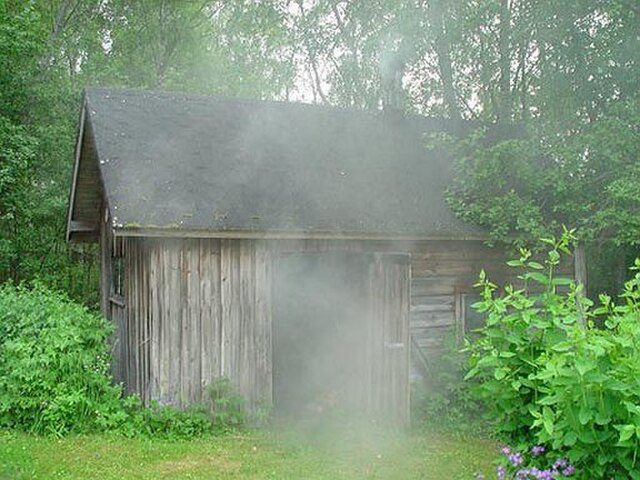
Kailo then goes on to explore the elements, practices, and spiritual aspects of sweat cultures in Indigenous America, ancient Iberia and Galicia, Ireland, Old Europe, and Finland in great detail. What emerges are striking commonalities. In nearly all instances, the sweat lodges and houses were built in the shape of a mound or beehive, with a small, low entrance, requiring the participant to enter with humility, and with a center pole connecting the heaven and earth. Among other shared features are the particular placement of objects; the importance of the cardinal directions; an emphasis on the connections of Earth and Sky – and a phrase she repeats often — “So above, as below;” paying respects to ancestors; the importance of water, fountains, and springs; fire as a purifying agent; the role of sweats and saunas in purification, healing, and the maintenance of order and balance; ancestor worship; shamanism and communication with spirits.
What I found particularly surprising was the importance of the bear – or the Great Bear Mother – in most of these cultures. As she explains it in detail in each of these cultures, it makes so much sense. With its cyclical pattern of hibernation and then emergence from caves in the spring with cubs, the bear is both example and symbol of rebirth and regeneration. In culture after culture, the bear is associated with spring, fertility, the return of the light, as are bear goddesses throughout the circumpolar North. Associated as they are with bears, bees and honey also are regarded as sacred.
But perhaps more important for Kailo’s purposes of reinterpreting sweat cultures through a feminist lens, is the connection she finds of bear-worshipping cultures with women-centered goddess cultures, and the function of sweat lodges, sweat houses, and saunas in creating sacred spaces of rebirth and regeneration. She makes a strong and striking case that the very shape and design of sweat houses as mounds or beehives with small, low entrances mimic not only the bear’s den, but also the maternal womb. To crawl into the sweat lodge or sweat house is to re-enter the safety and primal nature of the womb, and in that liminal space of darkness, drumming, chanting and altered states of consciousness one is able to access the peace of Oneness with the universe, as well as one’s unique path and purpose. One emerges then as one reborn. Hence the deep association with Goddess cultures centered around the sacred feminine and role of women in giving birth, as well as feminist spiritualities that seek to revalorize women’s bodies and being.

In her conclusion, Kailo writes that she suspects that when provided with information about these ancient matristic elements of sauna spirituality, women might “feel empowered and identify with its neglected maternal aspects.”[ii] I certainly found that to be the case with myself. I had not been so immersed in these aspects of goddess spirituality since first reading Riane Eisler’s The Chalice and the Blade, as well as many of Carol Christ’s works years ago, and I’d lost touch with much of the empowerment and sense of the divine feminine that I had at that time. It was in reading Kailo’s account of the Irish Sheela-Na-Gig[iii] in particular, of how these figures were carved into the Irish sweathouses and later appear on the walls of churches, castles, town walls, and tombstones, but primarily medieval churches, so that all those entering did so under representations of women’s vulvas – what Kailo calls “the gate of the womb”[iv] — that I wrote in the margins, “What would it have been like to be so empowered?” The text had brought me fully into the imaginary of living in a society and a spirituality that revered women, and it was deeply moving. What would it be like indeed? In her conclusion, Kailo suggests that this is precisely what we need, and that both Indigenous and ecofeminist spiritual views and practices would help to bring about a world of “balanced living, equality, ecosocial sustainability, peace and the gift paradigm.”[v]
While being a highly detailed scholarly work which at times engages in academic debates with other scholars of sauna culture, Kailo’s book is highly accessible. It is also greatly enhanced by all the photos and illustrations of sweat lodges, sweat houses, and saunas. It was surprising to me in delightful ways. As I said previously, I was expecting to learn a bit about the similarities between Finnish and Native sweat practices, but I finished the book with a strong sense of sweat and sauna cultures’ deep roots in matristic, women-centered and women-honoring cultures and spiritualities with values of interconnectedness, immanence, gifting, and reciprocity. When I began the book, I regarded myself as an outsider to the spiritualities of sweat culture, and instead found that in my own feminist spiritual beliefs and practices, I was deeply aligned, indeed a part of them. As Kailo writes in her conclusion, “The sauna, after all, is the first religion, the first temple of healing and well-being and the matrix where peaceful, trusting relationships have been celebrated since the beginning of time.”[vi]
You can purchase the book here.
[i] I live in Duluth, Minnesota, once known as “the Helsinki of the North” because of having the highest Finnish population anywhere in the country when waves of Finnish immigrants moved here in two waves in the early 20th century. Sauna is celebrated here (and people will often correct the pronunciation of those who call it “sawna,” rather than “sowna.”) This is the land of the Anishinaabe and the Native community here is very strong, especially since 1978 and the passage of the Indian Religious Freedom Act when Indigenous peoples here could restore and openly engage in their spiritual practices. Many Finnish and Anishinaabe married, thus the large population here of “Findians.”
[ii] 384.
[iii] Kailo defines the Sheela-Na-Gig as the “collective name for carvings of naked females who appear in positions to emphasize genitalia.” (274)
[iv] 274.
[v] 386.
[vi] 388.
Discover more from Feminism and Religion
Subscribe to get the latest posts sent to your email.

 Feminism and Religion
As soon as a person dives into some aspect of ancient cultures (some are still extant) it becomes obvious that the similarities are what’s important – the difference matter little – it’s our colonial splitting of wholes into parts that isolates… I am familiar with a lot of this material – but have never focused one sweat lodges …. sounds like this book might be very interesting to read….
LikeLiked by 1 person