

It was four in the morning in the north Georgia mountains. A woman labored quietly but powerfully in her home, with her partner at her side. Her watchful midwife hovered nearby. I was a nursing student and a zealous “birth junkie,” tickled pink by the invitation to observe childbirth. At just the right time, the mother delivered her child from her womb to the world. The sun rose with a new soul suddenly among us, and I knew I would never be the same.
Feminist theology has long-invoked the image of God as a laboring mother, and progressive theologian Marcus Borg suggested that humanity is God’s midwife. But less has been written about the opposite metaphor. Imagine that we are in labor, in pain, and God is our midwife.
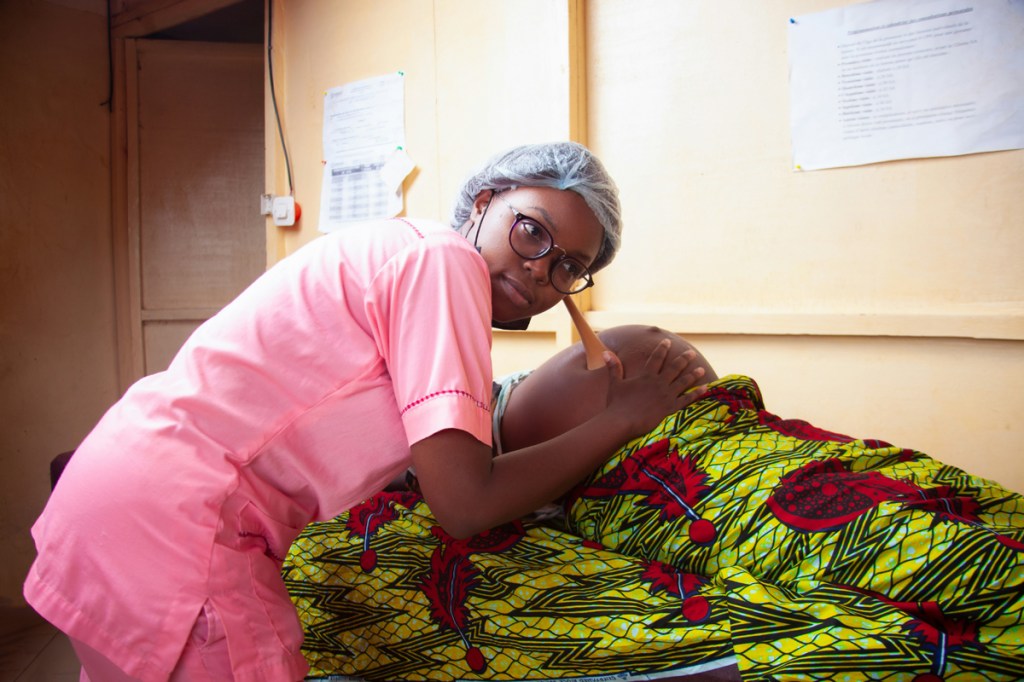
The word “midwife” means “with woman,” and that’s what midwives do: they are with birthing people through it all. They empower and guide, safeguard and witness, but they do not save. Midwives facilitate the birth process, but they don’t—they can’t—take the pain away. They don’t deliver babies; that honor belongs to their clients. Like physicians, they monitor the health of parent and baby, and can deftly manage a cord around a baby’s neck or stop a postpartum hemorrhage. But they mostly rely on the power of presence to bring babies earth-side.
Many of us were raised with the idea that God is essentially an obstetrician or an anesthesiologist—a deity who delivers us from our trials, or who takes away our pain. We were told that God is an interventionist. Someone who shows up and takes charge, a stereotypically masculine deity. A savior who is good, sure, but primarily powerful.
It’s only natural to hope that God can save us from our pain. Jesus hoped as much when he prayed, “Father, take this cup of suffering away from me.” But God did not take the cup away from Jesus, and the supposedly interventionist God has been quite disappointing in my journey, too.
After I witnessed birth for the first time, I went on to become a nurse, a doula, a midwifeʼs assistant, a lactation consultant, and a mother myself. I’ve had a doula client die in childbirth. I’ve miscarried a pregnancy into a Walgreens toilet. I’ve held my sobbing friend at her child’s funeral. And what of slavery? The Holocaust? COVID? The occupation and genocide of Palestinians?
You live in this world long enough, you’re going to feel pain, often excruciating pain. It makes all the difference in the world whether or not you see God as capable of removing your pain. To assign omnipotence to the Divine is to ask, or at least hope, that God would make the pain stop—and usually the pain doesn’t stop. What then? Is God all-powerful but can’t be bothered to intervene in our misery? Or is God a midwife?
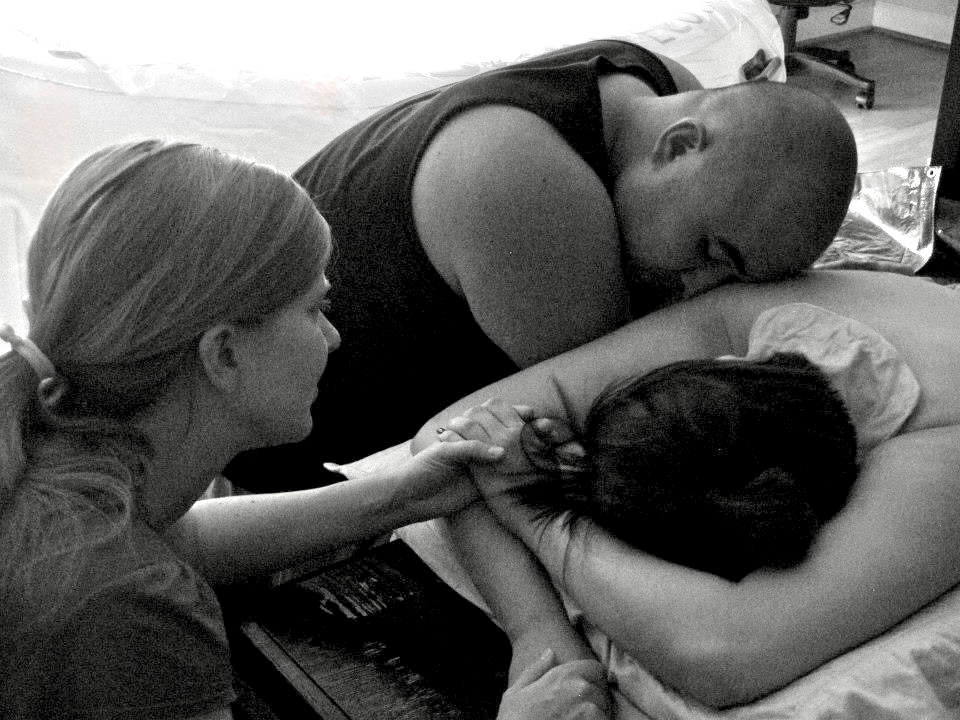
My husband felt angry with our midwives during my labor with our oldest child. He told me afterwards that when he’d felt helpless to relieve my pain, he’d look at our midwives and think, “Do something! Don’t let her suffer like this!” But my midwives did a lot. They stayed with me continuously. They whispered encouraging words. They monitored my health and my baby’s well-being. They showed me how to make my pain an ally instead of an enemy. They caught my baby when he finally came out, and they placed him right on my chest.
We are not accustomed to this kind of support, and we need to get mad at the assumed interventionist before we can come around to the gift of a midwife, the gift of presence instead of relief. Researcher and author Brené Brown once said, “I hoped faith would be an epidural for pain. Turns out to be a midwife who says ‘Push. I’m here. Sometimes it hurts.’”
God Herself is not the seat of power, but a mirror who reveals that the seat of power has always existed within us. God is not in the business of saving. Not because She won’t, but because She can’t. She also puts too much stock in our power to assume that level of self-importance. Divinity is not found in the masculine hoarding of power but in the feminine empowerment of others.
When I was in early labor with my second child, I texted a good friend who had just given birth herself ten days prior. I complained about the pain of my contractions and I joked, “You do it for me.” She laughed because of course she couldn’t, though she understood the longing! What is obvious about childbirth is less obvious about faith: No one can do it for you. Not even God.
That labor was brutal. My baby was in a wonky position, elongating the birth process, and the accompanying back labor was relentless. I cried out, “I can’t do this anymore!” And my midwife looked at me with tenderness and awe, reminded me that I was already doing it, and she stuck by me til the end.
By the way, my husband was not annoyed, let alone angry, with our midwives during my second labor and birth. He was my rock throughout: he put counter-pressure on my back, and took walks with me, and slow-danced with me, but he knew by that point that I was my own savior. He’d become not only a believer in midwifery, but a midwife himself.
After eighteen hours, my daughter was born in a compound presentation—she came out with her elbow bent over her head. I screamed bloody murder. My midwife couldn’t fix it, but she validated it. She couldn’t save me, but she helped me save myself.
Midwife isn’t only a noun, it’s a verb. And it’s not only who God is, it’s what God does. It’s a way of being. It’s a way of relating. With woman. God with us. The Divine Midwife has no anesthesia, no operating table. But She wipes our brows, squeezes our hands, and holds our hair back when we vomit. She’s with us, whether the outcome is joyful or horrendous. She bears witness to our inner strength as we deliver ourselves.
As Ivy Helman blogged about recently, there is no room for the mainstream “power over” God in feminist theology. That God controls and dominates, and is deeply intertwined with toxic masculinity and Christian nationalism. In the words of philosopher Charles Hartshorne in Omnipotence and Other Theological Mistakes, “Divine sovereignty sounds to some of us like a confession, an admission that it is sheer power, not unstinted love, that one most admires.”
Although I once found protection by such a God appealing, it turned out to not only be a false promise, but a recipe for my own disempowerment. Today I concur with the incomparable scholar Carol Christ: If God—or Goddess—has any power, it’s power with. Process theologians would say Godʼs power is persuasive, not coercive. It looks like solidarity. It looks like partnership. It looks like presence, like emotional labor, like midwifery.
We all find ourselves in hard labor at some point, and the pain of life is much more intense than the pangs of labor. Our conditioning tells us that presence is a poor substitute for relief, but it’s the response that does not fail. May we find the arduous beauty in it.

BIO: Halley Kim is a writer and editor who has worked extensively in maternal health care as a registered nurse, doula, lactation consultant, and midwifeʼs assistant. She was once a pastorʼs wife within conservative evangelicalism, and later, after a radical faith shift, began preaching from the pulpit once forbidden to her. Her forte is in the areas of spiritual, political, and social justice writing, with a flair for all things pregnancy and birth. Her writing has been featured in Tears of Eden, The Junia Project, and other blogs. Her ideas have been platformed by the podcasts Everyday Thin Places, The Heretic Happy Hour, The Phil Drysdale Show, and Shit No One Talks About. Halley lives with her husband, three school-aged children, and a very spoiled dog in St. Louis, Missouri. She is working on her debut book.
Discover more from Feminism and Religion
Subscribe to get the latest posts sent to your email.
 Feminism and Religion
Halley Kim, this is brilliant – thank you so much!! I am Lutheran pastor, mother of six, and midwifes have always been my go-to image for all things strong, competent, and no-nonsense compassionate that at the same time cannot change reality and magic it into something which it is not. A midwive shares reality with you with unflinching clarity. An honest companion, if ever there was one, in the middle of a mad unspeakable sea of pain. What an image for God! Psalm 22 says as much: “11 And to think you were midwife at my birth,
setting me at my mother’s breasts! When I left the womb you cradled me; since the moment of birth you’ve been my God.” (The Message) – and of course, it’s an image that patriarchal Christianity has hidden well and not elaborated on.
My by now strongly deconstructed faith has been (re)built with the help of feminist theology, progress theology, Charles Hartshorne, Carol Crist and other indispensable feminist theologians and your post ties all these strands together so absolutely wonderfully and clearly. With gratitude – and hoping that your debut book will cover some of the ground in your post; I shall be a more than eager reader.
LikeLiked by 2 people
How delightful to connect with such a kindred spirit! Three cheers to everything you said. Yes yes yes re: Psalm 22! I donʼt think itʼs coincidental that Jesus is said to have quoted from that psalm on the cross. My book is absolutely all about the theme of God as Midwife! You can follow my substack via my website if you like (halleykim.com) or find me on Instagram @maybegodisamidwife. Thanks so much for your eagerness to read!
LikeLike
I loved this. This line grabbed me — “They empower and guide, safeguard and witness, but they do not save.” What a wonderful description of divine love in the world that also contrasts with the far more familiar notion of a savior. I also have appreciated Carol Christ’s work drawing on Hartshorne and process theology. Thank you.
LikeLiked by 1 person
Thank you! Your words mean a lot.
LikeLike
I loved this essay – to be truly alive is to experience pain and anguish – religions in general sort of derailed this truth taking us captive in the process – Goddess/ Nature freed me from that delusion though it has been a process… midwifery is a wonderful metaphor as well as a concrete way of being with self and others – I see this operating the same way through the rest of nature…
LikeLiked by 1 person
Thank you so much! I love your thought that midwifery extends to the rest of nature! I think thatʼs so true, and gives me ideas for future writings :)
LikeLike
What an excellent piece! I love this paragraph: “God Herself is not the seat of power, but a mirror who reveals that the seat of power has always existed within us. God is not in the business of saving. Not because She won’t, but because She can’t. She also puts too much stock in our power to assume that level of self-importance. Divinity is not found in the masculine hoarding of power but in the feminine empowerment of others.”
I think even my fundamentalist mother who perceived God as a loving, all-powerful Father would have connected with many concepts here. (She never knew her biological father, and I think was in love with her image of him and found a God that substituted for an absent, earthly father.) My mother was also an RN, who found joy and meaning working with mothers and their babies in the 1960s. She was staunchly against the idea of choosing abortion over carrying a pregnancy to term. When I asked her if she would carry to term if she knew she were pregnant with a disabled fetus, she replied, “I should kill somebody else JUST for me?!” Interestingly enough, these days I work with women who make a choice to abort their pregnancies.
Are these two ways of understanding pregnancy mutually exclusive? This essay is so powerful, Halley. Thank you for writing it. Am curious, though, how abortion “works” within your understanding of “midwife-ing.”
LikeLiked by 1 person
Thanks so much for your encouragement and thoughtful engagement! I am firmly pro-choice, but once upon a time (when I was theologically conservative) I was opposed to abortion–itʼs been quite a journey. As far as how abortion works in the theological metaphor, I think that the Midwifing God supports us through both “abortions” and “births”–both are challenging, both are brave, both are deserving of support.
LikeLiked by 1 person
Thank you so much for this post. So helpful. I have long thought of god/dess-with-us as the most accurate depiction of the the divine. That is why, though I am largely pagan and certainly interfaith, I still connect with Jesus as emmanuel god-with-us. In times of greatest pain and crisis, I often hear the words, come into the presence or I just feel the presence without words through my whole body and being. Understanding this presence as midwife makes the concept so real and practical and offers a different way to experience pain and suffering, at least my own. I love that midwife is both a noun and a verb. Thank you!
LikeLiked by 1 person
Iʼm so glad it spoke to you! Iʼm also interfaith and not a “believer,” in the traditional sense, but deeply resonate with the incarnation of Jesus as God WITH us. Thanks so much for your kind feedback!
LikeLike
YES! Halley! YES!
Sawbonna,
Margot/Raven Speaks.
LikeLiked by 1 person
Margot! I wasnʼt familiar with Sawbonna so I looked it up and found an article you wrote about it here–letʼs just say Iʼm officially obsessed. Shared humanity! I see you! This is the way. So glad you liked my piece :)
LikeLike