

part 1 was posted yesterday
How God is Constructed
During my doctoral research, I worked in the field with a Lemba co-
Researcher who remains a good friend, Dr. L. Rudo Mathivha of Johannesburg and the Northern Province. When we sat with the women in the village of Hamangilasi, we asked Hanna Motenda, one of the interpreters and a retired schoolteacher, about the women’s concept of God. Throughout the interviews, the women’s conversations both in this village and elsewhere reflected God imaged as male.
I also asked whether the women imagine God as an external force, living in Nature or in Heaven, or as something living within themselves.
Hanna Motenda: Ourselves. God is in us. They say God is everywhere.
Even in Nature, when we look at anything, we see God. Quoting others, she
added, “God is like the wind, He’s everywhere and wherever I am, He’s
there.”
So Where is the Sacred Feminine?
As noted above, when I mentioned the possibility of a female deity, reactions from South Africa to the U.S. ranged from shock to suspicion to amusement among many of the respondents.5 The Lemba women and most of the U.S. Jewish women talked about God only as male, because this is what they have been taught. Does this affect whether the women hold their own work and lives as sacred? Does the lack of a prominent female Godhead in the three major religions—Judaism, Christianity and Islam—at least on the liturgical, institutional surface, affect our understanding of the Sacred Feminine as a living essence, both as deity and in us? Does it mute and blind our awareness of the fullness of life, and our concept of ourselves?
Throughout much of Africa, God is imaged as having both male and female attributes, leading me to think that such beliefs may well exist in the Northern Province. It showed among the Venda but not spoken about by the Lemba people I met. I wondered whether belief in God as Mother was buried deep beneath layers of Christianization and Western colonization, possibly hidden from their view and definitely hidden from mine. God’s name, Mwari, refers to a God who is both male and female among the Shona, among whom the Lemba of Zimbabwe have lived over the past 200 years; the names Mwari and Mwali are used interchangeably by the Lemba as God’s name.
Several of the Venda artists clearly portray the Sacred Feminine in their sculpture but the Lemba and Venda women, among others, still seemed to find the concept of God as female a foreign one.
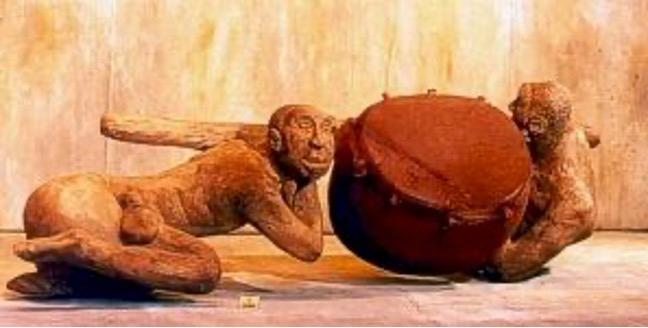
The works of Noria Mabasa, Meshack Raphalalani and Albert Munyai6 in particular spoke volumes, in courageous ways that non-artists, especially groups who have lived under colonial domination, may find too dangerous to
I wrote in my journal as I summarized my research one day: “Could it be that the act of discussion of God as Mother and Father would not take place in front of me, even though mythical symbols of both female and male deity are there? Haven’t many other scholars had to make a leap of faith in this darkness?7
Still, having once read that there was a Venda word for Goddess, I was curious, and brought it up in my conversation with Lemba men in the town of Mmakaunhaye, including University of South Africa linguist Tom Sengani, when we were talking about the role of the senior aunt of the compound.
D’vorah Grenn (DG): [Does she] have any special name, or title?
Tom Sengani (TS): She doesn’t have any other name except makadzi. You see, in our tradition, even with the Vendas, the senior aunt is an important person —like my aunt, with the spectacles on—she’s the senior aunt here. So whatever thing you do, she has to be informed.
DG: Does she have to approve it, or just be informed?
TS: She must be informed, she can approve, but if she doesn’t, do tell her. ‘Cause she’s sort of an intermediate between even family members, so that even if she disagrees with you, you must go and tell her.
DG: You can still do it.
TS: Yes.
I wondered, however, whether in practice many things would actually take place of which she did not approve.
I then told the group I had read the word mudzimukadzi in one Venda-English dictionary (Wentzel and Muloiwa, 1976)—and that it was translated to mean “goddess”8.Everyone was silent. Even Tom Sengani, who is in the business of words, seemed a bit puzzled by the question.
Uncle: (There’s only) makadzi…
TS: Makadzi’s the senior aunt. Mudzi…
DG: is God?
TS: (simultaneously) is God.
As in so many other instances during this research, my interviews left me with more questions than answers. Believing my senses and following my intuition, the art I saw spoke volumes, as can image and text not layered with only male-centered interpretations of humanity and deity. Through the images, and in my conversations with both Lemba and European-American Jewish women, the Sacred Feminine was clearly present—in between and behind the words—as She is most days of my life.
I am gratified to be one of the women creating a present and a future that acknowledges Her role in the lives of both women and men, in Judaism as well as in other traditions.
#######
5 There was a genuine willingness to consider the idea, or, among those espousing Goddess Judaism or feminist spirituality, a fervent belief in Her, among some of the liberal Jewish women I spoke with.
6 Mabasa, Raphalalani, and Munyai, personal communications, 2001.
7 A number of colleagues have spoken to me of this same experience, including Margaret Grove (Grove 1999), Judy Grahn (Grahn 1999), Lucia Birnbaum (2001) and Dianne Jenett (1999).
8 No one verified this, however, or seemed ever to have heard the word. Either there is such a term, and no one was willing to talk about it, or the authors were, perhaps, extrapolating. I find this unlikely, however, since it does not strike me likely that a missionary would go out of his/her way to include this term in a dictionary unless she or he had heard it from others.
BIO: D’vorah J. Grenn, Ph.D is a Yoreshet/lineage holder of a female Kabbalist tradition, priestess and ordained Mashpi’ah/spiritual guide. She founded The Lilith Institute (1997), co-directed the Women’s Spirituality MA Program at ITP/Sofia University and has taught at Napa Valley College and throughout the San Francisco Bay Area on women’s rituals, feminist thealogy and philosophies, sacred arts and literature, and Jewish mysticism. She co-teaches on the Kabbalistic Tree of Life with Reb Nadya Gross; they recently co-produced the symposium “Wisdom of the Mothers: Celebrating Matriarchal & Matrilineal Spiritual Traditions” and will co-produce a “Wisdom of the Mothers: Ancestral Roots and Connections” Symposium on April 22-23, 2026.
Publications include: Lilith’s Fire: Reclaiming our Sacred Lifeforce; Talking to Goddess, an anthology of writings from 72 women in 25 traditions; “Lilith’s Fire: Examining Original Sources of Power”, Feminist Theology Journal; Jewish priestess and Lilith entries in Encyclopedia of Women in World Religions; “For She Is A Tree of Life: Shared Roots Connecting Women to Deity”, her dissertation on beliefs and rituals among U.S. and South African Lemba women of Jewish ancestry, and “Spiritual Brokenness and Healing Presence of the Sacred Feminine”, FEMSPEC feminist journal. She has been a guest on a number of podcasts including the Revelation Podcast Project and Breaking Down Patriarchy, was a speaker in the recent “Crones, Hags and Elder Wise Women” Summit, and co-hosted 50 episodes of the “Tending Lilith’s Fire” broadcast with Kohenet Annie Matan.
Moderator’s Note: Yerusha and the Lilith Institute are sponsoring the symposium in April. There will be a call for papers coming up as well an invitations to attend the Symposium. For further information to and to stay up to date, visit their websites at Yerusha and Lilith Institute.
Discover more from Feminism and Religion
Subscribe to get the latest posts sent to your email.
 Feminism and Religion
This reminds me of the time on a Goddess tour of Turkey when I asked someone the word for Goddess in Turkish. He responded immediately, and disapprovingly “No Goddess. Just Allah!” I didn’t question him further (or mention Al-lat).
LikeLike
“Believing my senses and following my intuition…” Wonderful leading line, thank you.
I was fortunate to learn of God as Father-Mother, and the concept requires constant nurturing. In my book, Science and Spirituality: Celebrating the 150th anniversary of Mary Baker Eddy’s Science and Health, I wrote:
“In the spirit of scientific interests and sacred desires, I cannot hold onto a physical book or limited body of human stories as if God only spoke back in the good old days, which really were not all that good when it came to human rights and equality. Moreover, I cannot hold back the activity of science and spirituality, validating and manifesting ever unfolding spiritual ideas, including the idea of expanding Holy Writ.
“As farfetched as it sounds to discover and experience a new authoritative sacred text unconfined to denominations, it is in the making. What is the Bible but a plethora of stories, metaphors, mantras, glamour and gore, that took a thousand years to put together. This tome of tomes still passes through translations, revisions, rewrites, and biases galore. As in the past, misinterpretations occur today. However, a useful view of creator and creation, and the prophets’ healing work, cannot be annulled, lost, or restricted to a select group of people or to a special time in history.
“Sacred texts are human constructs, useful until they are not, but always compliant with scientific and spiritual revision and updates. Discovery of revelatory ideas related to a good God is happening. Trying to stop the all-acting spirit is like telling the sun to stop shining. Discoverers are at work. And all pioneers of truth experience the trials and triumphs of prophet, disciple, and advocate, whether they work in the field of religion, biology, politics, the armed forces, or are raising a family or baking croissants. Throughout the ages, the science of spirit rolls back the gloom that hides the eternal sunshine and reveals the environment and its inhabitants governed by one spiritual intelligence, the unity of good. The creator, infinite truth, spirit, soul, is not destroying the natural order of life but fulfilling it grandly and graciously.”
LikeLike