

Attending a Dodger game as a four- or five-year-old with my uncle, the biggest Dodger fan I ever met, was my first professional sporting events experience. To this day, I’m not a sports fan by any means, but if you ever do catch me watching or rooting for a sports team, it will be for the Dodgers, as it got wired into me at a very young age.
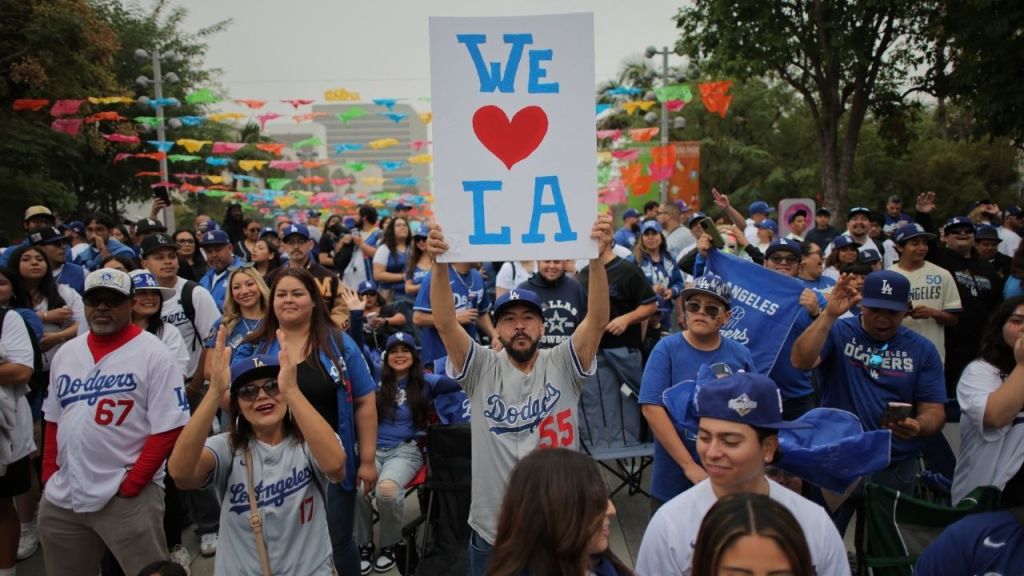
So, I was one of the 51 million people across the U.S., Canada, and Japan tuning-in to watch the 7th game of the 2025 World Series between the Dodgers and the Blue Jays. I cheered, clapped, and whoo-hoo’d as the Dodgers made the final winning double-play in yet another extra-innings game in the series. But it was not without mixed feelings that I cheered on the team that has been part of my life and family upbringing.
While the Dodgers have a special place in the heart of the Latinx community in Southern California, and Angelenos in particular, the team’s origins in Los Angeles had a violent start. When the Dodgers moved from Brooklyn to LA, its stadium was built on what was formerly known as the Chavez Ravine, a semi-rural community that “encompassed about 315 acres and had three main neighborhoods — Palo Verde, La Loma and Bishop.” Mexican-Americans established themselves there because of being, “red-lined and prevented from moving into other neighborhoods.” Still, not only Mexican Americans, but the whole array of Latin-American communities in Southern California embraced the Dodgers as their team, in large part due to the impact of their superstar player, Fernando Valenzuela.
He was Mexican, a new rookie player for the Dodgers who didn’t speak English when recruited, and he was stealing the show. He inspired the “Fernandomania” craze among Latino communities across the southland. I got to see him in person when I was in elementary school as my school ended up being one of the stops in his Los Angeles “Stay in School” campaign [his message was, “Be cool, stay in school!”]. It was a big deal. And since his death in 2024, the Dodger uniform has included his retired number, 34, on a patch with “Fernando” written over the number.
The Dodgers also have an official unofficial Spanish name: Los Doyers. “Los Doyers” emerged organically around the 70s as Spanish-only speakers had difficulty pronouncing the hard “g”-sound in the word “Dodgers.” The unique pronunciation has been widely embraced and represents an endearing way of capturing the special place the team has within the Latinx people of Southern California. Today you can even purchase Doyer gear on the official MLB website.
And yet, the tension continues. Currently there is a petition urging the Dodgers to skip the invitation to attend the celebratory White House visit (traditional after winning the World Series) due to the administration’s targeting of Latinx communities with their violent, indiscriminate ICE raids. There are also direct ties between the Dodger co-owner, Mark Walter, and “a private prison corporation that operates U.S. Immigration and Customs Enforcement (ICE) detention centers.” The same team that brings so many people together in community, that inspires pride and a sense of unity and joy, is part of a corporate franchise that profits from its violent oppression.
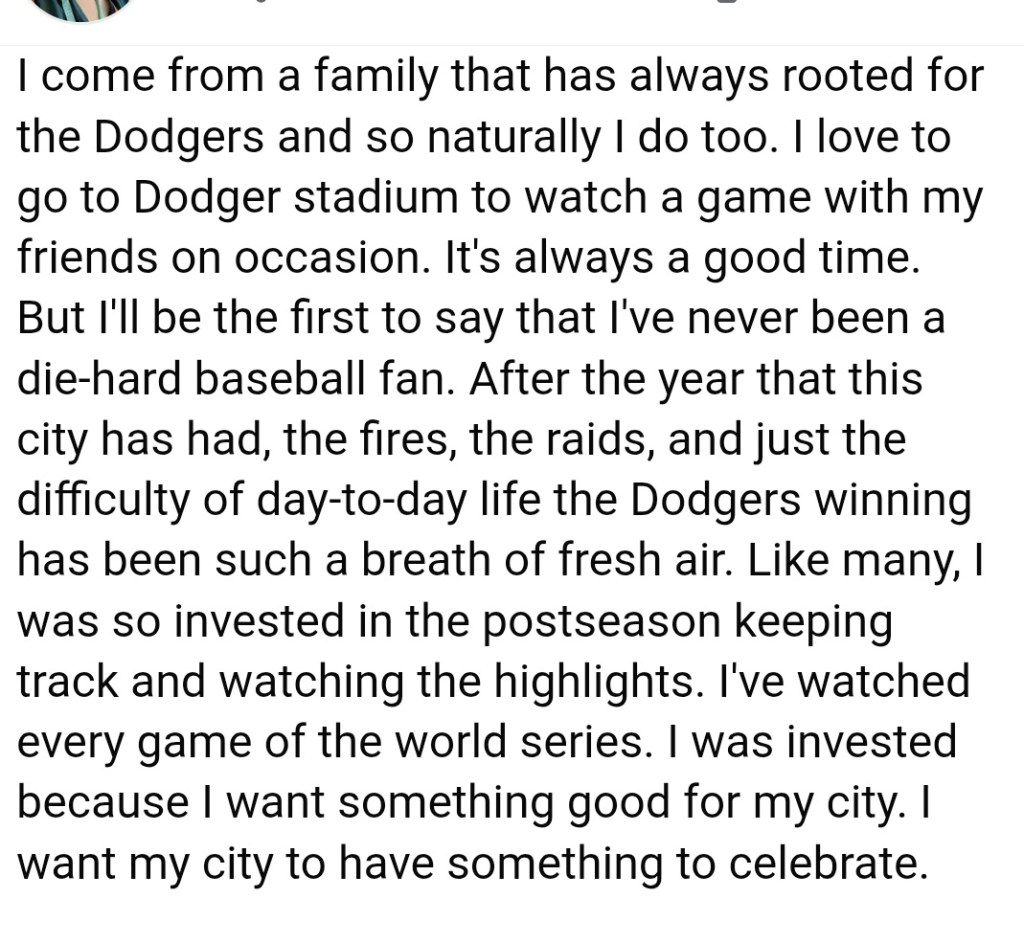
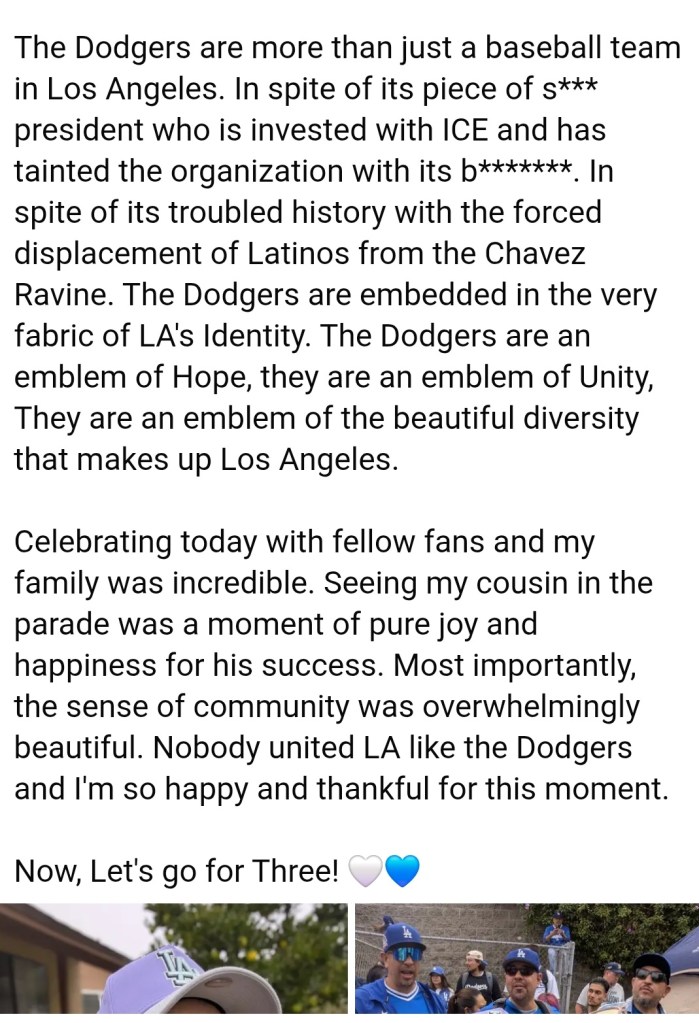
A friend and colleague of mine captured her personal experience of this tension recently on her Facebook post:
I have a couple of older feminist friends who always watch baseball together. It’s their favorite sport because they say it is the most feminist sport: it’s not violent, it’s not about gaining territory, it doesn’t run under the pressure of a clock, and it allows for time to learn about the players and tell stories about their past games in between the plays. Even still, the realities of neoliberal capitalism and white supremacy weave their way into even seemingly benign activities, like hitting a ball across a field and running over bases.
How do we pull the good and the bad apart? How do we live out our values and commitments in community within these complex webs? How do we hold on to the good as we are also inevitably enmeshed in systems and structures of oppression?
The first thing I think to do is to feel deeply and not shy away from the difficult and complex questions our realities raise in our conscience. This must be part of our spiritual practice. We then may find the next small step we can take toward the good that is nonetheless possible. Today I do the simple thing of signing a petition. It’s a small thing, perhaps only a symbolic gesture for now, but it is still part of voicing the community’s opposition to state violence, a place-holder before I find the next step to take…
Discover more from Feminism and Religion
Subscribe to get the latest posts sent to your email.

 Feminism and Religion
Excellent piece, Xochitl, that asks some great questions. “How do we pull the good and the bad apart? How do we live out our values and commitments in community within these complex webs? How do we hold on to the good as we are also inevitably enmeshed in systems and structures of oppression?”
I don’t know, however, I agree with you that not shying away from difficult and complex questions is essential. Find myself quite disappointed when all kinds of barriers get thrown up in conversations such as, This is not the time to talk about ___________ (fill in the blank). Or, We (often a church institution) don’t want to make anybody uncomfortable, so we won’t bring THAT up!
One of my fears now (since last Tuesday’s election) is that complacency will set in (again) which, of course, would not be wise. Signing petitions–both physically and metaphorically) is “something” we can all do.
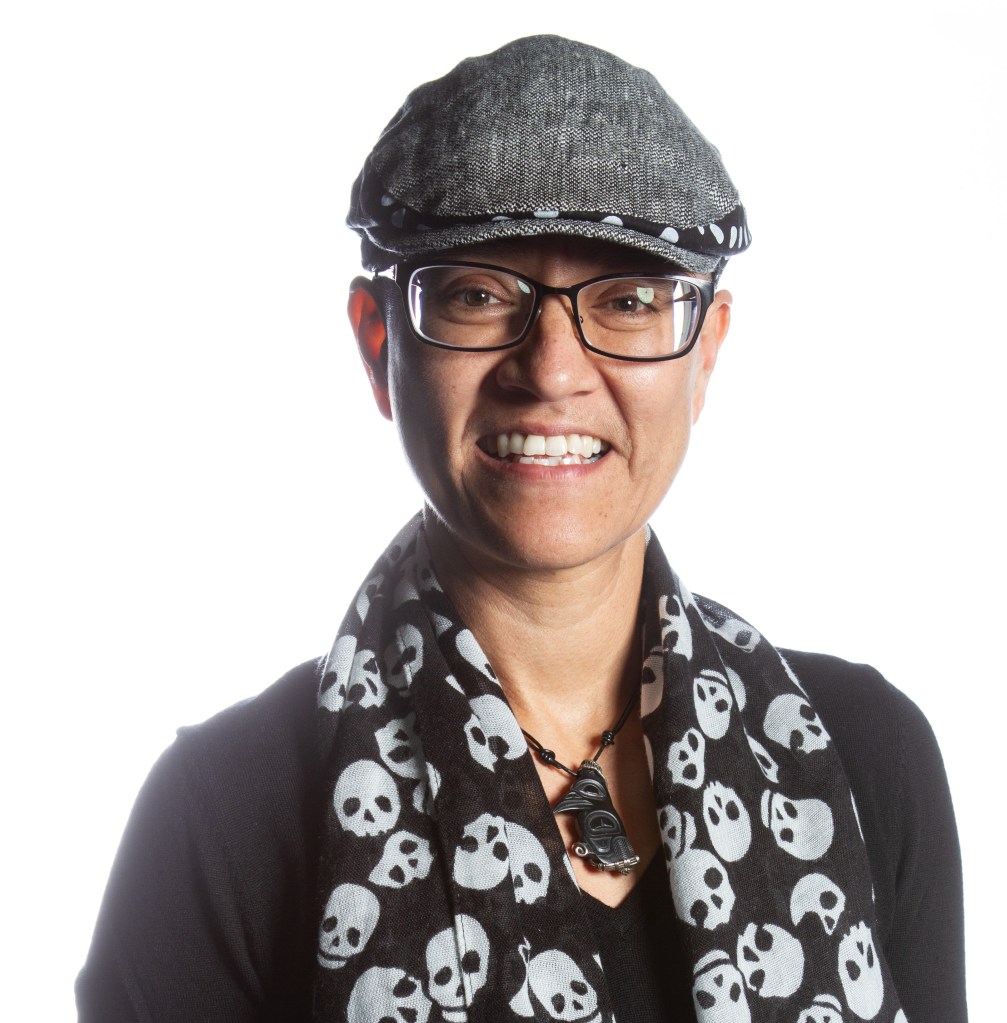
PS Love the scarf you’re sporting in your picture.
LikeLiked by 2 people
Oh Esther – this kind of anti-conversation creates utter deeper in me and reveals the inability of people to stay with what is… If this is not the time to talk then when the hell is the time??? The other issue for me is lumping what’s happening NOW with the ‘traditions’ of the past – it’s always been this way – hanging on to traditions doesn’t help every living thing has changed… but not our institutions or the minds of dead bodies.
LikeLike
Hi Esther – Indeed, complacency would be a terrible response. We have to keep the pressure and do our part to support those who are trying to save the fragile democracy we may still be able to preserve. Thank you for your comment – and I love that scarf too. I’ve had it for so many years (maybe close to 20)!
LikeLike
As usual Xochitl I learned a lot from this post about Dodger beginnings – the only time I was really attached to a collective sport – no doubt due to parents -I had no idea about the shady beginnings that apparently continue… but these words of yours stand out like a beacon of light: How do we pull the good and the bad apart? How do we live out our values and commitments in community within these complex webs? How do we hold on to the good as we are also inevitably enmeshed in systems and structures of oppression?
The first thing I think to do is to feel deeply and not shy away from the difficult and complex questions our realities raise in our conscience… The first thing is to FEEL -and yes it will hurt – but we all need to do it…. and then we must figure out how to hold on to what’s good knowing that we are so enmeshed as Esther says,,,,
LikeLiked by 1 person
Thank you, Sara. I totally hear you that at times it will hurt – and that’s the hardest part, because we may be called to make hard choices to let go of something we’ve held so dear since it is now too harmful in its impact or enmeshment. I’m struggling!
LikeLiked by 1 person
I think it’s a relief to acknowledge that we are struggling instead of enduring the endless oppression of everything is fine…or it’s getting better… ad nauseam – asking asking asking those hard questions – OVER AND OVER – who knows maybe we’ll crack open the door – in any event we are holding onto our integrity, honesty and willingness – maybe that is what matters…
LikeLike
I have my own story about baseball. When I was young, my father who was wealthy had box seats in Yankee Stadium right behind the visitor’s dugout. It was for his “business” where he sent clients he wanted to woo. When the seats weren’t be used, I would go. I would root whole-heartedly for them. Then one day, one of the players, I believe it was Mickey Rivers was playing against the Yankees. He had been traded. I remember sitting there in shock thinking “just who am I rooting for – George Steinbrenner?” I walked out of the stadium that day and have never watched another baseball game. That was in the 1970s.
I think about what you write and power of sports to bring a community together. That is powerful and we do need something of that nature. but I would say it has to be community based or it’s built on a rotten foundation. Professional sports are a business – big business – and we forget that at our own peril.
LikeLiked by 1 person
So true, Janet, the big business of sports is too often ignored – or not reflected on. I really didn’t think about it until recently. There are many posts on social media calling for us all to stop doing anything contributes money to the franchise. I think that makes sense; but then also feel the pull of the community aspect of it. So it’s about getting creative about that piece. We can do it!
LikeLike
you are so right Janet – it has to be community based and with so many many people – too many – too many still having babies – it’s getting harder and harder even when we try….
LikeLike
As a Canadian, I reacted differently to the World Series this year. I agree that “The sense of community was overwhelmingly beautiful. Nobody united [us] like the [baseball team]”. However, the “us” was Canadians and the baseball team was the Blue Jays. The national news often led with their 1993 win, and people from areas across Canada that are traditional rivals united on the anticipated outcome of these games. The loss was “heartbreaking”, although in keeping with the Canadian reputation for niceness, one headline read “fans return to the real world still stinging” and the Premier of Ontario congratulated the Jays for the “hard-fought World Series”.
Having said that, I agree with Janet that we forget at our own peril that professional sports are big business. My city has just voted to spend nearly half a billion dollars to renovate a sports stadium. The Mayor compared it to a library as a public service.
LikeLiked by 1 person
Judith, I so appreciate your comment. Thank you for sharing the other side of the experience, which is so valuable and obviously just as valid. First, the Blue Jays really played impressively – several times I exclaimed out loud how good a particular play of theirs was, because they really did play so well! I received disapproving looks from my watching companions of course :-) And to your second point – I feel you. Los Angeles is hosting some part of the next Olympics, and I know so much money will go to that, when what we really need is housing, so much more affordable housing. Olympics or stadiums are no substitute for the social services our communities need. Thank you for engaging!
LikeLike
Thank you for sharing this story in all its poignant beauty and disturbing complexity. Holding all realities instead of insisting that one cancel out the other is the beginning of healing and change.
LikeLiked by 2 people
I love that potential, that it is “the beginning of healing” – yes, may it be so!
LikeLike
Re baseball as a feminist sport, I love your description: not violent, not about gaining territory, minimal time pressure. To expand on this, however, I have heard it said that baseball is the quintessential American game; while in other sports an equal number of people interact with one another, baseball involves one person facing the entire other team alone.
LikeLiked by 1 person
Wow, never thought of that – that is striking! And to add to it, “one person facing the entire other team alone…” with their “team” viewing from the sidelines :-[
LikeLike
This conversation reminds me of the paper I wrote about baseball in graduate school in a class taught by Charlene Spretnak. I am from LA. My male ancestors played, some of whom are greatly flawed individuals. But I love the game — the physics and the Zen of it.
If all forces are equal then it is predicable. Three pitches, three strikes for three hitters then alternate. But it takes the human element to navigate maintaining the balance or else someone hits a line drive and the other team either fields it or misses or errors. Or their arm isn’t up to the throw from first to third. Or the pitcher missed his change up. Basically it is a chaotic attractor disrupting the balance of a perfect game — that unpredictable force and the drama of the human element navigating that new environmental variable, that makes it so exciting.
The other point I made, and my abusive boyfriend gets the credit for this insight; the game is a reflection of males in a prehistoric hunting-like situation. Deeply entrained, almost psychically aligned to each other as a team. They barely speak, but use hand signals, nods, eye contact and rituals like body posture and hat position, to stay silent, to not reveal to the opponent their next move while trying predict theirs.
Everything said here is true. Patriarchal capitalism on full display. Big money for a game while women are excluded and more important members of society will never be rewarded like ball players or communities displaced by big money. Trading young men who will age out like prize bulls because of their limited ability to produce a 97 mph fast ball or hit a ball 387 ft to change the balance of the game.
But we can understand this, pull apart the good and bad as you said, and still enjoy a much needed moment of feeling like we are part of rooting for something collective that gives us joy and is just fun. Those moments nourish us to keep on dealing with calling out and seeking justice in the many areas of culture that are way, way, waaaay out of balance.
LikeLike
Wow, Esikie, this changes my whole view of the game! I’m going to sit with this for a minute – thank you!
LikeLiked by 1 person