

This was originally posted on January 13, 2020
 About 20 years ago I witnessed a performance of the 3 plays of the Oresteia (the Orestes plays) by Aeschylus. I was stunned. Watching them in sequence, I understood that the plays were one of patriarchy’s “just so stories” and that their continuing performance was part and parcel of patriarchy’s perpetuation and legitimation.
According to the myths, Helen, the wife of King Menelaus of Sparta, ran off to Troy with its prince, Paris. In revenge for his lost honor, Menelaus called the Greeks to attack Troy and bring her back. Agamemnon, brother of Menelaus and king of Mycenae, assembled his ships, but the wind refused to fill their sails. He was told that his army would be allowed to depart only if he killed his daughter Iphigenia. He lured his daughter and her mother Clytemnestra to the place where his ships were waiting with the promise of marriage to Achilles. When they arrived, he killed his daughter and the ships sailed.
The myths do not tell us that in matrilineal and egalitarian matriarchal cultures the mother-daughter bond is the sacred because it represents the continuation of life.
The first play begins when Agamemnon arrives home from the war with the Trojan prophetess and princess Cassandra whom he captured and raped. In his absence, Clytemnestra is ruling with her consort Aegisthus. She lures Agamemnon to his bath where she kills him in order to avenge her daughter’s death. .
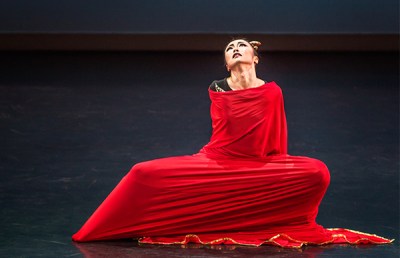
In the second play, Orestes kills his mother Clytemnestra to avenge his father’s death. In the third play, Orestes is pursued by three old women called Furies, whose duty is to avenge matricide. The Goddess Athena decides to hold a trial with a jury of 12 male citizens. Even though all those voting are men, the vote is tied. Athena breaks the tie, declaring that she was born from a father not a mother and stating that the mother is but the nurse, while the father is the true parent of the child.
The Wikepedia article on the Oresteia repeats the conventional wisdom that the “themes of the trilogy include the contrast between revenge and justice, as well as the transition from personal vendetta to organized litigation,” adding that the play depicts “the development of social order or a proper judicial system in Athenian society.”
Students are taught that the “old order” represented by the Furies was based on revenge and blood lust rather justice. It may be mentioned in passing that the Furies stand for the mother line, while Orestes and Athena uphold the values of the father line. But as the mother line is associated with violence, it is expected that it will be obvious to all concerned that the values represented by the father line are the higher values.
In the play, the 12 men are divided on the question of Orestes’ guilt. This may reflect the fact that even in Greek times, the patriarchal order had not completely triumphed. If this is true, then the fact that a Goddess is called in to vindicate the patriarchal order can be seen as a brilliant sleight of hand. Even the Goddess, who once was the symbol of the mother line and maternal values, no longer believes in the honor due to mothers!
In the Oresteia, the bloody deed of Clytemnestra is the only one that is judged to be truly wrong. The murder of Iphigenia by her father in front of her mother is glossed over, as is the rape and abduction of Cassandra. Nor does anyone blame Menelaus and Agamemnon for deaths on the battlefield.
Why?
The answer is that this is not a story about revenge and vendetta versus a system of justice.
This is a story justifying the power of men in patriarchy.
Agamemnon had the right to kill his own daughter in pursuit of male honor. It may have been “tragic” for him to have to kill his own daughter in order to start a war. Cassandra’s capture and rape may also be “tragic,” from her perspective at least. The deaths of soldiers in battle can also be viewed as “tragic,” especially by their mothers. But all of this must be considered necessary in order to achieve a “higher” goal, which in this case, as in so many others, is to protect male honor.
In contrast, Clytemnestra, had no right to kill her husband. As a good wife, her duty was to obey her him and to support his decisions, no matter how horrible they might have seemed to her.
Orestes, on the other hand, was justified in killing his own mother because she dared to question the power of men in patriarchy. And even the Goddess agrees.
We might ask: why did anyone believe such a crock of lies?
The answer is power. The fathers controlled the legal system. They could punish anyone who disagreed with their decisions. They controlled the educational system. Anyone who disagreed with their views would be silenced. They also took control of the religious system (though this took longer), rewriting the myths and co-opting the Goddesses (as Aeschylus did in the Oresteia) to their new social order.
Moreover, as their just so stories were passed down from generation to generation, people came to believe that they were true.
Today with the emergence of modern matriarchal studies, we are able to re-imagine “the old order” that the Furies represented. In matrilineal egalitarian matriarchal societies such as those of the Mosuo and the Minangkabau, mothers are honored because they nurture life. The nurturing of life is the highest value—and both girls and boys are encouraged to embody maternal values. In such societies, there is no domination of one sex over the other. Both males and females are valued, because both are children of mothers.
In order for patriarchy to succeed, the maternal values that focus on nurturing life must be discredited. The idea that honor is due to mothers must be destroyed. Violence against women must be legitimized. And if need be, the mother herself must be eliminated. It is not coincidental that matricide is at the heart of the story told in the Oresteia. Breaking the bonds between mother and child is the point of the story.
Discover more from Feminism and Religion
Subscribe to get the latest posts sent to your email.

 Feminism and Religion
This essay is so appropriate today, several years after Carol penned it, perhaps even more so. “In order for patriarchy to succeed, the maternal values that focus on nurturing life must be discredited.” Many men and women in power give lip service to the veracity of how valuable a woman’s work is in the home, yet they don’t “put their money where their mouths are.”
LikeLiked by 1 person
‘But as the mother line is associated with violence, it is expected that it will be obvious to all concerned that the values represented by the father line are the higher values”. Need I add that this a motherline associated with violence is pure patriarchal projection? Carol nails it every time. She sees through delusion and can articulate it so clearly… This is where we see that patriarchy is a strangler that has been crushing the life out of women for thousands of years – and anyone that defies that belief is punished horribly – oh gosh how much of it we are living today… I think of my own mother who was identified with Athena – pure patriarchy ruled her life – no wonder she had no use for me – betraying me until the end. This scenario makes in very hard to swallow the truth that the mother -daughter bond is sacred…. I think it can be and certainly is as practiced by Indigenous peoples. but those of us who have brutalized by a patriarchal mother have to work very hard to move beyond our ‘HIS – STORY’.
LikeLike
But why?? Why did patriarchy arise? What brought men to hate and fear women? Why is death elevated over birth? How could this have happened? What will it take to bring back balance to humanity?
LikeLike
Patriarchy, when I consider modern countries and their government, seems to beget violence.
The Haudenosaunee, and other NA Indigenous Peoples had a matriarchal form of government. The nurtures, the mother’s, made decisions based on what effect it would have looking forward 7 generations. The men had an equally significant role, that of being assigned to be a Warrior. The Warriors’ role was to protect their people, to rise above the chaos, to be far-seeing in understanding potential dangers that their people might be exposed to.
Early settlers were surprised to lean of the matriarchal form of government. A much healthier balance in my understanding.
LikeLike