

During the depths of winter, the tension between sacrifice and the joy of rebirth peaks. From Pagan celebrations of the Winter Solstice to Christian festivities marking Christ’s birth, this darkest time of year in the Northern Hemisphere is recognized as a moment when darkness nurtures light, promising the arrival of spring. It’s the perfect time to explore the story of the Inuit Sea Goddess, Sedna, whose tale encompasses sacrifice, transformation, and metamorphosis.
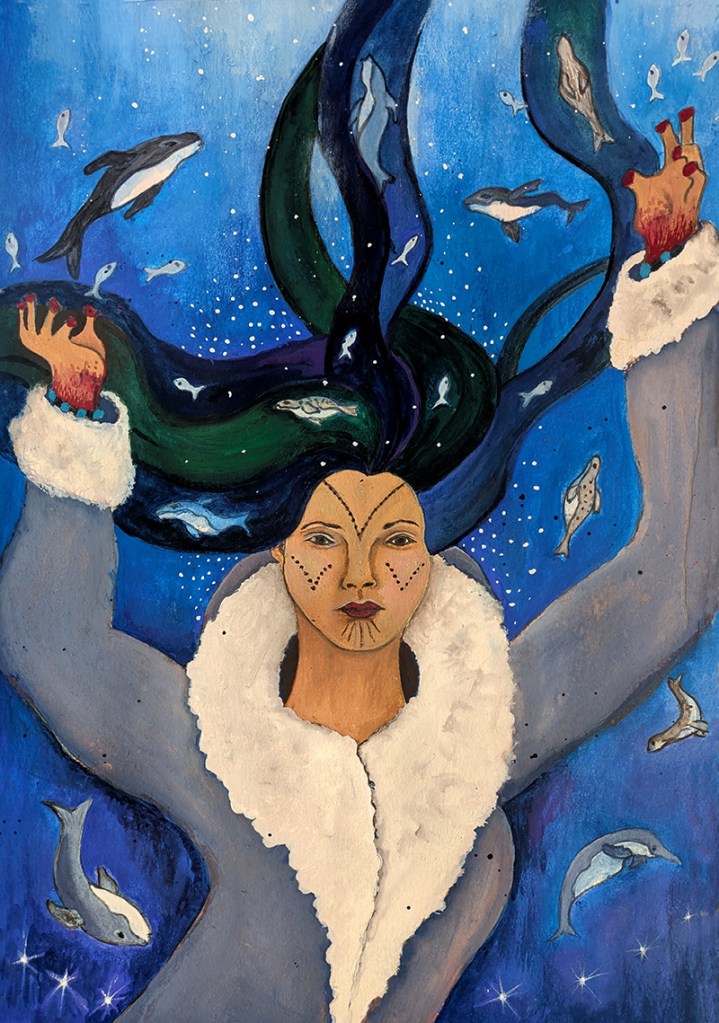
Many versions of Sedna’s story exist. In most, she is portrayed as a beautiful woman who becomes a Sea Goddess. Her metamorphosis occurs when her father throws her from his kayak and chops off her fingers as she clings to the boat to avoid drowning. Her severed fingers transform into the first sea mammals, crucial for the people’s survival. The details leading up to this moment vary greatly among Inuit communities.
To understand the difficulties of this myth, we must first explore the Inuit people of the Arctic regions of Alaska, northern Canada, and Greenland—a harsh environment where extreme cold prevents vegetable growth, trees are scarce, and food sources primarily come from animals like caribou, seals, fish, walruses, whales, and seabirds. This barren world of ice, snow, and sea, with its extremes of light and darkness, poses significant survival challenges.
Keeping this context in mind is important as we explore Sedna’s tale. Her story reflects the harsh realities faced by her people and the strength required to endure them. Ethnographers describe relentless cold, hunger, and the constant search for food, noting that the Inuit will eat almost anything, from the fermented juices of a walrus stomach to seal eyes, and even practiced cannibalism. Before modern comforts reached the Arctic, some believed it was better to consume one’s young child than to starve together, as the child would die without parental protection.
Some stories depict Sedna as prideful, temperamental, and selfish. In one version, she meets her fate after trying to eat her father’s arm while he sleeps, suggesting her hunger was immense.
In most versions, her story begins with her refusal to marry any of the suitors her father offers, believing herself superior to them. In some accounts, her father is deceived by a suitor who misrepresents himself and fails to provide Sedna with a comfortable, secure home. In others, Sedna makes the choice and then becomes dissatisfied with what her husband offers, prompting her father to try to rescue her after learning of her unhappiness.
Often the tales depict Sedna as being tricked into marrying a creature disguised as a man, typically a bird, symbolizing the spirit realm, or a dog, symbolizing the Underworld; dogs are Underworld guardians in myths from around the world
In some stories her father arranges the marriage, while others suggest Sedna is deceived by the spirit bird-man or dog-man. Regardless, her marriage quickly becomes one she wishes to escape.
In the most popular version of Sedna’s story, she marries a fulmar—an Arctic sea bird—disguised as a man. Known far and wide for her beauty, Sedna loved to comb her long dark hair for hours on end.
One day, a fulmar spotted Sedna as he flew overhead. He fell in love with her and swooped down, asking her to marry him. Sedna simply laughed and refused.
Determined to win her heart, the fulmar transformed into a man, donning a rich sealskin coat and unique glasses made from walrus tusks. When he appeared to Sedna in this disguise, he asked her to marry him again. Intrigued by his appearance, she accepted and left with him despite her parents’ objections.
At first, she was happy in their little rock hut by the sea. He brought her fresh meat and sang to her while they made love. But, one day, the bird-man’s glasses fell off, revealing his true eyes. Sedna suddenly saw him as ugly and grew unhappy, yearning to leave and return to her parents’ home.
Meanwhile, her parents, distraught by her disappearance, paddled frantically in search of her, calling out her name. Finally, they reached the little rock hut by the sea, and begged her to return with them. She agreed, stating that she could no longer abide her husband’s ugly eyes.
Her husband, the fulmar, returned home only to discover that Sedna was gone. Flying over the sea, he searched and searched. Putting on the spectacles that had helped win Sedna’s heart, he found their boat and began flapping his wings wildly, sending large waves crashing toward their fragile boat. Sedna’s parents were terrified, fearing they would all die due to Sedna’s prideful nature.
They yelled at her to jump overboard, blaming her for the chaos. She refused, fearing death and blaming the storm on her husband. Overwhelmed by fear, her parents tossed her overboard. As she clung to the side, her father chopped off her fingers, yet she somehow held on. Then he cut off both of her hands, causing her to lose her grip and plunge beneath the waves. The storm subsided, and her parents paddled home safely without Sedna.
Sedna’s mortal life ended with the transformation of death. As she sank to the bottom of the sea, she became Sedna, Mother of the Sea, reigning over the oceans, storms and all sea creatures. Her sacrificed fingers birthed fish, whales, seals, and walruses, all finding their home in her luxurious long hair. This abundance provided the people with nourishing sea mammals essential for survival in the harsh cold. However, abundance and favorable sea conditions are deeply tied to her moods, which are influenced by human actions.
Without hands, she could no longer comb her hair as she once loved to do. Sitting at the sea’s bottom, she grew increasingly miserable as her hair became dirtier with each passing day.
The reciprocity needed between humans, nature, and spirit comes to light through Sedna’s inability to care for herself as she ruled her underworld domain, Adlivun. Adlivun translates to “those who live beneath us”— sea creatures, the spirits of the dead, and the ancestors.
To the Inuit, the goddesses and gods do not exist in a distant, transcendent realm; they are of Earth—approachable and part of life. Thus, Inuit shamans, known as angakkuit, entered trance states to journey to Sedna in Adlivun, where they offered prayers and made amends for humanity’s misdeeds, such as greed, disrespect, and lack of gratitude.
They also cared for Sedna, combing her hair, massaging her aching limbs, and cleansing her body with sand. Only then would Sedna send the angakkuit back to the surface with news that she would provide calm seas and animals for the people to hunt, ensuring they would not starve. The tale of Sedna underscores the importance of honor, accountability, reciprocity, and stewardship in maintaining a balanced world.
Sedna’s Symbolism
The symbolism in Sedna’s tale is rich and varied. In this and many other versions, we glimpse the nature of attraction and the perils of being seduced by beauty. The fulmar’s eyeglasses serve as a façade masking his true identity. Sedna is drawn to this false image, illustrating how superficial appearances can conceal deeper truths. However, her attraction disappears the moment the glasses fall off, revealing the reality of her choice. Unable to see her husband’s true self and its spiritual dimension, she grapples with the conflict between physical beauty and inner truth. Feeling betrayed by a love that was never genuine, she now faces the consequences of her actions.
Sedna represents the cycles of nature—life, death, and rebirth—and the interconnectedness of existence. Life nourishes itself through a delicate balance of taking and giving, as each being feeds upon another. Sedna reminds us of the importance of gratitude for the sacrifices necessary to sustain life.
She symbolizes our dependence on the natural world for survival and spiritual connection. While the sea and nature provide abundant resources, they can also act as destructive forces. Sedna personifies this duality, reminding us to live in harmony with the natural world. Like the angakkuit’s caring actions toward Sedna, we too must nurture the sea, land, and air—a vital message for our modern society, often disconnected from nature.
Sedna’s story also symbolizes resilience, illustrating the strength and adaptability needed to survive. Her journey from a self-absorbed young woman to a powerful Sea Goddess serves as a guide for all when facing hardship and challenges. Sedna reminds us that from difficulty growth emerges. She encourages us to embrace our struggles, finding strength in our connections to community and the natural world.
May you find courage from Sedna’s story to endure your own challenges and those faced by the world collectively
Judith’s oracle decks, Celtic Goddess Oracle & Animal Wisdom Oracle are available here.
Judith’s prints, merch and some originals are available at Judith Shaw Art.
Discover more from Feminism and Religion
Subscribe to get the latest posts sent to your email.

 Feminism and Religion
I am not sure where you are getting your research but this is an ancient Inuit handmaids tale where the daughter is betrayed and sacrificed to the sea. She becomes mistress and protectors of the animals – the Inuit STILL make offerings to her before they go to sea.
LikeLike
Thank you for all the varied tellings and understandings of this tale, Judith, and for the beautiful painting of Sedna in the sea.
LikeLike
Elizabeth, As with most myths there certainly are many versions of her tale.
One that was too long to include in my re-telling is completely different from all the others in that Sedna was not sacrificed. In that one Sedna was forced to marry a dog. She gave birth to a litter of puppies and human children. Her father took pity on her and killed the dog but now there was no one to provide meat for Sedna and her children.
So her father began bringing them all meat but Sedna was still mad at him for having forced her into the marriage and had the dogs attack her father. He escaped but didn’t return out of fear.
But soon they were hungry. Sedna made boats out of the soles of her boots and put her dog children in one boat, sending them off across the sea, with the promise that they would be skillful with weapons. White men are descended from these dog children.
Her human children went in another boat, with instructions to go inland. These became the ancestors of Indians who lived to the south of the Inuit. Then the girl returned home and lived with her parents again.
It’s interesting that though very different, Sedna still becomes a Creator Goddess, only in a different way.
Also in some of the ones where she becomes Mother of the Sea, her father, after sacrificing her to save himself, is drowned when a large wave washes over him while he slept. He ends up at the bottom of the sea with Sedna.
This tale is making me reflect on fear and the damages it does to our world. More to come on those thoughts in the future.
LikeLiked by 1 person
Wow! Thank you, Judith, for sharing this complex version of the tale. Fascinating about the two lineages. I look forward to your further thoughts.
LikeLiked by 1 person
I’d been looking forward to this post ever since you shared the draft painting of Sedna in pencil. WOW she’s emerging strongly!!! Thank you for all your thorough research! Is there an archetype that Sedna embodies for you specifically? I’ve only encountered her this year in June, and for me she is a combination of the wounded healer, and even the warrior, who stands firm despite challenges and limitations…
LikeLike
Eline,
I also just recently discovered Sedna in my research into sea goddesses for my ongoing series of sea goddesses and mermaids. In terms of archetypes I agree that she could represent Chiron, the Wounded Healer though not so sure I agree with her being part of the Warrior archetype. But for sure I see her as part of the Mother Creator Goddess archetype, as her sacrificed fingers birthed the sea mammals so necessary for her people’s survival. And then there’s her ability to control the weather and use that as way to keep her children on the right track of gratitude and stewardship for her blessings.
I find it very interesting that a dwarf planet was discovered in 2003 and named Sedna. It has an elliptical orbit which extends far beyond the reaches of Neptune and takes approximately 11,400 years to complete a single journey around the Sun. It’s strange orbit creates isolation from the other planets.
Astrologers are still exploring the symbolism of Sedna’s influence, but it is believed to represent deep-seated karmic lessons and unresolved issues that span across lifetimes. When prominent in a natal chart, Sedna can indicate areas where one might experience profound challenges, ultimately leading to spiritual growth and evolution. Seems like the astrologers chose the right name for this dwarf planet.
LikeLiked by 1 person
Yes, my astrological chart is strongly influenced by this planet… which is how I found out too :-)
The warrior energy for me is in how Sara mentioned her as protectors of the animals – Warrior energy for me always has more protection, clear boundaries, standing your truth, than about attack or destruction that it has for most… But yes, mother energy too, for sure, creatrix!
LikeLike
Probably a silly question, but do you sell card sets with your amazing goddess collection?
LikeLiked by 1 person
Not a silly question at all. Yes my Celtic Goddess Oracle deck is still available on my website and from my Etsy shop. For folks who live in the E.U. my Etsy shop is the only option, ever since the E.U. imposed their VAT tax on everything, no matter how small, making it impossible for small time artists like myself to ship to the E.U. Etsy has the size to handle that for me.
LikeLiked by 1 person
I more meant writing cards, to send someone for their birthday, or on special occasion… What a shame about the EU difference – I did spot your oracle card deck on Etsy, but the shipping fees are too steep…
LikeLike
Yeah, shipping prices have become absurd. It’s part of the reason it’s getting harder and harder for small businesses to sell online. I do make greeting cards of my work but again the cost of shipping them internationally would be outrageous.
LikeLike
I’m coming to the States in March – maybe you can send them to a friend whom I’ll be staying with? I’ll contact you privately :-) Love!
LikeLike
Thank you for sharing this story. I always found Sedna very interesting. Your painting is awesome.
LikeLike