

Moderator’s Note: We are breaking into our hiatus because of the importance of what is happening in Minnesota. FAR is not designed for breaking news but we do look at underlying patterns about what is going on in the world and what we are seeing is patriarchy in action. We think it important to bear witness and to understand the trends of what is occurring. This piece by Beth Bartlett does both.
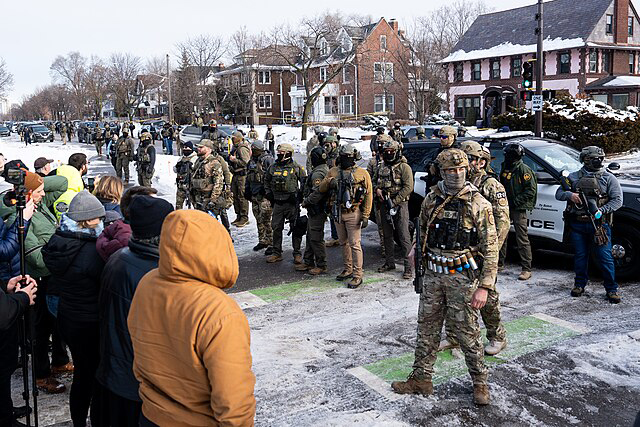
Author’s Note: I live in Duluth, Minnesota, 150 miles north of the Twin Cities where “Operation Metro Surge” is being conducted by ICE agents. Since first writing this, the invasion and siege against the Twin Cities has increased. The Department of Homeland Security has sent 1000 more ICE agents to Minnesota, making the total over 3000. Constitutional observers and people simply driving through an area or being at gas station or parking lots are being pepper sprayed or detained. ICE agents are smashing car windows and dragging people from their cars. ICE agents have targeted schools and daycare centers. They are going door to door. The brutality they have unleashed is indescribable. No one is safe. But the resistance is strong; the mutual aid efforts even stronger. People are caring for each other. …. And as I write this, ICE agents have arrived in force in my city.
“This city will be wiped out, and upon its ruins history will expire at last. . . .”
–Albert Camus, State of Siege
“Loving the daylight that injustice leaves unscathed. . . I found an ancient beauty, a young sky. . . in the worst years of our madness the memory of this sky never left me. It was this that in the end had saved me from despair.”
–Albert Camus, State of Siege
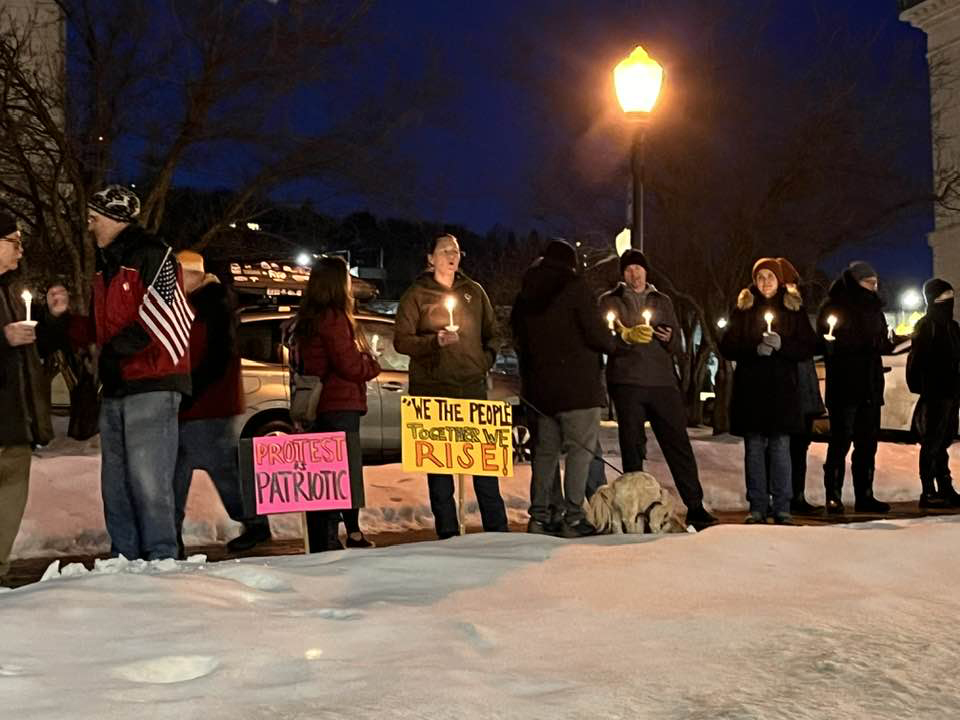
The scene as I drove to the protest and vigil against yet another of the government’s actions and agents was a bit surreal. Juxtaposed against the violence and state repression lay the backdrop of a strikingly beautiful sunset, the sky streaked with pink and purple, peach and blue, and then ahead of me as I passed the hospital, in glowing neon red, the words ”EMERGENCY/TRAUMA.” Yes. We are facing an emergency in this country and trauma of epic proportions. Violence and beauty, rage and tenderness – both. Among the fellow vigilers — friends, former students, long-time comrades in the struggle. We hugged and cried, lit candles, shared our hopes, our fears, our sorrows. Together in this moment we found community in each other.
The next morning, I turned to the post-World War II writers who always have spoken most deeply to me – Camus, Arendt, Orwell. I had taught Orwell’s 1984 in 1984, naively thinking we were safely well-past that Orwellian future, despite Camus’s warning in The Plague “that the plague bacillus never dies or disappears for good; that it can lie dormant for years and years . . . and that perhaps the day would come when . . . it would rouse up its rats again and send them forth to die in a happy city.”[i]
Since Trump’s taking office in January, the plague has roused up its rats again. Under the direction of Stephen Miller and Kristi Noem, the federal government has mounted its ruthless campaign against immigrants in this country, with ICE agents taking on the role of Nazi Gestapo. As raids have increased in number and brutality, we have been approaching a precipice of violence and repression. On January 7th in Minneapolis we edged closer to the brink of that cliff when an ICE agent shot and killed Renee Good, a poet and mother who was attempting to leave the scene.
Witnessing the scene in Minneapolis posted in the news and social media, the first thought coming to mind was that we are in a state of siege. Lines from Albert Camus’s play by the same name echoing the realities in the US today haunt me:
“The Plague: What has happened to this husband of yours?
Woman: He didn’t come home last night.
The Plague: Yes, I deported him . . .
The Plague: . . We must speed up the transformation of innocent into guilty parties. . . . We start with the premises that you are guilty. But that’s not enough; you must learn to feel, yourselves, that you are guilty. And you won’t feel guilty until you feel tired. So we weary you out . . . . once you are really tired . . . everything will run quite smoothly.”
And the repressive regime is not concerned solely with the transformation of the citizenry into compliant subjects; it also seeks to transform ordinary citizens into the thugs we see on the streets of Minneapolis — The Plague: Only dress up your free men in my policmen’s uniforms, and see what they become!”[ii]
In the context of the killing of Renee Good, these lines in the play are especially pertinent and ominous: “The Plague: So the great thing is to secure a majority of slaves by means of a minority of well-selected deaths. . . . That’s why, after having killed or humiliated the requisite number of persons, we shall have whole nations on their knees.”[iii] Is this the tactic being played out in Minnesota? In the country? A minority of well-selected deaths? Just enough and just random enough to reduce the population to its knees, to silent, obedient masses? This is the tactic of terror. “Terror becomes total,” wrote Hannah Arendt, “when it becomes independent of all opposition; it rules supreme when nobody stands in its way.”[iv]
So also, in State of Siege, the repressive regime asserts that ultimately nobody will stand up to it. The protagonist, Diego, remains defiant, confidently declaring that the people are with him, to which The Plague responds, “They will always fail you; you will always be alone. And the lonely man is doomed.”[v]
Arendt maintained that totalitarian regimes succeed by creating and preying upon loneliness. That totalitarian state requires absolute loyalty, and such loyalty, she posited, can only be won from those who are isolated from family, friends, comrades. And loneliness, she said, is increasing. If that was true eighty years ago, it is even more true today, in our isolated cars, homes, and silos of information. In this post-Covid work-from-home and zoom era we are often even isolated in our places of work and worship.
The irony, perhaps the promise of these acts of repression is that in response, citizens, neighbors, friends gather together in acts of resistance and create the very community and solidarity that breaks the back of totalitarianism. As Orwell reflected on his experience in the Spanish civil war resistance, there he found that “’one had been in a community where hope was more normal than apathy or cynicism, where the word ‘comrade’ stood for comradeship.. . .’”[vi]

Moreover, asserted those who lived through the oppressions of the Spanish civil war and Nazi Germany, one must not underestimate the capacity of beauty to overwhelm despair. Even surrounded by death in the trenches Orwell sustained himself by giving his attention to things of beauty, “crimson buds were forming on the cherry trees . . ., you could find violets and a kind of wild hyacinth, . . . wild roses with pink blooms the size of saucers struggled over the shell holes . . .”[vii]
The character Diego similarly extolled the ability of beauty to sustain us despite a regime’s best efforts to erode our resilience: “I’ve seen through your famous system,” said Diego, describing conditions not unlike today. “You have imposed on men the pangs of hunger and bereavement to keep their minds off any stirrings of revolt. You wear them down, . . . But when you were compiling your precious registers, you quite forgot the wild roses in the hedges, the signs in the sky, the smiles of summer, the great voice of the sea, the moments when man rises in his wrath and scatters all before him. . . For there is in man [sic] . . . an innate power that you will never vanquish. . .”[viii] Words of courage and encouragement for these times.

Throughout State of Siege, the people of the besieged city turn to the sea, saying “the sea will save us.” The symbol of the sea as the Great Mother and the goddess is not lost on me. Nor is it on Camus, for he ends the play by invoking the sea, “the waves . . . are calling all to meet together, all the outcasts to make common cause, O mighty mother, whose bosom is the homeland of all rebels, behold they people will never yield!”[ix] We need the strong, rebellious, and powerful energy of the feminine divine to right the wrongs and sustain us in the struggle to resist the powers of patriarchy, militarism, imperialism, domination.
Friendship, solidarity, beauty, the sea, and the sky, the feminine divine – all sources of strength and renewal in these times. They will get us through.
“Yes, there is beauty and there are the humiliated. Whatever difficulties the enterprise may present, I would like never to be unfaithful either to the one or the other.”
– Albert Camus, “Return to Tipasa”
Link to support Minnesota’s immigrant communities.
Sources
Arendt, Hannah. The Origins of Totalitarianism. New Edition. New York: Harvest Brace Book, 1973.
Camus, Albert. Lyrical and Critical Essays. Ed. Philip Thody. Trans. Ellen Conroy Kennedy. New York: Vintage, 1968.
Camus, Albert. The Plague. Trans. Stuart Gilbert. New York: The Modern Library,1948.
Camus, Albert, State of Siege. In Caligula and 3 Other Plays. Trans. Stuart Gilbert. New York: Vintage, 1958.
Solnit, Rebecca. Orwell’s Roses. New York: Viking, 2021.
[i] Camus, The Plague, 278.
[ii] Camus, State of Siege, 180, 182, 222.
[iii] Ibid., 227.
[iv] Arendt, Totalitarianism, 464.
[v] Ibid., 222.
[vi] Orwell, Homage to Catalonia, 104, quoted in Solnit, 104.
[vii] Ibid., 72, 101, quoted in Solnit, 103.
[viii] Camus, State of Siege, 206.
[ix] Camus, State of Siege, 231-232.
Discover more from Feminism and Religion
Subscribe to get the latest posts sent to your email.

 Feminism and Religion
This is excellent, as a testimony to our history and our to strengths as well as our vulnerabilities. I too am incredulous that we are living through another authoritarian loop. I am also fortified by an American spirit that is being activated, tested, and ultimately, I believe will move out the rats. I also think that as a young society we became complacent about what it takes to ensure the American experiment succeeds. A free society that values the rights of all members must be participatory, it must be educated, community-oriented, and like you said, address the disenfranchisement of so many of us. I feel a swelling of pride as an American when I see the people of your state resist the dumb club of tyranny. I know such actions matter and are contagious.
LikeLiked by 1 person
I appreciate your thoughts. Yes, we are a young country. I know I succumbed to complacency during Obama’s presidency, assuming we were finally on a better path, and then the 2016 election happened. I’m proud of Minnesotans, too. :)
LikeLike
Thank you, Beth. Heart with Minnesota and with us all.
LikeLiked by 1 person
Thank you, Elizabeth. <3
LikeLike
Thank you for this post, and for your vigilance?? Isabella Russell-Ides
Sent from Outlook for iOShttps://aka.ms/o0ukef ________________________________
LikeLiked by 1 person
Thank you! My hope has been diminishing each day as I read the reports from Minneapolis. Your beautiful writing has helped me reverse the course of this downward trend as I recall that the cold of a Minnesota winter is followed by spring. And that the feminine force has the strength to overcome the cruelty of patriarchy when mobilized.
LikeLiked by 1 person
My hope ebbs and flows, too. What is happening in the Twin Cities is truly horrifying. And it’s not confined to the Cities. It’s the whole metro and now in smaller cities and rural areas as well. I met with several former students yesterday and they all agreed that ICE is messing with the wrong state at the wrong time — that Minnesotans pull together, especially in the winter! And that’s been quite evident.
LikeLike
Dear Beth! Wow! So much of your inspiring content echoes Prime minister Mark Carney’s speech at Davos last week.
Sawbonna Margot/Raven Speaks
LikeLike
I’ve heard about his speech, but haven’t heard it. I’ll look for it. Thanks.
LikeLike
Here you are, Beth: https://www.youtube.com/watch?v=izDAOvHz5Wc
Sawbonna,
Margot/Raven Speaks.
LikeLike
Thank you!
LikeLike