

This blog was originally posted on Dec 2, 2019
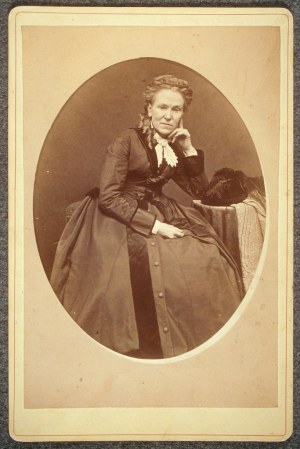
Matilda Joslyn Gage was an activist in the nineteenth century struggle for women’s rights equal to Susan B. Anthony, and a writer and theorist equal to Elizabeth Cady Stanton. That she is not remembered is due in large part to Susan B. Anthony’s efforts to write her out of history.
Matilda Joslyn Gage was also a scholar of women’s history unrivaled in her time. In Woman Church, and State, Gage argued that “the most grievous wrong ever inflicted upon women was in the Christian teaching that she was not created equal with man.” (page 1) From this it follows that feminists must never lose sight of the role Christian teachings have played and continue to play in the unequal treatment of women.
According to Gage, women’s position in church and state did not improve in the Christian era. To the contrary it declined! Gage proved this thesis in chapters titled: The Matriarchate, Celibacy, Canon Law, Marquette, Witchcraft, Wives, Polygamy, Woman and Work, and The Church of Today.
In her chapter on Celibacy, Gage pointed out that though celibacy had been part of Christian history from the beginning, it did not become a requirement for priests in the western Church until the Fourth Lateran Council in 1215 CE. Before that, most priests were married (as they continue to be in the Eastern Orthodox churches). Why do we not know that celibacy has not always been a necessary part of the priesthood? Is this part of the mystification of power?
According to Gage, celibacy did not become required for the priesthood in order to promote holiness. In fact, it did the opposite. Rather its purpose was to increase male power and to line the coffers of the church.
Married priests would leave their property to their wives and children. But with no wives and no children, priests would leave their property to the church. But women also joined celibate orders, didn’t they? The Church encouraged rich women to join holy orders in order to gain control of their property. Poor women were not.
OK, you might be thinking, but celibate priests were holy, weren’t they? Not having wives and children, they could devote their lives to service. In fact, as Gage shows, the majority of priests were never celibate.
After the Fourth Lateran Council, married priests were told to leave their wives and children. This created a class of women and children who were cut off from all means of support, given that married women had already been prohibited from owning property. Many priests refused to follow the church’s orders, but this meant that their wives were declared whores and their children illegitimate: as such, they could not inherit.
As more and more priests refused marriage, more and more women found themselves without even the (limited) financial and social protection marriage provided. The numbers of prostitutes increased. It was so widely assumed that priests would not be celibate that they all had to pay a “concubinage” tax. Things were so bad that in some places priests were forbidden from sheltering their mothers or sisters—because many priests were committing incest with their mothers and sisters. Priests were also prohibited from visiting widows and orphans because they so often took advantage of them.
According to Gage, the insistence that priests must avoid marriage strengthened the church’s claim that women were inherently evil, while increasing the power of priests. It was already church dogma that woman (Eve) introduced sin into the world. It was also already church dogma that original sin was transmitted through the desire that was aroused in the sexual act. Male priests were now declared free of this sin.
Whereas they had once been viewed as men like other men, priests were now set apart. Their authority could no longer be questioned. This gave them new opportunity to take advantage of the power they had. Developing the theory that they were spiritually free of sin even while carnally engaged in it, priests told women that having holy sex with them was less sinful than having sex with a husband. Do you find (as I did) that hard to believe? Gage’s footnotes show that this was widespread practice.
Gage notes that after the Fourth Lateran Council, the requirement that sins be named through spoken confession increased the power of the newly holy and now infallible priests. They learned the most intimate secrets of people and could use the threat of eternal damnation to control them. The system of paid indulgences became common. No, the confessional (that led to one of my aunts being excommunicated when she confessed using birth control after her husband’s serious heart attack) was never a good thing!
About the time of the Fourth Lateran Council, ordinary people were prohibited from reading the Bible: they could have no recourse against the priests. Heresy was defined more broadly and more severely punished. The Inquisition began. This was also the time when the Church tightened its control over civil law.
Rereading Gage’s book after several decades, I found myself so shocked and disgusted by the information she was presenting, that I kept closing the book and setting it aside. My margin notes show that I had indeed once read the entire book, but I had not remembered all of the details. I probably had not wanted to.
We like to think that the abuse of priestly power was the aberration, not the rule.
We like to think that things were not really that bad.
We may also like to think that celibacy is a wierdly Catholic problem.
The idea the celibacy is holy is an outgrowth of the belief expressed in many religions that birth through the body of a woman is to be overcome, because spiritual liberation requires “rebirth,” understood as transcendence of life in the body. The Mother who was once revered as the source of life is despised as the source of sexual temptation, and woman is forced to obey the new rule of man.
Information on Gage can be found on the Matilda Joslyn Gage Foundation website.

Discover more from Feminism and Religion
Subscribe to get the latest posts sent to your email.

 Feminism and Religion
This is such a great piece, thanks so much. I have wanted to know how the catholic church was behind women’s subordination. Not to forget, separating us from God when we are God, one is all there is. I would love to know everything about this and I hope that women who are in the know write books about this because the time is now for all of this to come out.
LikeLiked by 1 person
‘The idea the celibacy is holy is an outgrowth of the belief expressed in many religions that birth through the body of a woman is to be overcome, because spiritual liberation requires “rebirth,” understood as transcendence of life in the body”. Of course! it’s so obvious to me now – but this holy thing had power of me as I was socialized into this culture – I don’t think celibacy has anything to do with anything but personal choice! I never chose celibacy – I just decided that marriage didn’t work for me after trying a couple of times!
LikeLike
I took part in a summit not long ago and learned that co-creation of life takes place between Divine Mother God and women. The soul of our child comes through Divine Mother God, who is responsible for manifestation. This is a direct interface between Divine Mother God and the mother of the child to be born, whereby the soul of the unborn child comes through Divine Mother and in through the mother of the child and into her womb then into the heart of the child, the breath of life begins here. What people are discovering is that Divine Mother God lives within us, she is no “holy ghost” after all. Anne Barring just wrote a great book called The Forgotten Feminine Face of God, it is quite a telling book. The church stole the birth process from women through baptism, claiming our child born of God, who is actually God, is just a sinner. The church has done so much harm to women, it is so disgusting really. Time for healing and reversing all of those twisted beliefs.
LikeLiked by 1 person