

Moderator’s Note: This post has been posted in cooperation with the NCRI women’s committee. NCRI stands for the National Council of Resistance of Iran. You can learn more information as well as see this original article by clicking by link below. A description of their Council can be found at the end of this post. As an introduction, a NCRI representative sent us the following statement about the war. It was originally posted on March 11th and we are reposting it because of its importance.
STATEMENT: I would like to mention that the Iranian Resistance — which established a government-in-exile years ago — has long advocated a clear position: no to war, no to appeasement of the mullahs, but a third option — regime change by the Iranian people and their organized resistance.
Mrs. Maryam Rajavi, the President-elect of the Resistance and an internationally recognized figure, has outlined this vision in her Ten-Point Plan. I am sharing the link below, as it reflects the roadmap of the Iranian Resistance. Maryam Rajavi’s Ten-Point Plan for the future of Iran
Unfortunately, behind-the-scenes dealings and political interests have often ignored this democratic alternative. In recent days, a provisional government framework has also been announced as part of this process. Announcement of the Provisional Government by the National Council of Resistance of Iran (NCRI)
In any case, we are prepared to determine the future of our own country. We kindly ask you to help reflect the voice of the Iranian Resistance, a movement notably led by women ,so that this alternative can be more widely heard.
“Gender-Based Discrimination Under Iranian Law” is the title of the NCRI Women’s Committee’s report to CSW70, as it focuses on “Ensuring and strengthening access to justice for all women and girls, including by promoting inclusive and equitable legal systems, eliminating discriminatory laws, policies, and practices, and addressing structural barriers.”
The religious dictatorship ruling Iran is one of the few political systems in the world to have institutionalized discrimination against women systematically across all levels of its legislative framework.
At a time when the world is moving toward the abolition of the death penalty, and when the number of women executed in other countries remains in the single digits, the religious dictatorship ruling Iran set a new record of brutality in 2025 by executing 65 women.
The fundamental question is why the fate of these women ends at the gallows.
The answer cannot be found solely in the solitary confinement cells of Qarchak or Evin prisons, nor in the psychological condition of the victims themselves. Rather, it must be sought in legal texts that define “woman” not as a free human being, but as the property of men and a matter of so-called religious expediency. Every knot tightened on the noose of an Iranian woman was first woven into the most foundational laws of this regime.
The execution of 65 women in 2025 is the logical outcome of a structure in which “being a woman” is not recognized as a human identity but rather treated as an existence subordinate to men.
The constitution of the religious dictatorship blocked the path to equality from the very outset. The Civil Code sidelines women by cutting their economic worth and legal credibility in half. Family law endorses child marriage and enforces dead-end divorce regulations to keep women dependent, while the Penal Code, monstrous in nature, takes revenge on women who challenge these barriers, condemning the weakest and most isolated among them to death.
To substantiate this argument, we will examine step by step the obstacles embedded in the clerical regime’s laws that prevent women from accessing justice.
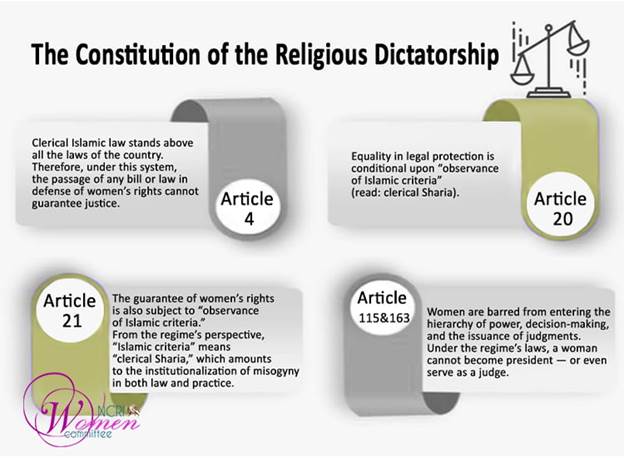
In this document, prepared for CSW70, the NCRI Women’s Committee demonstrates, through a meticulous examination of the clerical regime’s laws, how the mullahs have systematically sealed off access to justice for Iranian women through layers upon layers of misogynistic legislation.
The review theme of CSW70 is “Women’s full and effective participation and decision making in public life, as well as the elimination of violence, for achieving gender equality and the empowerment of all women and girls (agreed conclusions of the sixty-fifth session).”
Therefore, in chapters 2 and 3 of this report, you will read about the growing level of violence against women in Iran and whopping gender gap depriving of the most educated women of Iran from the opportunities they deserve.
INFO: NCRI The NCRI Women’s Committee works extensively with Iranian women outside the country and maintains permanent contact with women inside Iran. The Women’s Committee is actively involved with many women’s rights organizations, NGOs, and the Iranian diaspora.
The NCRI Women’s Committee is a major source of much of the information received from inside Iran with regard to women. Attending meetings of the UN Women, the UN Commission on the Status of Women (CSW), the Human Rights Council, and other international or regional conferences on women’s issues, and engaging in a relentless battle against the Iranian regime’s misogyny are parts of the activities of members and associates of the NCRI Women’s Committee.
The NCRI Women’s Committee is one of the 25 committees of the National Council of Resistance of Iran.
For more on this women’s committee click here.
If anyone wish to support our work, you may consider donating via this link. Your support is entirely optional and greatly appreciated.
Support the struggle of Iranian women – Our projects
Discover more from Feminism and Religion
Subscribe to get the latest posts sent to your email.
 Feminism and Religion