Exploring the F-word in religion at the intersection of scholarship, activism, and community.
MaVynee Betsch: Preserving History and the Environment by Maria Dintino
Moderator’s Note: This piece is in co-operation with The Nasty Women Writers Project, a site dedicated to highlighting and amplifying the voices and visions of powerful women. The site was founded by sisters Theresa and Maria Dintino. To quote Theresa, “by doing this work we are expanding our own writer’s web for nourishment and support.” This was originally posted on their site on Feb 18, 2025. You can see more of their posts here.
“It’s history and nature all wrapped together, baby.” -MaVynee Betsch
I had heard of MaVynee’s great-grandfather, Abraham Lincoln Lewis (1864-1947), one of the founders of the Afro-American Life Insurance Company in Jacksonville, Florida during the Jim Crow era. Lewis became Florida’s first Black millionaire.
Dismayed by racial segregation, Lewis purchased beachfront property on Amelia Island, just north of Jacksonville, and created American Beach, one of four Black beaches between Jacksonville and Daytona.
The Earlier Years
He [A.L. Lewis] believed that a beach should be open to everyone. In no time, American Beach was hopping. Marvyne Elizabeth Betsch’s birth on January 13, 1935, coincided with her great-grandfather’s purchase of 200 acres of beach. Her childhood flourished alongside American Beach, which became a popular, thriving resort with homes, restaurants, hotels, nightclubs, and businesses.
After high school, she attended Oberlin Conservatory of Music. Marvyne graduated in 1955 at the top of her class and trained and performed in Europe as an opera singer for ten years. In the mid-60s, when her mother became ill, she returned home.
Friend and journalist Russ Rymer explains:
“She was raised in one of the preeminent black families in the South and was educated at the Oberlin Conservatory of Music in Ohio. She studied voice in Paris and London, and sang opera throughout Germany during the mid-1950s and early ’60s in concert halls where she is still remembered four decades after she quit her glamorous career because she felt herself called home to Florida.”
Homecoming
After returning to Florida, Marvyne’s focus altered dramatically. Eventually, her first name changed too. She dropped the ‘r’ in protest of the Reagan Administration’s environmental policies, and added an extra ‘e’ for the environment. She became known as MaVynee (pronounced Ma-veen) for the remainder of her life, and perpetuity.
Living at her mother’s house on the beach, MaVynee became captivated by the birds, butterflies, and more. She learned all she could about these precious creatures. This desire to educate and protect led MaVynee on the path to becoming an environmental activist.
Although she left the stage behind, it is said her activism became her performance. She delivered her message of protecting the environment, its inhabitants, and history with an incredible vocal range, and captivating, memorable drama.
Soon after, her mother died. MaVynee spent her days sitting along the shore, wrapped in a blanket of sadness. She sat. And sat. So much had changed since her childhood days on American Beach.
Her mother passed in 1975, leaving her a hefty inheritance which over time she donated to various conservation and research organizations. Soon she had given everything she had away. (Some note that she inherited the philanthropy vein from her Great-grandfather Lewis, yet not his business savvy!)
Broke and homeless, MaVynee lived on the beach and determined to focus her work locally, to save what she could of American Beach, increasingly encroached on by high rises and other sorts of development.
Determined to save what remained. MaVynee became the caretaker for American Beach. She picked up trash, planted trees, and remembered colorful stories about its early days when Zora Neale Hurston sunbathed on the sand and Ray Charles juked the local joints.
It became most important to protect what was left of her great-grandfather’s stretch of American Beach and to share its significant history. After the passage of the Civil Rights Act in 1964, there wasn’t the need for Black beaches and these once vibrant resorts fell into disrepair. Most of the beachfront land and structures were purchased by developers.
An Activist Emerges
MaVynee especially wanted to protect a sand dune she named NaNa which means grandmother in Ghanaian, “part of the tallest dune systems on Florida’s Atlantic Coast”(National Park Service).
Her sister, Dr. Johnnetta B. Cole gave her a small RV and a monthly stipend, so she no longer slept in a chaise lounge on the beach (unless she chose to), and ultimately she ended up living in a small apartment. Here she amassed a collection of documents, clippings, and memorabilia about American Beach, with plans to one day establish a museum.
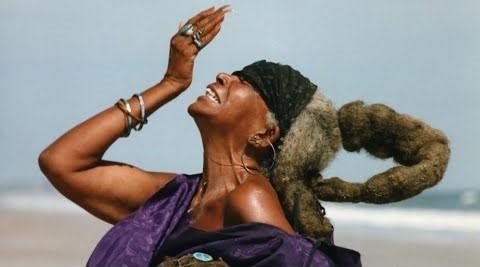
MaVynee was 6 feet tall and carried herself with poise and grace. She grew her nails a foot long on one of her hands and sometimes painted the nails orange, the color of the rope used in the Jim Crow days to separate whites and Blacks in the water. She grew her hair into a 7-foot dreadlock that seemed to take on a life of its own. MaVynee dressed colorfully and wore copious amounts of natural jewelry, such as seashells and stones. Her appearance made a statement most likely beyond what her great-grandfather Lewis meant when he told his great-grandchildren, “Understand that everything you do makes a statement, whether it’s your jewelry, your clothes, or your house.”
“The schoolchildren of American Beach have a theory about MaVynee’s magical ability to prevail—they whisper that she’s a shaman or a witch. Their evidence is her appearance: her fingernails are very long—until they got clipped in the hospital, those on her left hand spiraled to more than a foot and a half. Her hair, coiffed into a wheel over her head, cascades in graying dreadlocks down her back and past her ankles. Her hair and clothes are festooned with political buttons, unfailingly radical and generally funny, most expressing her commitment to social and racial justice, ecological causes and vegetarianism. Her colorfulness acts as a mighty come-on, especially for children. “They come to see my hair,” MaVynee says mischievously, “and I give ’em a little history”(Rymer).
Beyond these theatrics MaVynee walked the walk and talked the talk. She and her allies were persistent and kept the preservation of nature and history at the forefront.
“She [MaVynee] and others also blocked developments on adjacent islands and successfully campaigned to add American Beach to the National Register of Historic Places. During these campaigns, she regaled county commissioners with speeches about “devil-opers,” wrote letters, spoke to school groups, traveled to the state capital in Tallahassee to lobby and protest, and otherwise made herself impossible to ignore”(Nijhuis).
The madder she grew, the braver she got. She squabbled with city commissioners, wrote letters to lawmakers, and marched to Tallahassee to fuss at the governor.
MaVynee’s Legacy
Diagnosed with cancer in 2002, MaVynee courageously continued her work until she died on September 5, 2005, at 70 years old. The fruits of her labor include a textbook on butterflies dedicated to her, and “An Atlantic-traveling whale…given her name (MaVynee #1151) by biologists at Boston’s New England Aquarium”(Rymer).
MaVynee’s spirit lives on, entertaining, educating, and inspiring. This beautiful children’s book, Saving American Beach, delivers her story to hundreds of children, sharing the positive impact one impassioned woman, with the help of others, can make in our world.
As MaVynee neared the end of her life, she said, “Baby, I’ve done what I’m supposed to have done.” And some.
BIO: Maria Dintino has worked in higher education for twenty-six years, the first twenty-three at Keene State College in Keene, NH and the past few years at Flagler College in St Augustine, Florida. While in graduate school, Maria became enamored with the Transcendentalists, especially Henry David Thoreau. Although introduced to Margaret Fuller then, she did not comprehend her undeniable significance until another encounter many years later. It is now clear to Maria that Margaret is destined to claim her rightful place in American herstory and one of Maria’s goals is to help her do so. Maria’s first work of creative nonfiction, The Light Above: A Memoir with Margaret Fuller has been recently published and she is at work on her second book. Contact Maria at mdintino477 at aol.com.
Discover more from Feminism and Religion
Subscribe to get the latest posts sent to your email.
Login to your WordPress account to facilitate your comment submission, https://wordpress.com/log-in/ and please also familiarize yourself with our Comment Policy before posting. Cancel reply




 Feminism and Religion