

I recently returned home from a two-week visit to Buenos Aires, Argentina—a trip I took with my eldest son, Mike, who throughout the years has expressed an interest in my birthplace. He has an avid interest in history, geography, and economics. It was like putting puzzle pieces together for him—attempting to understand the various aspects of Argentina in light of my experience. What was it like living in a “foreign” country? Did I have friends? Who were they? What were they like? How did we, the family (parents, 4 children—the 5th was born much later), get along?
My parents were American, Protestant missionaries. They met at Moody Bible Institute, Chicago, Illinois, in the early 1940s. My mother was a Registered Nurse. My father had been recently discharged from the U.S. Navy. Both of them were eager to do the “Lord’s work.” For them, that meant serving the Lord as missionaries. They felt “called” to go to Argentina and preach the gospel mainly to Jews, God’s “chosen people.”
In Argentina, my parents struggled financially. Their mantra (especially my mother’s) was “God will provide.” That translated in my mind to “don’t ask for anything we cannot afford.” My parents’ income depended on God placing our needs on the hearts of people (mainly in the U.S.) who would then be moved to support our mission—the New Testament Missionary Union. Funds were divided among all the missionaries in the organization equitably, meaning the more children you had, the greater percentage of the available funds you received. It was never enough. My maternal grandmother, Jessie, often supplemented our income. I don’t remember ever going hungry, but I do recall appearing slovenly and disheveled—always an embarrassment. Except for my school uniform, the only clothes I wore were hand-me-downs or the ones Jessie sent from the U.S.
For years we lived at Liniers 562, Temperley, a suburb of Buenos Aires—the address indelibly etched in my memory.
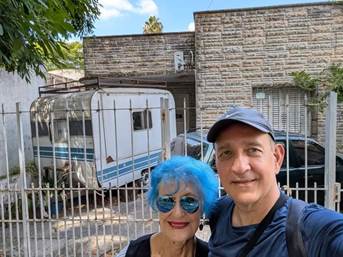
The house’s windows and front door are barred. There’s a metal fence in front of the property with concrete walls on either side. A small camper and car are shoved into the yard—the place my mother grew her red geraniums when she could get a “cutting” from a friend or neighbor.
While reminiscing by the house, a man eventually appeared. I spoke with him. In Spanish. Yes, he lived there. told him I used to live in this very house. He fidgeted, locking the gate behind him while we spoke through the bars. No, that’s not possible, he barked. Yes, I played with a friend, Garibaldi, who lived behind the place. is face remained closed. When he realized our family did not own the house, he relaxed—but just a little. We only rented, I assured him. Did he think I wanted to make a claim on the property? Hard to know, but that same watchfulness, bordering on paranoia, began to seep back into my bones. It’s how I remember life in Argentina. Be careful what you say, who you are seen with, and where you go. Never trust a soul! He said he could not invite me in to see the place. I told him I understood.
My father frequently took the train to Buenos Aires’ “Jewish district.” Somehow, he obtained a microphone hooked to a loudspeaker from which he boldly proclaimed the message the Lord had given him to deliver. “Repent, for the kingdom of heaven is at hand.” I accompanied him to hand out literature infrequently, however, when I did, the whole event mortified me.
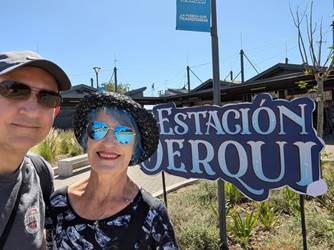
After some years, my parents branched out and ministered to non-Jewish people. The most memorable place was Derqui, a suburb of Buenos Aires, almost an hour by train northwest of the city. Today, Derqui’s streets are paved—not dirt pathways. There’s a grocery store, two small restaurants, a clothing and home shop, a school, a clinic, Catholic Church, and police station. My parents worked with the Ostiks, a Polish family who spent time in a displaced person’s camp toward the end of WW2, had refugee status, and were in the process of becoming Argentine citizens.
Mike had many questions. I had no absolute answers—only my experience. So much puzzled him. The proselytizing. The seemingly “willful” poverty at the expense of the children. The bars on the windows and theft-proof enclosures of homes. The continual political upheaval. Why?
Argentina, as far back as I can remember, has been in turmoil. Food shortages. Electrical outages. Water and fuel rationing. Bus and train strikes. The “desaparecidos” (1976-1983 “dirty war.”) The country still mourns for people, dubbed as enemies of the state, abducted off the street, imprisoned, tortured, and then murdered. Pregnant women were taken, kept alive until their babies were born, then killed—their offspring given to military officers’ families. (Doesn’t some of this sound familiar to us in the USA?)
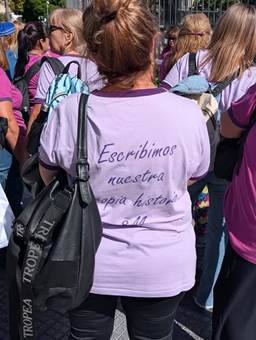
Today, demonstrations in the Plaza de Mayo in Buenos Aires still happen. We witnessed two. “The Mothers of the Plaza de Mayo” tirelessly attempt to uncover the truth about (and remains of) their relatives. They want the government to be held accountable.
Am so grateful to have taken this pilgrimage with Mike to Argentina! Besides discovering that we travel well together, we enjoyed conversations that probably would not have happened without this two-week hiatus in our lives. I lived fully in each moment—one of the many gifts travel offers.
We are finite and mortal. Our visit to Chacarita, a sprawling cemetery in Buenos Aires, brought this truth into stark relief. The entrance to Chacarita is elegant with its well-pruned trees and colorful landscaping. The farther one walks into the cemetery, chaos and disarray become evident. Unmarked graves. Collapsed graves. Niches stacked high, reminding me of filing cabinets—many with broken glass and bones falling out of the compartments onto the ground.
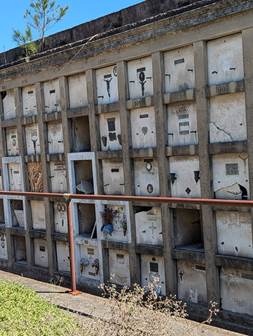
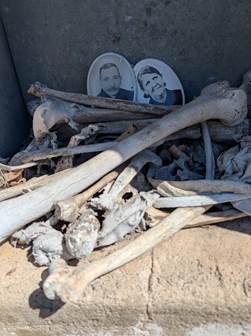
Is this couple overlooking their own bones? Does anybody today know of these people? How long can we be expected to be remembered after our demise? Is that even important? Perhaps one takeaway (there are many) from this trip is the reminder to fully experience the present moment—whatever that moment offers. Then, embrace it. That’s all we have.
Discover more from Feminism and Religion
Subscribe to get the latest posts sent to your email.

 Feminism and Religion
It’s all we have – this is a mantra I have to adopt – for everything – thank you for this moving story – each one of us carries ‘holes’ in the fabric – i think it’s important to acknowledge this – thank you
LikeLiked by 1 person
Thanks, Sara!
LikeLike
Esther, thank you so much for sharing this story. How wonderful that you and your son not only traveled together to Argentina but to new experience and understanding of each other.
LikeLiked by 1 person
Yes, that’s exactly right, Elizabeth! We all want to be known, yet we don’t seen to achieve that goal very well. Best we can do is work towards it. Thank you for reading and commenting.
LikeLike