Mary Daly: Can I Love the Luddite and Deplore the Transphobe? by Dirk von der Horst

David’s Loves, Jonathan’s Laments by Dirk von der Horst

Mary Daly was one of the most prescient voices of her time with regard to environmental disaster.

Daly was also an explicitly transphobic thinker.

These two facts are deeply related.

What links these two directions in her thought is a radically anti-interventionist ethic.  Daly repeatedly shows how the patriarchal impulse to control everything in the world not only destroys womens’ lives but is destroying the living, natural world.  She describes boundary violation as one of the key elements of control, and her concern for the ability of nature to be on its own terms extends to such unconscious phenomena as comets.  In Quintessence: Realizing the Archaic Future, she laments scientists “harpooning a comet, just to see what’s inside,” revealing the extent of her respect for the integrity of natural processes. (3)

In contrast to the technological use of science to bend nature to human purposes, Daly advocates participation in Be-ing.  Be-ing is a natural process of unconstrained movement, in which various Selves and Elemental forces unfold.  In an unalienated state of participation in Be-ing, connection is genuine and unforced, and the relations that emerge in this process further spur the development and creativity of a natural unfolding process.  Among the many words Daly reclaims and plays with, her use of “Wild” describes women’s participation in Be-ing, and it especially brings out a sense of uncontrolled creativity.

Continue reading “Mary Daly: Can I Love the Luddite and Deplore the Transphobe? by Dirk von der Horst”

Honey: A Thousand Flowers by Mary Beth Moser

Today I am finishing the last bit of the honey I hand-carried home from my most recent trip to Trentino. Sun yellow in color, it is made from the nectar of mountain flowers. Its label tells its origin—di montagna, of the mountains, and its type — mille fiore, often translated as “wildflowers.” Literally, however, it means “a thousand flowers.”
The valley where my maternal grandmother was born, Val di Sole, is renowned for its honey. In Croviana, one of the villages in the valley, new honey is celebrated in July with a sagra, a communal food festival. There are more than a dozen different types of honey from Trentino, including apple, chestnut, and rhododendron. These are plants of place – nature’s gifts that appear in the folk stories and are present in everyday life. Continue reading “Honey: A Thousand Flowers by Mary Beth Moser”

Missing a Teachable Moment: The Purple Dress by Marilyn R. Freedman

Intelligent and impish eyes took in my approach, and the little girl moved away from the post office doors. But not before I saw her sweet face with round cheeks still full of baby fat squished against the glass. With slightly messy, curly blond hair and wearing a shiny, deep purple, ruffled dress-up dress, she looked pretty, happy, and confident. This was her world, wherever she was. When I smiled, though, she turned away, shy of a stranger.

I got into the long line with my kid and listened to the little girl’s dad discuss gift card values with her older brother. The boy named an amount, and the dad commented about how expensive it was. “What a great way to teach a little economics and finance,” I thought.

Continue reading “Missing a Teachable Moment: The Purple Dress by Marilyn R. Freedman”

Reclaiming Yourself From Domestic Abuse by Kitty Nolan

One in three women worldwide experience Domestic Abuse at some point in their lives; I am one of them.  There are many terms to describe what we experience:  Gender Based Violence (GBV); Domestic Violence (DV); Wife Battering; Violence Against Women and Girls (VAWG); I’ve opted to use the term Domestic Abuse because it covers many of the behaviours women, and men, experience.  Firstly, domestic describes the running of the home, or family relations, and is synonymous with private; private or intimate relationships are the grounds for this abuse.
I use ‘abuse’ instead of violence because it covers physical violence, sexual abuse, financial abuse, emotional and psychological abuse, power and controlling behaviour, isolation, and spiritual abuse.  Some victims experience some of these behaviours, many experience all of them. Women and men experience abuse differently. For one thing, men are more likely to murder their partners than women are, and women generally have full responsibility for the care of children.  With that in mind, my focus in this piece will be on women. Continue reading “Reclaiming Yourself From Domestic Abuse by Kitty Nolan”

When Community Eclipses Polarity by Kay Bee

I recently accepted a new position at my local public library and yesterday the duties of that position happened to include staffing our library’s Eclipse Viewing Party. From about 10am to 1pm, I answered countless questions about the eclipse, helped people of all ages make pinhole projection viewers out of everything from cardstock to saltine crackers, loaded & reloaded NASA’s footage that we live streamed on the big screen, & handed out moon pies. And, of course, encouraged the couple hundred folks who had descended on our little library to be good neighbors and share the fifty pairs of NASA-approved eclipse glasses we’d managed to get our hands on the week prior.

The eclipse was stunning. We were able to experience the temperature drop, the change in the quality of light, and a safe view of the peak of the eclipse, which was at about 80% here in the Four Corners area. But what really struck me about the experience was the spirit of community I witnessed.

Image courtesy of NASA/GSFC/CI Lab

Folks shared eclipse glasses with each other freely, passing them around beyond the friends or family they had come with to people they didn’t necessarily even know. “Did you get to take a look?” was a phrase I heard everywhere I went as I wove through the crowd, helping wherever I was needed. “Here, use these and then pass them on.” Kids broke moon pies together, splitting them into pieces to share with those who hadn’t snagged one before we ran out of those as well. People spotted shadows of the eclipse naturally projected onto the ground or on one gentleman’s white cowboy hat by the sun’s light as it passed between tree leaves and happily showed each other. Elders taught children they didn’t know how to use their pinhole projectors just like they did when they were young. Everyone cheerfully & excitedly helped each other get a different perspective on this moment in time in order to better appreciate the ever-shifting relationship between our Earth, Moon, & Sun.   Continue reading “When Community Eclipses Polarity by Kay Bee”

Memory Beneath the Coptic Roof by Nazia Islam

Memory Beneath the Coptic Roof

The past two years,
I’ve been trying to channel
the spirits my of ancestors.

Connecting them
to hymns of history and litanies of theory.
Searching for rootedness.

But I didn’t find a sense of rootedness
until they reminded me that
roots are more than remembering. Continue reading “Memory Beneath the Coptic Roof by Nazia Islam”

Lektrima by 2 Worlds

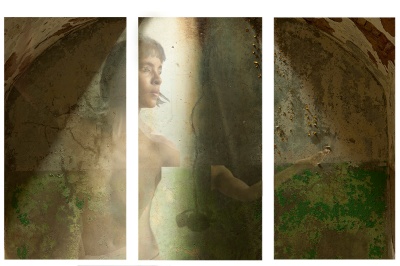
Lek Trima is a portfolio of photographs expressing reverence for feminine energy.

I had doubts as to whether I should create around this topic, I’m not a scholar, subject expert, or woman, but during flailing phases of the project I counted on sincerity and passion to keep me focused and hopeful.

In fact, after an exuberant start with some reading and research, I became dismayed in that any attempt on my part would seem to contribute to the problem that the majority of world literature on female archetypes, religious figures and myth traits has been written from a male viewpoint and projection. With a tempered demeanor, I continued. My intentions were earnest and as the work began to mature, I regained confidence and felt I could make something interesting and purposeful.

The title, Lek Trima, is taken from a mystical song composed by the first Dali Lama (1391-1475) in celebration of the Tibetan Buddhist deity, Tara. Tara is known as the “mother of liberation,” and recognized as a female Buddha. Ultimately, she represents a set of Buddhas and traits that are called on as focus points in developing inner qualities by practitioners of tantric mediation. Continue reading “Lektrima by 2 Worlds”

David’s Loves, Jonathan’s Laments by Dirk von der Horst

David’s Loves, Jonathan’s Laments by Dirk von der Horst

LGBTQ+ people in biblical religions often turn to the story of Jonathan’s love for David as an example of biblical affirmation of same-sex love.  The biblical narrative in 1 and 2 Samuel stresses Jonathan’s love for David from the moment David and Jonathan meet to Jonathan’s death after which David utters the famous words, your love to me was wonderful, passing the love of women.” Nevertheless, “love” can indicate many different kinds of relationship, both sexual and non-sexual, and one finds much resistance among biblical scholars to reading Jonathan and David as a model of sexually-expressed love between men.  While some passages in the text are sexually suggestive, nothing in the Bible explicitly states, “David and Jonathan had sex.”  Thus, the strategy of holding up Jonathan and David as a biblical vindication of same-sex love and desire only throws LGBTQ+ people back into the exhausting state of being endlessly debated.

My new book, David’s Loves, Jonathan’s Laments: Gay Theology, Musical Desires, and Historical Difference speaks from the pain of the experience of being caught in the crosshairs of that debate.  Inspired in large part by Mary Daly, it also speaks from an impatience with the state of being stuck in a debate that endlessly repeats itself.  This inspiration from Daly is only one way in which feminist thought deeply informs my project of rethinking the relationship of Jonathan and David.

Continue reading “David’s Loves, Jonathan’s Laments by Dirk von der Horst”

With Women by Kay Bee

Someone told me the other day that Death Doulas are one of the fastest growing career fields out there right now. As a (currently not practicing) Birth Doula, this does not surprise me. The term Doula came into its modern – predominately American – usage in the early 1970s, in reference to a woman who provided non-medical care for a birthing woman. The word is Greek in origin and depending on who you ask, means “with woman” or “servant woman.”

While I suspect the earlier “servant woman” version is the correct etymology, the romantic in me appreciates the “with woman” version, even in its technical inaccuracy. This is because at its core, the role of the Birth/Postpartum Doula is the formalized return of what I believe in my bones to be an ancient cultural practice of women being with each other as a woman passes through an intense life transition.

Whereas before, when a woman gave birth, the older, multiparous women of the local culture would gather around her to see her through her passage from expectant to postpartum motherhood; now some of us approaching that same rite of passage use the Internet to reach out into the culture to hire a Doula to do that very same thing. How we bring it about has changed, but what we desire has not. We desire to be supported, cared for, & loved by someone who has gone through what we are about to — we desire to be with women.

The number of Birth Doulas in the U.S. and abroad, at this point, has increased dramatically over the last ten years and now it would seem that the Conscious Birth movement has birthed a Conscious Death movement, complete with Death Doulas. Again, how we secure the care we want at birth or at death has changed, but what we desire in those powerful moments of passage has not.

The fundamental physical, emotional, and spiritual craving to be with women at life’s major rites of passage runs incredibly deep within us. It is also something denied to us by the patriarchal structures of most major religious systems, but over the last sixty years or so, we’ve worked hard at taking that back. Continue reading “With Women by Kay Bee”

A Mother’s Gifts by Dawn Morais Webster

Dawn Morais Webster, the Pope off to his summer palace, Castel Gandolfo. He tells the world he will now become just a “humble pilgrim.”Parvati is a gentle mother goddess. But as Kali, she also wields enormous power. The daughter of Himavan, the king of the Himalayas, consort of Lord Shiva, and mother of Ganesha, the Elephant-Headed Lord, Parvati is the embodiment of all the energy in the universe.  Her seat is on a lion or a tiger.  In the words of a hymn to this goddess, she is “the auspiciousness of all that is auspicious.”

Lakshmi, the consort of Sri Maha Vishnu is often depicted as a very beautiful woman, seated on a full-bloomed lotus, holding lotus buds in two of her hands, a pot of gold in the third. She is flanked by elephants, reflecting her royal status. Lakshmi, as the Goddess of Prosperity, is brilliant in red silk, gold and precious stones. She also offers peace and a sense of balance.

Mother’s Day provided good reason to remember these Hindu deities. They lent their names to the two cows who were milked daily to feed me in the first six months of my life in my grandparents’ home by the sea in Thiruvananthapuram—or Trivandrum, Kerala. I wrote those foreign place names for decades in application letters and immigration forms but it was more than five decades before I first returned to the place where I was born. Continue reading “A Mother’s Gifts by Dawn Morais Webster”