Lady of the Trees by Mama Donna Henes

Donna Henes, Urban Shaman, Queen of my  self, crones,

Her roots reach to the very center of the Earth where they wind around the sacred wells, the deep source of wisdom…

Possessing the potent powers of fertility, growth, resilience and longevity, the tree is widely seen as the progenitor of the world. Family Tree. The Tree of Life. The tree goddess was seen as a sylph, an airy tree spirit who resides among the green leaves, sustaining and nurturing the vegetative forces. She is the symbol of the flow of life, a Mother Goddess who is Herself the Tree of Life.

The Maasai people claim their descent from an original parent tree. For the Slavs, the world tree is the symbol of all relationship, and as such, is held as the central philosophical image in that culture. The Maya of Central America understand themselves to be part of a great celestial ceiba tree. This silk-cotton tree, which stands for all life is the pole at the center of the Earth and serves to hold up the heavens. The Koran refers to the cosmos as a tree. Continue reading “Lady of the Trees by Mama Donna Henes”

What About Contraception in Pope Francis’s Promise to the Poor? by Dawn DiPrince

Pope Francis, at nearly every opportunity – including the choice of his name, has symbolically expressed a commitment to the poor. In just a little over a month, he has declined the customary gold papal cross, the ermine-trimmed red velvet cape, and the showy red loafers worn by his predecessor. He has refused the palatial papal penthouse apartment and is currently living in a two-room suite among the Vatican’s cardinals.

In additional to a more austere lifestyle, Pope Francis has spoken out about the world’s poor. His namesake is St. Francis of Assisi, who famously worked for the poor and for peace. The Pope claims he was inspired to take the name Francis when remembering a friend’s urging to “not forget the poor.” More to the point, Pope Francis has stated that he wants “a Church which is poor and for the poor!” Continue reading “What About Contraception in Pope Francis’s Promise to the Poor? by Dawn DiPrince”

The Danger of the Patriarchal Domination Mindset: Can We Do Anything About It? by Thea Iberall

The Danger of the Patriarchal Domination Mindset: Can We Do Anything About It? By Thea Iberall The Swallow and the Nightingale

At the confluence of misogyny, prejudice, homophobia, religious intolerance, environmental destruction, and violence is the patriarchy. We all know this and talk about it here from our own perspectives. I come as a scientist and writer. I have a love of history and science as well as a skill at simplifying complicated things. I abhor what some people are doing to our planet and the arrogance with which they do it. Unfortunately, because we want the stuff they are manufacturing, because there are too many of us, and because we are letting them do it, they do it with our blessings. I want to help change this situation with a novel I’ve been working on for almost 15 years.

In the year 2000, I sat in a dinghy in the caldera of the active underwater volcano at Santorini helping my geologist sister count the bubbles coming from below us. The experiment was part of my father’s research into the origins of life. I had had the seed for a novel thirteen years earlier when I heard Mimi Fariña sing The Swallow Song, talking with her about her deceased husband Richard Fariña and how lost his music has become. I began developing ideas, learning about the nightingale connection and discovering a 12th century Sufi master’s epic allegory about god. Sitting in that dinghy, everything coalesced: the story of how western civilization went off course. My book of contextual poems, The Sanctuary of Artemis, explores the roots of Western patriarchal culture and tells some of it. The novel would have a backdrop of a world collapsing as ornithologist Dr. Deborah Wright is unwittingly guided by the Sufi to figure out why the Capistrano swallows are dying. It would include an underlying history of an egalitarian world lost when this volcano erupted in 1628 BC. Richard Farina’s song would be playing throughout the pages.  Continue reading “The Danger of the Patriarchal Domination Mindset: Can We Do Anything About It? by Thea Iberall”

Breaking the Stained Glass Ceiling? Conflict in Religious Histories by Meagen Farrell

Meagen Farrell, women's ordination

In attempting to research and write about the process and arguments in the development of women’s ordination in the Anglican Church of Ireland (which I first wrote about here on Feminism and Religion), I am frustrated by the polarization of language. While “objectivity” is fruitless, I strive for what Warren Nord calls philosophical fairness: when teaching about contested religious territory, to characterize each position in the terms they would choose for themselves.

How do I fairly label an historical debate on whether or not to admit women to the diaconate and priesthood? Using the phrase “women’s ordination” in my current Kickstarter campaign already puts me in a particular camp. The constraints of the medium require brevity. I have to make a choice. Continue reading “Breaking the Stained Glass Ceiling? Conflict in Religious Histories by Meagen Farrell”

Incarnating the Mystery with Psychological Awareness by Jean Benedict Raffa

image010As a college professor I taught Children’s Literature. Mythology, stories about humanity’s relationship with the gods, always raised a few eyebrows. Students tended to feel uncomfortable when this term was applied to their own faith traditions since it generally connotes “untrue.” So I found it helpful to note up front that myths are not necessarily literally or historically true, but they’re always psychologically and spiritually true.

From his extensive study of myths, psychologist Carl Jung concluded that we are all born with a “religious function,” an inherent sense of awe about, and longing to connect with the Sacred Mystery of life. He saw it as a faculty of our central archetype, the Self: our core and circumference, our god-image.  Myths, rituals and religious symbols are our attempts to incarnate the Self so that we can be infused with love, hope and holy wonder. Some myths are helpful in this endeavor. Others are dysfunctional; for example, myths which justify the dominance, exclusion or destruction of others considered less worthy or entitled.

When our primitive ancestors reflected on the miracle of life, the Self prompted the thought that because humanity is gendered, the Mystery must be as well.  Since Earth was the foundation of existence and had an inexhaustible fruitfulness, it felt like a Mother. This shaped our earliest images of God. Mircea Eliade noted: “In some cases, the sex of this earth divinity, this universal procreatrix—does not even have to be defined. A great many earth divinities…are bisexual. In such cases the divinity contains all the forces of creation—and this formula of polarity, of the coexistence of opposites, was to be taken up again in the loftiest of later speculation.” Continue reading “Incarnating the Mystery with Psychological Awareness by Jean Benedict Raffa”

Women’s Ordination and the Mormon Church by Margaret Toscano

Me April 2011 3Caroline Kline’s March 26 post, “Mormons Who Advocate Women’s Ordination,” marks a new direction in the Mormon feminist movement. As she describes, the website Ordain Women was launched on March 17 by a few dozen Mormon women and men who state: “As a group we intend to put ourselves in the public eye and call attention to the need for the ordination of Mormon women to the priesthood.” By the end of March, 44 people (37 women and 7 men, including a Mormon bishop) have posted profiles with photos where they describe their relationship to Mormonism and why they think women should be ordained. I understand from the organizers of this site that a number of others have submitted profiles for posting and that the site has had close to 100,000 hits. On the corresponding Facebook page, however, only 363 people have given Ordain Women a “Like” sign.

While supporters may appear to be a small group in comparison to the 14 million Mormon (aka LDS) church members worldwide, it is a significant number for a grassroots movement like this. As a Mormon feminist who has publicly advocated for the ordination of women since 1984, this is the first time I have seen more than a handful of people willing to state publicly their belief that women should be ordained. In the past, women’s ordination has always been the dividing issue among Mormon feminists. All Mormon feminists want women to have more voice in the Church, more decision-making power, more visible authority and equality. Very few have wanted to be ordained into the male-priesthood structure of the Church, though more have claimed a private, spiritual priesthood.

And yet, as I have always argued, there is no way that Mormon women can be equal to Mormon men as long as they are denied access to priesthood ordination and offices because the priesthood structure controls all resources, discourses, and practices. In some ways this issue is even more crucial in the LDS Church than in other religious traditions because the Mormon organization is based on a lay priesthood where all active boys and men have priesthood. What this means is that grown women have less practical and religious authority than their 12-year old sons. Continue reading “Women’s Ordination and the Mormon Church by Margaret Toscano”

Pope Francis: A Fisherman for Our Times? by Dawn Morais Webster

Dawn Morais Webster, the Pope off to his summer palace, Castel Gandolfo. He tells the world he will now become just a “humble pilgrim.”

 A thoughtful non-Catholic friend, Mei Li, in largely Muslim Malaysia, wondered aloud in a Facebook chat after the election of Pope Francis: “How many people get to start anew like this?   A new name, a new life, a new kingdom here on earth. He could be what keeps thousands, maybe millions of people from getting AIDS. Even if my vote does not count, so to speak, I have to care what he teaches.”

Yes, believers or not, we all have to care.  The skeptics were right.  Picking a Pope from the ranks of the nuns was expecting the current crop of cardinals to cast their net further than they could. But Pope Francis may yet prove to be a fisherman who casts a different kind of net.

Countries of the South, where Catholics still fill the churches, rejoice at the selection of a Pope with whom they might claim a closer kinship. It is unclear whether he can ensure the success of a soccer team, or even whether his election proves that God is an Argentine.  But the fact that even the weary are tuning in is a good sign. Continue reading “Pope Francis: A Fisherman for Our Times? by Dawn Morais Webster”

Gender in Kabbalah by Judith Laura

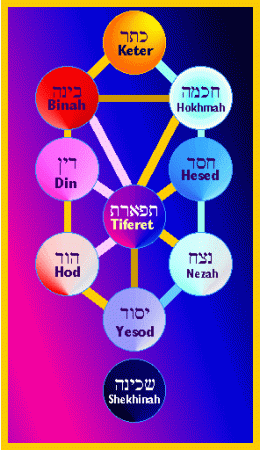
Judith LauraI first started delving into both Jewish Kabbalah and Hermetic Qabalah in the 1990s, after friends told me these forms of mysticism included both female and male representations of divinity and therefore were gender equitable. They were right about the first part: Kabbalah/Qabalah contain both divine masculine and feminine imaging and male and female images.  But as far as gender equity goes, to use today’s slang, not so much!

tree of life kabbalah

Though they are both transliterations of the same Hebrew word, as is common I use “Kabbalah” for the Jewish versions, and “Qabalah” for the Hermetic version, best known through its association with the British Hermetic Order of the Golden Dawn, which began in the 19th Century. The word means “that which is received,” with the understanding that it was “received” from ancient times. Though there is one tradition that says Adam was given Kabbalah in the Garden of Eden, the first written material for Kabbalah, Sefir Yetsirah (Book of Creation), is dated to between 200 and 500 C.E. Kabbalistic concepts changed over the centuries, with writings becoming more significant in the 13th century and even more popular in the 16th and 17th centuries.

Beginning with the Sefir Bahir (Bright Book) in late 12th century France, Kabbalah is represented by the Tree of Life, which has round areas transliterated sefirot (Heb. pl.; sing. sefirah) that I think of as fruit and others call “spheres,” but which in the Bahir, are more accurately translated “sapphires.”*  These “divine emanations,” as they are often called in English, are gendered. How equal is the gender representation? Continue reading “Gender in Kabbalah by Judith Laura”

What Does Exclusivism Feel Like? Part II by Janice Poss

This is part two of a post started yesterday. At the end of it I asked why a woman cannot be a follower of St. Ignatius and a Jesuit.

The days of separating religious communities because rape is a possibility should be behind us–as we all know separating the sexes does not prevent rape anyway.  Let’s get real, if I can understand the Ignatian exercises, use them in discernment, prayer, and reflection, understand the concepts and gain the graces, through doing them in a similar fashion as male Jesuits, what’s the big mystery, what’s keeping me out of the Jesuits–except that that it is a male club that is exclusive.  Exclusion of any kind is oppressive, whether it is for racist, sexist, or other reasons.

Communities based on separation and exclusion because of sexual temptation ignore the simple fact that all people need to be responsible for their own actions.  Male religious in exclusivist communities are like the Iowa  dentist who fired his assistant because she was “too” good looking.  He said could not control his own urges, his own temptations.  An all-male court was unanimous in upholding his right to fire his assistant of more than 10 years. Is not an all male court a biased court? The woman in question certainly did not get a decision rendered by her peers!

That such a trial could even take place is an aberration of colossal proportions and reeks of the male, misogynist, supremacist backlash that is going in society right now in America and everywhere.  Continue reading “What Does Exclusivism Feel Like? Part II by Janice Poss”

What Does Exclusivism Feel Like? Part I by Janice Poss

In the last few weeks of 2012, a sister parishioner recommended I read Transforming Knowledge by Elizabeth Kamarck Minnich.  Many in academia perhaps have already read this book, but I am just getting to know the world of scholars and have found this book refreshing.  It puts its finger on the messy entangled core issues that we grapple with on this blog site.

Minnich enumerates errors prevalent the way we think, suggesting that we need to restructure knowledge traditions that privilege the few and create “higher/lower” thinking, categorical “kind” thinking, and hermeneutical circles of presuppositions that only get reinforced time and again.  Such circles are never broken into by any other thoughts or ideas because they are believed to be epistemologically and ontologically normative.

Imbalances that start in academic disciplines and then trickle down to and through society at large in all areas, not just religion, must be brought into consciousness so they can be corrected with new thinking that no longer oppresses those outside these circles, but brings them into the dialogue so that new more creative thinking happens.  The point is to level the playing field, but not to relativize knowledge.  The goal is create a new way of thinking that is a diverse and pluralistic.

Much that currently passes for reasoning is based on four errors in thinking that Minnich identifies as:

  • faulty generalizations – thinking that uses the few to create maxims about the many;
  • circular reasoning – thinking that reinforces its major premise over and over again without evolving even in the view of new information that might refute the original thesis;
  • mystified concepts – thinking evolving out of circular reasoning by surrounding the idea in a mythical membrane of illogically, believed legends that endure;
  • partial knowledge – one-sided thinking that refutes impartiality never considering the whole picture. Continue reading “What Does Exclusivism Feel Like? Part I by Janice Poss”