Legacy of Carol P. Christ: The Devil’s Bargain: “If You Can Convince a White Woman”

This was originally posted on August 12, 2019

This week’s news from America. Where to begin? When will it end?

The President of the United States is a racist who incites racist violence. Republicans have been slow to condemn the President and are not likely to pass a complete ban on assault weapons and to make those currently in circulation illegal.

After reading a speech condemning hate speech and gun violence that he obviously didn’t write, the President scheduled a round-up of brown people working in chicken-packing factories in Mississippi to coincide with his unsympathetic visits to the cities of Dayton and El Paso, where two recent mass killings by assault weapons occurred. The next morning, we were greeted by images of little children coming home from school in small towns in Mississippi to find their parents missing. We were told that none of the surviving victims of the El Paso shooting wanted to meet the President.

This is not the America I want. But it is the America that many Americans seem to want. I would like to think that women as a group reject the President and his agenda. Sadly, this is not true.

Continue reading “Legacy of Carol P. Christ: The Devil’s Bargain: “If You Can Convince a White Woman””

Legacy of Carol P. Christ: “Fertility” and the Regeneration of Life

This was originally posted on October 12, 2020

Prehistoric and indigenous religious traditions are often disparagingly mischaracterized as primitive fertility religions, concerned not with higher morality, but rather with the processes of reproduction of humans, animals, and plants. When these religions feature a Great Mother Goddess, it may be assumed that these religions are primarily focused on birthing human babies. Nothing could be farther from the truth.

Indeed, archaeologist Marija Gimbutas discovered that in the symbol systems of Old Europe, the Goddess is only rarely imaged as pregnant or giving birth. Nor is She portrayed solely in human form. Rather, She is portrayed with a bird head, wings, and a plethora of other animal and plant features. If She is a Great Mother Goddess, She is revered as the Source of Life, not simply as a mother of human babies. Gimbutas states that in Old Europe the Goddess was worshiped in as a symbol of the powers of birth, death, and regeneration in all of life. Gimbutas said these societies were matrilineal and probably matrilocal. Recent research into matrilineal and matrilocal egalitarian matriarchies provides insight into the values of prehistoric societies. The Minangkabau of West Sumatra, Indonesia are matrilineal and matrilocal, with family ties being traced through the mother line and land being held communally and in perpetuity by the maternal clan. Though the Minangkabau trace their ancestry through their mothers and grandmothers, it is important to note that, as Peggy Reeves Sanday discusses in Women at the Center, it is not birth or the ability to give birth that is celebrated as the highest value, but rather the nurturing of the weak and the vulnerable.

Continue reading “Legacy of Carol P. Christ: “Fertility” and the Regeneration of Life”

Legacy of Carol P. Christ: “Calling All Women” to Save the Earth, signed and shared by Carol P. Christ

This was originally posted on April 1, 2019

I contend therefore that we have allowed these chemicals to be used with little or no advanced investigation of their effect on soil, water, wildlife and man himself. Future generations are unlikely to condone our lack of prudent concern for the integrity of the natural world that supports all life. Rachel Carson, Silent Spring

Today we are faced with a challenge that calls for a shift in our thinking, so that humanity stops threatening its life-support system. We are called to assist the Earth to heal her wounds and in the process heal our own – indeed to embrace the whole of creation in all its diversity, beauty and wonder. Wangari Maathai

I want you to feel the fear I feel every day. And then I want you to act. Greta Thunberg

We are calling all women and our allies to come together to save the earth that sustains us all. Is it any wonder that from Rachel Carson to Wangari Maathai to the emerging young leader Greta Thunberg, women have been in the forefront of environmental movements for a century? As daughters, sisters, mothers, grandmothers, and aunts, we have long cared and advocated for the most vulnerable among us, the very young, the very old, the disabled, those who are the first to suffer the consequences of climate catastrophe and the many kinds of pollution that are poisoning the earth we share.

Continue reading “Legacy of Carol P. Christ: “Calling All Women” to Save the Earth, signed and shared by Carol P. Christ”

Legacy of Carol P. Christ: Visions of the Goddess: A White Horse

This was originally posted on May 4, 2020

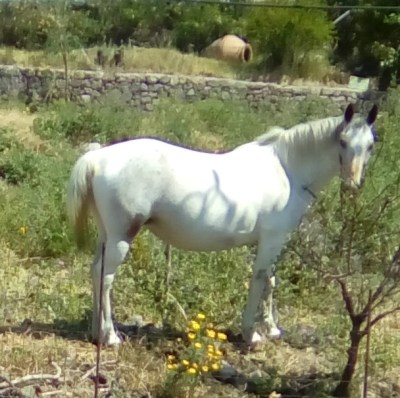
Imagine my surprise when, a few days ago, I looked out my window to see a dappled horse munching on flowers in the field across the street from my house. In the next days I got used to her being there. I would look for her in the mornings and at odd times during the day. Sometimes she was visible and sometimes she was not. When I could see her, I would open the window and call out, “Hello, white horse, you are very beautiful.” Once or twice she turned her head to look at me and seemed to respond, “Thank you for noticing.”

Many hundreds of years ago, Sappho must have had a similar vision in a field near a grove of trees where she and her students waited for the Goddess to appear, for she wrote: “In meadows where horses have grown sleek among spring flowers, dill scents the air.“ These lines are part of a longer poem addressed to Aphrodite that begins: “Leave Crete and come to us.” In this place, “incense smokes on the altar,” there is a stream, there are apple trees and rose bushes and horses in a field of flowers.

Continue reading “Legacy of Carol P. Christ: Visions of the Goddess: A White Horse”

Legacy of Carol P. Christ: Goddess as Love: From Experience To Thealogy

This was originally posted on September 24, 2012

If theology is rooted in experience, how do we move from experience to theology? In my life there have been a number of key moments of “revelation” that have shaped my thealogy. One of these was the moment of my mother’s death.

In 1991 my mother was diagnosed with cancer. While she was being treated, I realized that I had never loved anyone as much as I loved her. When I wrote that to her, she responded that “this was the nicest letter” she “had ever received” in her life and she invited me to come home to be with her and my Dad.

My mother died only a few weeks after I arrived, in her own bed as she wished. She was on an oxygen machine, and I heard her call out in the dark of early morning. When my Dad got to the room, he tried to turn up the oxygen, but it didn’t help. Then he called the doctor who reminded him that my mother did not want to go to the hospital under any circumstances.

Continue reading “Legacy of Carol P. Christ: Goddess as Love: From Experience To Thealogy”

Legacy of Carol P. Christ: Let Us Proclaim the God Who Bleeds Now

This was originally posted November 19, 2018

we need a god who bleeds now

we need a god who bleeds now
a god whose wounds are not
some small male vengeance
some pitiful concession to humility
a desert swept with dryin marrow in honor of the lord

we need a god who bleeds
spreads her lunar vulva & showers us in shades of scarlet
thick & warm like the breath of her
our mothers tearing to let us in
this place breaks open
like our mothers bleeding
the planet is heaving mourning our ignorance
the moon tugs the seas
to hold her/to hold her
embrace swelling hills/i am
not wounded i am bleeding to life

we need a god who bleeds now
whose wounds are not the end of anything

–Ntozake Shange

Continue reading “Legacy of Carol P. Christ: Let Us Proclaim the God Who Bleeds Now”

The Legacy of Carol P. Christ: “We Say the Silence Has Been Broken”

We treat the physical assault and the silencing after as two separate things, but they are the same, both bent on annihilation. Rebecca Solnit

When I was in my twenties and in therapy I had a recurrent dream in which a strange man was chasing me and caught up with me and started to strangle me and I could not scream. I was asked to act this dream out by my therapist, who told me that this time I would scream. I could not. She got up and came over and put her hands around my neck and started to squeeze. I still could not scream.

Two decades later I had a dream in which I was a baby and suffocating in my crib. I asked my current therapist if she thought someone had tried to suffocate me when I was an infant. Her answer was simple: “There is no need to think about this happening when you were an infant. You have been silenced all your life.”

When I was a child, my father used to punish us by taking off his belt, sitting down, asking us to pull down our pants and lie across his lap, and then lashing our bare bottoms with his belt. This was typical child-rearing practice in the 1950s and 1960s. Rita Nakashima Brock was the first to name it for me as child abuse. Nonetheless, when we got older, my brother and I preferred to be spanked, rather than to have our 25 cents a week allowance taken away from us. At least, we thought, being spanked was over in a minute, while losing your allowance was something you would suffer for a long time.

Continue reading “The Legacy of Carol P. Christ: “We Say the Silence Has Been Broken””

The Legacy of Carol P. Christ: Was Ariadne the Most Graceful Bull-leaper of All? Deconstructing and Re-visioning Greek Mythology

This was originally posted on March 3, 2014

Sometimes we think of Greek myth as a pre-patriarchal or less patriarchal alternative to the stories of the Bible. After all, Goddesses appear in Greek myths while they are nearly absent from the Bible. Right?

So far so good, but when we look more closely we can see that Greek myth enshrines patriarchal ideology just as surely as the Bible does. We are so dazzled by the stories told by the Greeks that we designate them “the origin” of culture. We also have been taught that Greek myths contain “eternal archetypes” of the psyche. I hope the brief “deconstruction” of the myth of Ariadne which follows will begin to “deconstruct” these views as well.

bull leaping ring before 2000 bc phourni

Ariadne is a pre-Greek word. The “ne” ending is not found in Greek. As the name is attributed to a princess in Greek myth, we might speculate that Ariadne could have been one of the names of the Goddess in ancient Crete. But in Greek myth Ariadne is cast in a drama in which she is a decidedly unattractive heroine.

Continue reading “The Legacy of Carol P. Christ: Was Ariadne the Most Graceful Bull-leaper of All? Deconstructing and Re-visioning Greek Mythology”

The Legacy of Carol P. Christ: What if Divine Feminine and Divine Masculine Are Not Oppositional Categories?

Moderator’s Note: The blog was originally posted May 18, 2015

A friend who is a spiritual teacher speaks often “bringing back the values associated with the Divine Feminine.” For her this has to do with helping women to understand the beauty of our bodies and the importance of ways of being such as giving and caring for others that have been associated with the undervalued so-called “feminine” side of the masculine-feminine polarity. Though she also speaks about the Goddess, I think she prefers the term “the Divine Feminine” because of the implication that men too have their “Divine Masculine.”

This friend has a wonderful husband who is a teacher in his own right and who often ends up spending a lot of his time among powerful women who enjoy talking about the Goddess. In these conversations he sometimes speaks of the need for men to “recover the Divine Masculine” if they are to become whole.

Continue reading “The Legacy of Carol P. Christ: What if Divine Feminine and Divine Masculine Are Not Oppositional Categories?”

The Legacy of Carol P. Christ: Who Is Jephthah’s Daughter? The Sacrifice of Women and Girls

Moderator’s Note: The was originally posted on January 20, 2014

Last week I reflected on Angela Yarber’s insightful essay and painting on Jephthah’s daughter. For those who did not read the earlier posts, the story of Jephthah’s daughter is found in the Hebrew Bible.  Jephthah’s daughter was sacrificed by her father after he swore in the heat of battle that if his side won, he would sacrifice the first person he would see on returning home.  Angela called us to reflect on who Jephthah’s daughter is in our time.

In my earlier midrash on the story, I invoked Daniel Cohen’s powerful retelling of the story of Iphigenia.  Cohen concludes that Artemis told Agamemnon that his ships would sail only if he sacrificed his daughter not because she wanted him to do it—but because she hoped this challenge would induce him to realize that the costs of war outweigh any possible gain.

Continue reading “The Legacy of Carol P. Christ: Who Is Jephthah’s Daughter? The Sacrifice of Women and Girls”