An Omer Calendar of Biblical Women by Jill Hammer

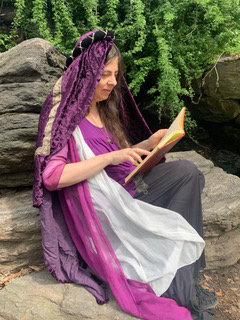
Jill as the prophetess Huldah

Right before Passover every year, my wife and I visit a botanical garden to look at the spring flowers: daffodils, tulips, cherry and apple blossoms, magnolia.   One year, in 2004 or so, we were on our way there when I had an idea. I grabbed a pen and started scribbling long lists of biblical women.

“What are you doing?” my wife asked.

“Making an Omer Calendar,” I said. 

Since biblical times, there is a Jewish practice of counting the forty-nine days between the holiday of Passover (the barley harvest and festival of freedom) and the holiday of Shavuot (the first fruits festival and the season of receiving Torah).  These forty-nine days were the time of the barley and wheat harvest and were a fraught time for biblical farmers.  According to the Talmud, each day of the Omer must be counted along with a blessing.  One must count consecutively each day (usually in the evening) and one loses the right to say the blessing if one misses a full day of the count.  The Omer is often understood as a time of semi-mourning because of plagues said to occur during this time, but it is also a joyful season when nature’s abundance is at the forefront.  This seven-week period embodies both fear that the harvest will be damaged and gratitude for the harvest.

Continue reading “An Omer Calendar of Biblical Women by Jill Hammer”


From the Archives: Tree of Life: The Festival of the Trees in an Age of Treefall by Jill Hammer

This was originally posted on January 22, 2019

Almost every day, I walk in Central Park.  There are certain trees there I’ve come to know: the gnarled cherry trees by the reservoir, the bending willows and tall bald cypress by the pond, the sycamores that drop their bark each summer, the hawthorn not far from Central Park West.  Lately I’ve been taking photos of the trees to try to capture their essence, their posture in the world.  The trees around me feel like friends, which is what an ancient midrash (interpretation/legend) called Genesis Rabbah says about trees: that they are friends to humankind.  To me, they’ve always been a central manifestation of Mother Earth.

Currently, the national parks in the United States have no staff because of the government shutdown. Some people have taken the opportunity to cut down the rare and endangered Joshua trees in the Joshua Tree National Park—just for fun, I guess, or as a trophy of some kind.  Meanwhile, President Bolsonaro of Brazil recently has indicted that he wants to remove protection for the rainforest, in order to allow development.  It appears that my friends the trees have enemies.  Sometimes the enmity is for personal/corporate gain, and sometimes the enmity seems to have no reason at all.

Continue reading “From the Archives: Tree of Life: The Festival of the Trees in an Age of Treefall by Jill Hammer”

The Legend of Istehar by Jill Hammer

Blue supermoon 2024

This summer I had the opportunity to travel to Fire Island, New York, which is a long sand bar full of small beach towns with no cars. Fire Island’s been a haven not only for beachgoers but for queer folk for many decades. We stayed in the town of Cherry Grove with friends, and one night we went out to look at the supermoon/blue moon. The moon rose over the horizon, red and a little scary, a sight like none of us had ever seen. Not far from the moon was a star so bright it came out in the photographs. I wondered if that was the morning star.  Venus, in our current understanding. Inanna or Ishtar, among some of the ancients. And that made me think of Istehar.

Istehar, in Jewish legend, is a maiden who became one of the Pleiades. Her legend is unusual among Jewish legends because it reads like a Greek myth. It takes place during the time when some angels had descended to earth because they desired human women. One of these angels, Shemhazai, noticed a certain woman named Istehar, and desired her and wanted to be intimate with her.  Istehar wished to flee this angel, and so she said: “I won’t accept you as a lover until you give me your wings and teach me the Divine Name that allows you to fly to heaven.” The angel gave her his wings and taught her the Divine Name.  Istehar immediately uttered the Name and flew up to the sky, thus escaping the angel. God was impressed by her virtue and decided that she would be placed among the seven stars, in the constellation of the Pleiades, “that humans might never forget her.” (Legends of the Jews I:4:11).

Continue reading “The Legend of Istehar by Jill Hammer”

Three Women Sit on a Stone: Images of Fate in a Jewish Incantation by Jill Hammer

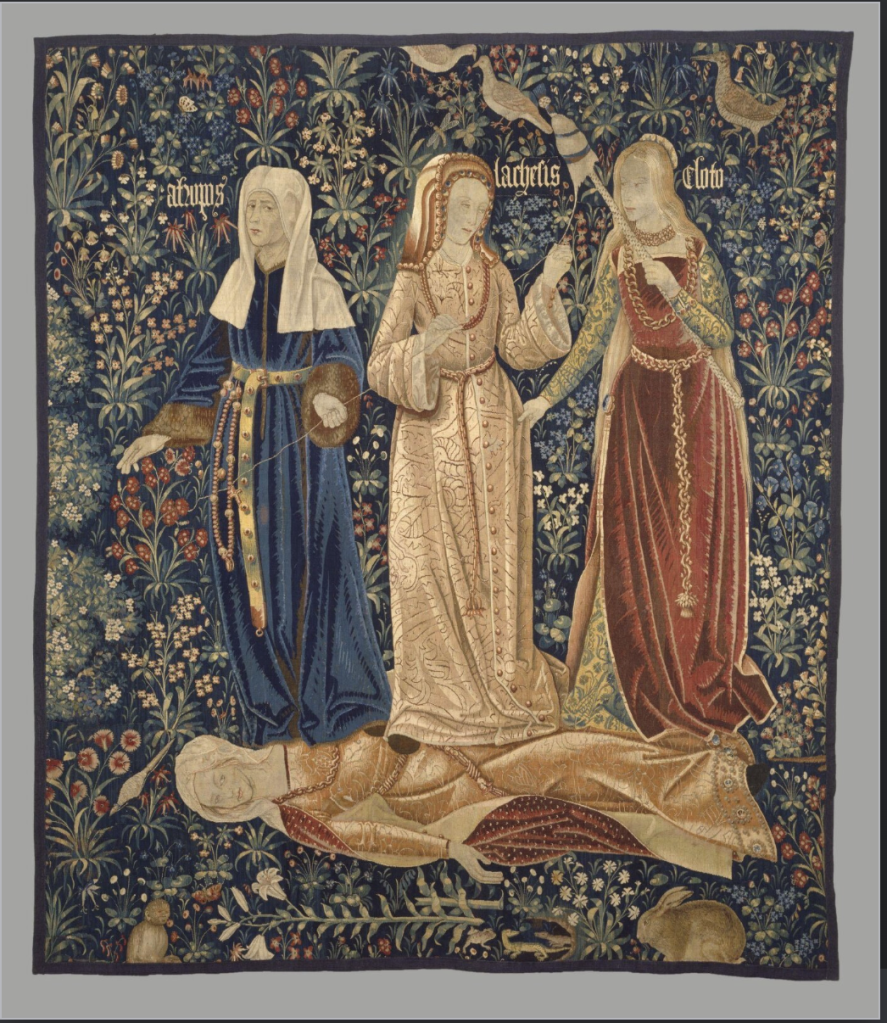
Tapestry, three fates, 16th century Netherlands

There is an old Yiddish incantation, documented from the 18th century forward, that features three mysterious women.  It is a folk spell warding off the evil eye–the negative influence that may come either from demons or from the jealousy and spite of others (or both). Fear of the evil eye is the reason it was traditional not to compliment cute babies or talented people—because the evil eye might be attracted to such beauty or talent and cause harm.  The evil eye, to give a personal example, is the reason my father, who was normally not a religious person, refused to allow my mother to shop for a crib until I was born, lest the evil eye notice they were going to have a baby and prepare some terrible fate for me.

Continue reading “Three Women Sit on a Stone: Images of Fate in a Jewish Incantation by Jill Hammer”

From the Archives: The Three Mothers: Feminine Elements and the Early Kabbalah by Jill Hammer

This was originally posted May 22, 2108

For over ten years, I’ve been teaching a work of early Jewish mysticism known as Sefer Yetzirah, or the Book of Creation.  There are widely differing opinions on the book’s origin and dating, but many scholars date it to the sixth century.  Its core concept can be described simply: the Divine used the Hebrew letters as metaphysical channels to create the different aspects of reality: the directions, the elements, the planets, the months of the year, and so forth.  Each letter is a channel by which God creates a unique form or entity, and meditating on the letters provides us with a connection to divine creative power. In its discussion of the letters, Sefer Yetzirah shows a strong connection to feminine imagery, and thus helps the later kabbalah develop its own link to the feminine.

Continue reading “From the Archives: The Three Mothers: Feminine Elements and the Early Kabbalah by Jill Hammer”

The Problem of Jehosheba: Reading One Biblical Character in Two Different Feminist Ways by Jill Hammer

Tucked away in II Kings 11 is the story of a mother-daughter feud that is personal, political, and ultimately fatal. Jehu, a charismatic military commander, is anointed by Elisha as the next king of the northern kingdom of Israel. Jehu kills the previous king of Israel, Jehoram, and also Jehoram’s mother Jezebel (yes, that Jezebel—the famous/infamous queen). As part of his violent rise to power, Jehu also kills Ahaziah, king of the southern kingdom of Judah. Ahaziah’s death should mean that Athaliah (Atalya), who is queen mother of Judah as well as the daughter of Jezebel, cedes power to a new king and a new queen mother. Instead, according to the Book of Kings, Athaliah has the rest of the king’s sons and grandsons murdered, and seizes the throne for herself. 

All seems lost for the Judean line, except that Jehosheba (Yehosheva), wife of the high priest Jehoiada and sister of the murdered King Ahaziah, saves one of Ahaziah’s sons, along with the child’s wetnurse, and hides them both in the Temple. Jehosehba keeps the boy, Joash, and his nurse in the Temple until he is six years old. At that time, Jehosheba’s husband, the high priest, anoints Joash king, stages a coup, and executes Athaliah as a usurper. Jehosheba’s action saves the Davidic line. The collection of Jewish legends known as Otzar Midrashim lists Jehosheba as one of the righteous women of the Jewish people.

Continue reading “The Problem of Jehosheba: Reading One Biblical Character in Two Different Feminist Ways by Jill Hammer”

The Daughters of Zelophehad and the Five Feminine Powers of the Kabbalah by Rabbi Jill Hammer

Jill anointing her daughter. photo by Shoshana Jedwab

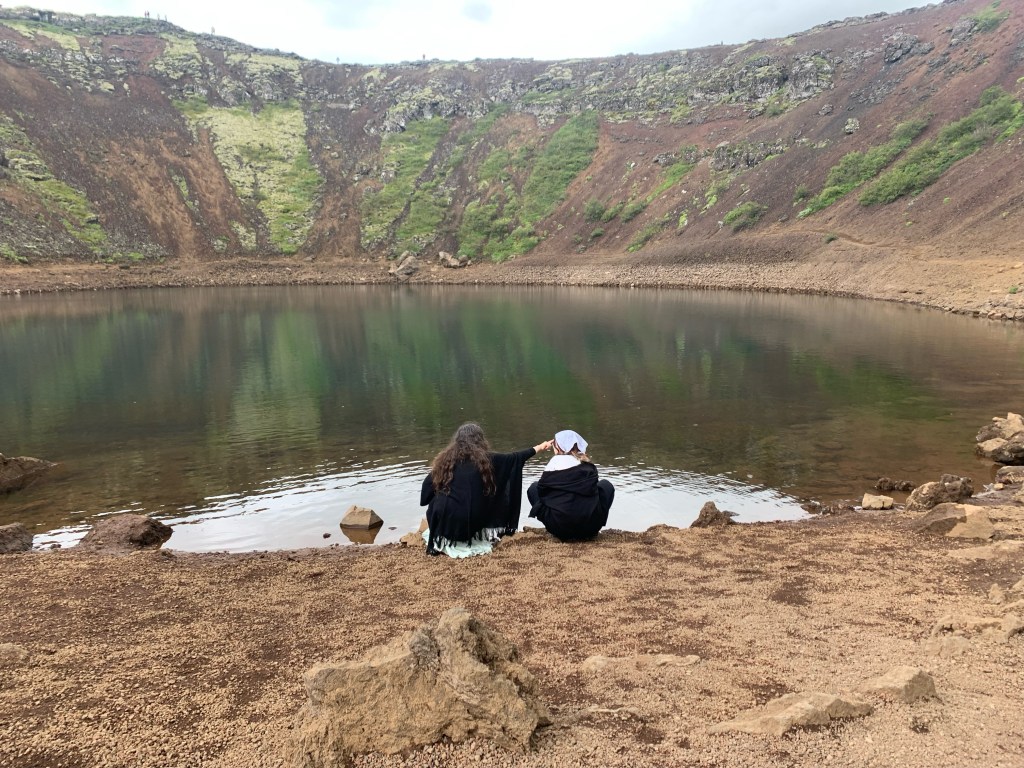
This summer, I visited Iceland, a beautiful and magical land.  While I was there, I saw the Kerid Crater, which is a caldera: a volcanic crater with a lake inside.  My family and I hiked around the edge of the crater and then down close to the lake.  The perfect roundness of the crater-lake gave the impression of a circular container—a jewel-box shaped by some immense hand— or else a massive eye looking up from the earth.  My daughter and I sat by the lake’s waters and anointed one another, having the sense we were in a sacred place.

Later that summer, I grappled with a story that reminded me of the crater. In Numbers 27, five sisters—the daughters of a man named Tzelafchad—approach Moses with a question.  Their father had daughters, not sons, and it seems this means his family will receive no land allotment in Canaan.  The daughters ask that they be given land allotments: “Let our father’s name not be lost to his clan just because he had no son!” (Numbers 27:4).  Moses takes their complaint to God and brings back an answer: the daughters have spoken rightly, and will receive a land allotment as they request.  However, they must marry men of their own tribe so that the tribal land is not lost— if the women married men of another tribe, their heirs would belong to that other tribe and so the land would change its tribal designation.  Thus, patriarchy is mitigated but not ultimately contradicted—the women become heirs to their father, but primarily for their father’s sake, not their own. 

Continue reading “The Daughters of Zelophehad and the Five Feminine Powers of the Kabbalah by Rabbi Jill Hammer”

Iron Mothers: Iron as Embodiment of the Biblical Matriarchs in Jewish Folklore by Jill Hammer

Jewish amuletic objects come in many forms: salt, the hamsa or hand, the bowl, the scroll with verses, even sword-shaped amulets. These items are meant to provide spiritual protection from malevolent forces such as demons and the evil eye and vary across different times and places.  One protective item from Jewish folklore is iron. In medieval Germany, for example, pregnant Jewish women carried an iron object to repel malevolent forces.  This was part of a wider cultural norm: across Western Europe, iron was understood to repel fairies and spirits of all kinds, and was sewed into babies’ clothing, hung above cradles and doorways, etc.  According to one Jewish legend, when the waters of Egypt turned to blood during the first plague, water in metal vessels was 34245 the only water to remain unchanged. Pieces of iron were placed on all vessels containing water during the solstices and equinoxes—considered to be a time when spirits were roving the world—to protect them from contamination.

Continue reading “Iron Mothers: Iron as Embodiment of the Biblical Matriarchs in Jewish Folklore by Jill Hammer”

Calling All Biblical Wise Women by Rabbi Jill Hammer, PhD

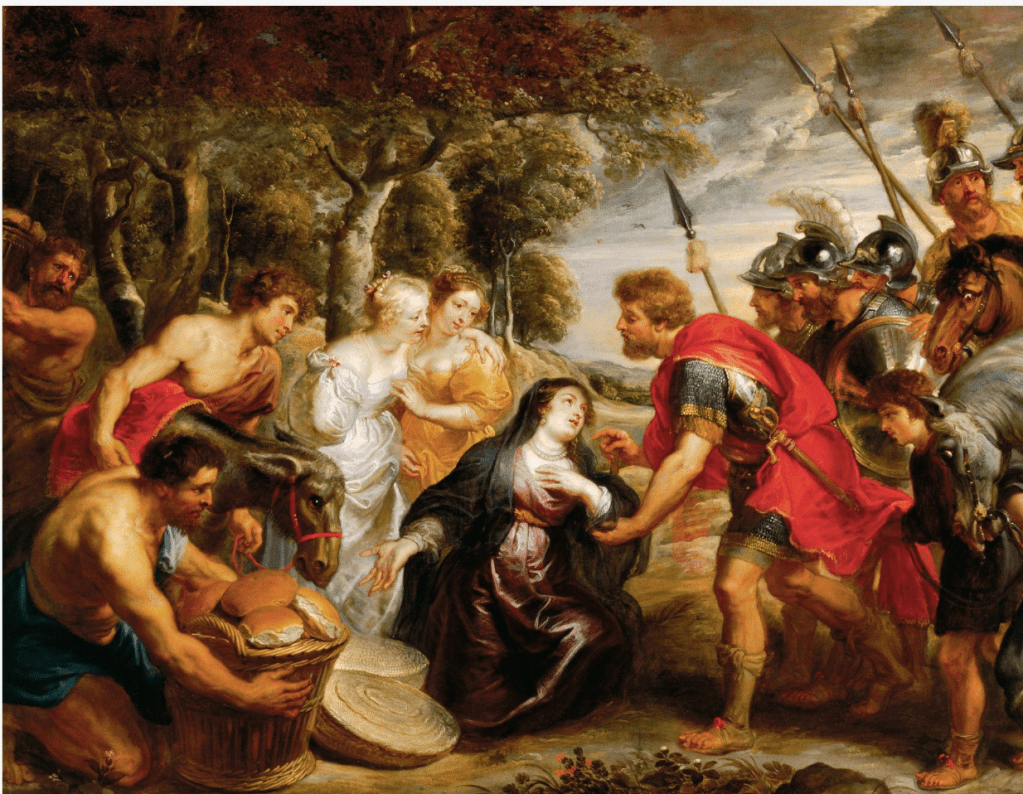
The meeting of David and Abigail by Peter Paul Rubens circa 1630

In these days when so many are afraid and aching for the people of Ukraine, and concerned about the lasting impacts of this war around the world, I cannot help thinking of the wise women of ancient Israel. These wise women, unafraid of confronting dangerous men, used their intelligence and storytelling skill to defuse violent situations between powerful adversaries and restore peace. May their wisdom be felt in the world now. 

The institution of “wise woman” appears several times in the Bible. In the Book of Samuel, a wise woman (chachamah in Hebrew, from chochmah, wisdom) steps in when there is a war, or political conflict, to promote peace. In II Samuel 14, after King David’s son Amnon rapes David’s daughter, Tamar, the king does nothing. Tamar’s full brother Absalom takes matters into his own hands and kills Amnon, then flees to another country.  David grieves for Absalom but won’t send for him. The wise woman of Tekoa appears before King David, pretending to be a woman whose sons fought, and one killed the other. The story she tells helps to reconcile King David with his son Absalom, at least temporarily.  

Continue reading “Calling All Biblical Wise Women by Rabbi Jill Hammer, PhD”

Moving to Ursula: Dream Wisdom and the Sacred Feminine by Rabbi Jill Hammer, PhD

For the last seven years, I have been conducting research for my book Undertorah: An Earth-Based Kabbalah of Dreams, which is about to appear courtesy of Ayin Press.  On this writing journey, I’ve interviewed seventy dreamers, and have studied pre-modern dreams from texts of ancient Israel and ancient Sumer to dream accounts of women kabbalists and Chasidic masters.  I’ve also sat with my own dreams and their odd truths. Many of the dreams I’ve encountered express powerful visions of the feminine. I find these often odd and eerie visions particularly useful in expressing “the multiplicity of experiences of [the feminine]… rather than an imposed definition of those experiences…”[i]

Continue reading “Moving to Ursula: Dream Wisdom and the Sacred Feminine by Rabbi Jill Hammer, PhD”