Why is it that some who experience violence as children repeat the pattern while others imagine a world without violence? I have been pondering this question in recent weeks.
Why has Mitt Romney’s Mormon faith mostly been a non-question in his political life? John Kennedy was asked if he would obey the Pope or make his own decisions, Jimmy Carter was asked how his Baptist faith would affect his Presidency, and Barack Obama was asked if he agreed with the sermons of his preacher. Why is the press afraid to ask Mitt Romney if he agrees with the patriarchal teachings of his church and if so, if this affects his views on the rights of women?
Where patriarchalism trumps love, when push comes, shove often follows.The underside of love patriarchalism is hatred of the independence of women.
We are told that it is the duty of a loving father and husband to protect his wife and children. In exchange, good wives support their husbands and good children obey their fathers. The bottom line of patriarchy is control. The fight over abortion is a fight about men’s right to control women.
I have spent much of the past few weeks wondering why so many Republican men hate women. Why do they want to deny the right to an abortion to a 12 year-old girl raped by her father, to a 21 year-old college student gang raped at a fraternity party, to a 33 year-old woman who submitted to a violent boyfriend she did not know had poked a hole in his condom, or a to a 41 year-old woman who offered a cup of coffee to the man who came to her house to fix the electricity, but who said “no” when he assaulted her.
I have also wondered why Republican men would deny the right to an abortion to 28 year-old married woman who got pregnant while taking the pill, to a 15 year-old girl who got carried away with her boyfriend, or even to a 35 year-old woman who got drunk one night and had sex without protection. We are all human aren’t we? Birth control sometimes fails and sometimes women make mistakes. Apparently women are to be punished for both! Continue reading ““LOVE PATRIARCHALISM”—ITS UNDERSIDE IS HATE by Carol P. Christ”
Just when you think you have heard it all, here we go again – another politician with “open mouth-insert foot” syndrome. Discussing his zero-tolerance policy for abortion, Missouri Representative Todd Akin made the following statement last Sunday about pregnancies that result from rape:
“from what I understand from doctors, that’s really rare. If it’s a legitimate rape, the female body has ways to try to shut that whole thing down. But let’s assume that maybe that didn’t work or something. I think there should be some punishment, but the punishment ought to be on the rapist and not attacking the child.”
In an inadequate attempt to apologize and clarify his words, Akin stated that he meant to say “forcible rape.” This clarification fares no better nor does the fact that he later acknowledges that women “do become pregnant” during a “forcible rape.” It is interesting to note what Akin considers to be “rare.” According to the Washington Post, approximately 5% of rape victims become pregnant. Akin reduced this to a statistic – 1 out of 32,000 women. This, for Akin, is a rare occurrence.
Stating that a woman’s body is capable of preventing pregnancy in the case of “legitimate rape” demonstrates how out of touch politicians are and further (re)affirms the bigotry that exists within our political system. The same politicians who have waived a “war against women” this year, try to promote policies that exercise control over what a woman can and cannot do with her body; policies that are based on ill-advised misinformation. Decisions politicians make for a woman – what she can and cannot do with her body – are rooted in personal faith beliefs, party-line agendas, and supporters (campaign financing dollars and lobbyists). This year, a woman’s body has become a platform for votes.
You may be tired of the controversy about Chick-fil-A, but the events of the last few weeks revealed a big issue in the organization – that of discrimination and the illusion of religious freedom. However discrimination exists beyond the LGBTIQ community, it applies to Catholics and those “outside” their strict fundamentalist belief system. However, the hierarchy in the Catholic Church seems to be embracing many of the beliefs put forth by Evangelical Fundamentalists in the political arena.
When it was time for my eldest daughter to get her first job, she applied and was hired to work at Chick-fil-A. Knowing they were a Christian organization, I felt that she would be well treated and we could still have family time on Sundays. Everything started out o.k. but the longer she worked there, problems developed. First, when I stopped through the drive-thru to show my support as her mother, I received apocalyptic material in my bag talking about the end times, where my soul would go, and inviting me to their church. I found the material offensive and never returned. Despite the organization’s community support and “Christian” values, I was still fairly naive about their discriminatory practices that many experience on a daily basis.
Can women have it all? Possibly. Can men ever have it all? Maybe. Regardless of however we put it, the are ills to every good deed in the world and we need to get back to understanding how and why we use each other in order to fully understand that behind every good man might be a good woman but also behind every good women there might also be a good man.
Growing up, my favorite movie was The Associate staring Whoopi Goldberg as a woman at a Wall Street firm attempting to climb her way up the corporate ladder through hard work and dedication. Her character Laurel Ayres does all the work and comes up with the ideas that clients eventually invest in, her partner Frank takes all the credit and eventually surpasses her at work by getting the promotion she had been vying for. In a prodigious scene that I still vividly remember from my childhood, Laurel quits her job and starts an investment firm on her own; betting every cent and piece of property she has on the eventual success of her new business adventure.
In an attempt to break through the proverbial glass ceiling and play with the big boys of Wall Street, Laurel eventually discovers that although she can be (and is) the genius behind many of the great ideas that would save companies millions, she still needs to have her ideas expelled by a man she creates in order to win over clients, which eventually leads her to become successful. However, while Laurel is reaping in the benefits of having Mr. Cutty, her made up business partner, by her side, she eventually learns that no matter what she does she will always be secondary to her male business partner. Continue reading “Why Men (and Women) Can’t Have It All by John Erickson”
Spiritual Power is arguably the most dangerous power of all. In the wrong hands, it gives the power to make judgments even about the eternal fate of another person. It needs a sign on it at all times saying, ‘Handle with extreme care.’ The greater the power a person exercises, the more need there is for checks and balances before it is used and accountability after it is used.” – – Bishop Geoffrey Robinson
May 6th, I addressed the issue of abuse of power in the Catholic Church and how we seem to be unraveling any kind of progress made since Vatican II. Since writing that article, the Leadership of the LCWR met with Vatican Officials and expressed their concerns openly. A dialogue occurred and left no resolution, just information that the leadership will discuss with the community at their August meeting. That meeting will reveal their next step in this controversy – concede and follow the conditions and rules sets forth by the CDF or disband and form a new religious community or maybe there will be another option revealed.
I have to ask though – Was this a meaningful meeting or was it meant to pacify the Sisters and their supporters? Will the Vatican change its stance? Certainly, the U. S. Catholic Sisters have not been
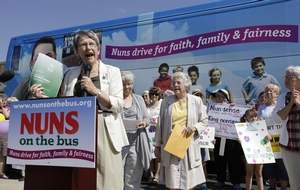
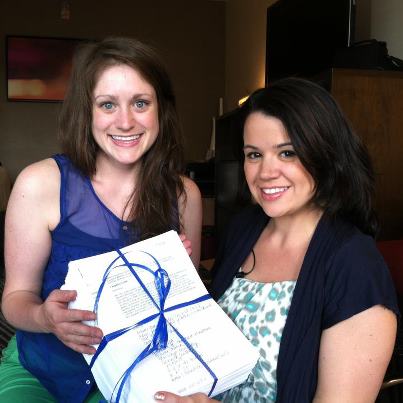
pacified, nor have their supporters. For example, there is a “Nuns on the Bus” tour traveling around the United States, prayer services for the Sisters, #nunjustice and #whatthesistersmeantome campaigns on Twitter. Even the Women’s Ordination Conference delivered a petition containing over 57,000 signatures to the Vatican in support of the Sisters. Certainly, the support for the sisters and their mission is not dwindling, but growing stronger every day.
As for the Vatican, a change in their position is doubtful, but we can continue to pray. I am, however, very discouraged by a statement attributed to Pope Benedict that indicates a desire to have a smaller more faithful Church of Catholics then a large Church of people who do not adhere to Church Teaching – seeking out a small, strong, holy community.
Obviously, it is my hope that this statement was taken out of context, but I have to be honest and say
Women’s Ordination Conference delivering Petition Picture reprinted from WOC’s page on Facebook
that my hope is filled with doubt. This is not the first time I have heard clergy make this statement. Priests have made this statement in my presence – wanting a more faithful flock and dismissing those that do not adhere to their interpretation of Church teaching. This stance does not bear fruit, but is rather a power play – a play that can be called many things – misogynist, arrogant, non-pastoral, cold-hearted, and frankly un-Christian. It also plays with a person’s spiritual fate and in many cases their soul. The psychological impact of something like this is dangerous for some. Some ordained will go so far as to withhold sacraments or even compromise the person’s status in the Church, including their role in ministry, for the sole purpose of inducing compliance – a tactic that dates to the medieval period.
I have a beautiful picture of vagina hanging on my wall. However, for the longest time it was in the back of my closet, with a plastic bag covering it. I wasn’t ashamed of it but my ex-boyfriend, like most gay men, refused to have it on the wall where he could see it. He is now long gone; the vagina is now out and proud.
I bid on the picture one fall during a showing of the Vagina Monologues at Claremont School of Theology. One of my best friends was in the show and I had always loved its powerful message. I walked out of the theatre, waiting for my friend, and there it was: the picture of the vagina. I found myself caught up in its beauty. Its gaze had mesmerized me. The outlying layers of red, the contours of its shape, they all began to mold into a figure before my eyes. While I have never thought of myself as a religious person, I realized that at that moment I was no longer looking the old photo but rather I was staring at the outline of the Virgin Mary. At that moment, I realized that I had to have the picture.
My ex boyfriend was ashamed of the photo. I let him shame me into putting it in the back of my closet and cast it away like it was nothing. Like the experience, call it religious or not, had never happened. When we ended our relationship, I found myself inconsolable and pacing up and down my stairs in a never-ending cycle of sadness and downheartedness. As I was pilfering through our items, I came about the picture. I saw it and for a split second, I was no longer sad. Continue reading ““Vaginas are Everywhere!”: The Power of the Female Reproductive System by John Erickson”
I am all of these things and more. By the recent attacks by the hierarchy of the Catholic Church, I am beginning to think I am the problem. I seem to stand foreverything the Vatican and USCCB seek to silence. Is it because of my organizational ties with the U. S. Vowed Religious and Girl Scouts, or my writings as a Feminist and Theologian? Maybe the answer is simply – because I am a woman.
According to the criticisms launched by the USCCB and the Vatican, I seem to be part of the problem rather than the solution. Why is this so? It was not until I started my journey in ministry that my idealistic “Catholic” bubble popped – not so much by me, but by those in ministry and leadership, by those that did not like laity to pose questions and think critically about their faith beliefs, and by those that do not like people who do not fit within the preconceived mold of what a “good Catholic” should be. This ideological construct is difficult enough when you are part of a Church community, but when you begin to embrace leadership as a woman, question teachings, exercise your canonical rights, your peers and even people you thought were your friends, no longer talk or associate with you. The betrayal is vicious and runs deep – it is behavior not becoming of a minister or one who professes the Catholic faith.
If the attack on you is not enough, these same people victimize your children through their words and behavior. It is a difficult position for anyone to survive spiritually. For children of the Church who bear witness to this hypocritical behavior, a journey begins – they search for meaning within the spiritual realm and become disgruntled with anything that resembles organized religion. A place where one seeks community and spiritual nourishment becomes a place of oppression and starvation. If attacking family is not enough, let’s start attacking groups that promote community – groups like the Girl Scouts of America.
“As we approach Memorial Day Weekend (and the militaristic patriotism it promotes), as the 2012 election cycle heats up, and as I meditate more deeply upon my and my country’s many riches, one of [Walter] Brueggemann’s prayers in particular spoke to me.”
One of the three books I took with me on vacation is by the world’s leading interpreter of the Old Testament, Walter Brueggemann. It’s not actually on the Bible, but something he published in 2008 called Prayers for a Privileged People.


 Why is it that some who experience violence as children repeat the pattern while others imagine a world without violence? I have been pondering this question in recent weeks.





 Feminism and Religion