On Tetzaveh by Ivy Helman

29662350_10155723099993089_8391051315166448776_oThe Torah parshah for this week is Tetzaveh (Exodus 27:20 – 30:10).  Mostly it describes the priesthood, both of Aaron and his sons. It details how they should be consecrated, what they should wear, the difference between the garb of the high priest and the others, institutes the daily burnt offerings of rams, and provides instructions for the construction of an altar for locally-sourced incense.  

The parshah works to establish differences between members of the Israelite community through consecration as well as in function and in dress by decreeing the institutionalized of the priesthood.  Priests undergo an elaborate consecration ceremony which includes the sacrifice of animals, the smearing of their blood, the waving of various animals parts into the air and the burning/cooking of the sacrificed animals’ flesh.  In addition to the blood smearing and animal sacrifices, the priests are also anointed with oil and offer oil and grain offerings to the divine. In terms of function, priests should offer daily sacrifices to the divine in the form of two rams (one in the morning and one in the evening).  Also, all priests have four items of similar clothing: tunic, girdle, turban and short pants. However, the high priest has four special items only he wears, like the breastplate and a golden forehead piece. His clothes are laden with gold, precious stones, and royal dyes.   Continue reading “On Tetzaveh by Ivy Helman”

Generosity and Community: the Alternative Worldview of Women’s Ritual Dances, Part 2 by Laura Shannon

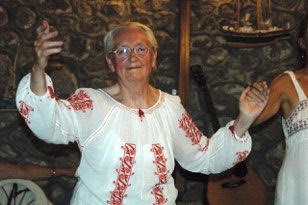
Dr. France LeJeune Milchberg taking her turn to lead the dance line, Lesvos 2007. Photo: Sheryl Ackerman

Starhawk describes the work of her Reclaiming collective as the creation of ‘spaces of refuge from a harsh and often hostile world, safe places where people can heal and regenerate, renew our energies and learn new skills.’[i] These words also apply to the women’s traditional dances. One participant on my courses expresses it thus: ‘In the circle no-one is left out, no-one is ignored, all are held and included, all have their place, all are connected.’[ii]

Crucially, women’s ritual dances empower everyone to develop leadership skills. Every woman must know how to lead the line at the appropriate time, and she must also know how to pass on the responsibility afterwards. Continue reading “Generosity and Community: the Alternative Worldview of Women’s Ritual Dances, Part 2 by Laura Shannon”

Seeking Enlightenment? Let’s Try Endarkenment by Barbara Ardinger

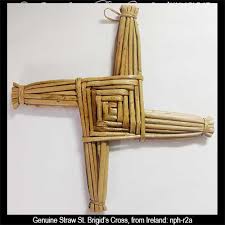
In the version of the calendar I follow, February 1 is the true beginning of spring. That’s because early February is when we can see the light coming back. We know spring is really coming. February opens with a holiday/holy day variously known as Imbolc, Brigid, and Groundhog Day. Imbolc is the name of a traditional Celtic festival. The word is related to milk, possibly ewes’ milk, as lambing starts around this time. Brigid, whose name means “bright one,” is a triple goddess and ruler of (1) the sun and fire (and smithcraft), (2) poetry and inspiration, and (3) healing and medicine. It’s said that the straw left over from making Brigid’s crosses and other charms has healing powers. The newer Brigid is the Catholic saint who refused to marry and became a nun. And, of course, Groundhog Day is a secular holiday that uses helpless animals to make silly predictions. (But the movie is good.)

February (from the Latin word februa, which mean purification) gives us opportunities to become both enlightened and endarkened (yes, another word I invented).

ENLIGHTENMENT: “You light up my life.” A charismatic person “lights up the room.” When we become aware of something, the “lights go on” or we suddenly “see the light.” In cartoons, a light bulb turns on over the head of the guy who has the idea. Conversely, we call someone who isn’t enlightened “a dim bulb,” or maybe we say, “The lights are on but nobody’s home.”

Continue reading “Seeking Enlightenment? Let’s Try Endarkenment by Barbara Ardinger”

Generosity and Community: the Alternative Worldview of Women’s Ritual Dance, Part 1 by Laura Shannon

My life’s work with traditional women’s circle dances of Eastern Europe and the Near East has been a natural interweaving of feminism, activism and Goddess spirituality. In more than thirty years of experience, my students and I have gained valuable insight into their potential as tools for healing and transformation.

These simple and ancient dances connect us with women’s ritual practices from the past which are rooted in a Goddess-reverent paradigm honouring the earth, the body and the female face of the divine. In the present day, the practice of mindfully dancing traditional circle dances which embody this worldview can help us imagine and create a more equitable society in the future.

Continue reading “Generosity and Community: the Alternative Worldview of Women’s Ritual Dance, Part 1 by Laura Shannon”

Find Your Warrior Archetype, Sisters: We are in the Fight of our Lives by Trelawney Grenfell-Muir

I read a news story this week about dozens of children sex trafficked at an auto show in Detroit. I read about a young man getting no jail time for sexually assaulting a six year old girl… sex traffickers targeting and grooming girls through internet apps for children… white women still earn $0.80 for every dollar men earn, and women of color even less… the Supreme Court may kill Roe v. Wade this week… five women executed in a bank, and the media ignored it… many men used the government shutdown to coerce (rape) poor, desperate mothers into trading sex for money or food… yet another gunman shot his ex-girlfriend and four other people…

There’s plenty more bad news. We live in a collapsing, apocalyptic dystopian misogynistic nightmare. Misogynist violence floods to us in a toxic deluge from billboards, magazines, movies, TV shows, ads, games, and most interactions with family, friends, and our culture.

How do we survive in this holocaust? How do we keep sane? How do we protect that which we hold most dear?

Continue reading “Find Your Warrior Archetype, Sisters: We are in the Fight of our Lives by Trelawney Grenfell-Muir”

Receiving, Giving, Reciprocating vs. Nonintervention: Two Different Models for Environmental Ethics by Carol P. Christ

“Gifts from the earth or from each other establish a particular relationship, an obligation of sorts to give, to receive, to reciprocate.” –Robin Wall Kimmerer

The notion of a gift economy is at the heart of Robin Wall Kimmerer’s Braiding Sweetgrass. Kimmerer shares a different way of being in the world: one that recognizes the gifts that have been given to us and the necessity to reciprocate. In the modern world we have been taught that nature’s resources are ours for the taking. We have not been taught that nature’s resources are not infinite, that they exist in a web of interdependent relationships in which minerals, plants, animals, and human beings all participate. Everything we do has consequences for other living things.

For many environmentalists, the goal is to leave “wild” nature alone. In this model, the destruction human beings have done to nature is recognized. But what is not understood is that human beings are part of nature too. For hundreds of thousands of years, we and our ancestors have interacted with nature. The model of setting aside spaces for wild nature does not recognize that human beings can interact in positive ways with nature and that we have done so for millennia. Continue reading “Receiving, Giving, Reciprocating vs. Nonintervention: Two Different Models for Environmental Ethics by Carol P. Christ”

Eve is the Hero of the Garden of Eden, Part 1 by Janet Maika’i Rudolph

She is a tree of life to those who embrace her

and those who lay hold of her are blessed.

Proverbs 3:18 (Berean Study Bible)

Eve’s story, as it has been passed onto us from the Bible, makes Her responsible for manki . . .ahem . . .humankind’s being cursed for all time. The story as our culture sets it up is that the serpent is an evil tempter with Eve as a weakling co-conspirator. Both Eve and the serpent are considered guilty parties, responsible for their own drawing down of the curse.

At the risk of being rude: BULLSHIT!

In truth, Eve’s story is a powerful tale complete with a magical talking serpent. And it only communicates directly with Eve, and never with Adam. Why?

BECAUSE THIS IS EVE’S STORY.

Continue reading “Eve is the Hero of the Garden of Eden, Part 1 by Janet Maika’i Rudolph”

Eulogy for My Father by Natalie Weaver

Fourteen years ago, I was pregnant with William Valentine.  I had no idea what to expect.  I knew only that I was in a body, and it was pregnant.  Things happened to me, to my body, that seemed extrinsic to my person, so much so that for most of those forty weeks, I felt as though the doctor’s office was having the baby, and I was a mere observer.  But, when the time came to deliver the baby, I realized it was my body that was trying to make passage for another’s.  The particularities of myself and the baby’s self seemed to fade away into something more vital and primordial in the process of the transmission of life.  After a safe delivery, I felt a deep and curious gratitude that was beyond the gratitude I had for my child or for our health.  This strange gratitude was born of the passage I had been so fortunate to experience, that is, this novel yet ancient, essential yet unparalleled dimension of human being-ness.  I had given live birth, and I was grateful to know what that was like.  In that experience, I was more connected to my human brothers and sisters than I had ever been before, including to this new baby, who I knew in my deepest self was more fundamentally a brother human than even he was my own child.  I knew that in this transmission, I had helped a fellow traveler, and that transmitting life was simple even while it was giant in scope.  The experience was and would always be about walking with each other, from the cradle to the grave, in our vulnerability, in our fragility, in our humility, and in that walk, to find our strength, our dignity, and our luminescence, as persons, as creatures that think and speak and love.  To have been a party to another’s coming to be, this was an occasion of the greatest gratitude I had known.

In accompanying my father in this final stage of his life during these challenging and difficult months as he journeyed toward his death, I felt that same vital and primordial passage of being that I had in giving birth.  While it was not my body that this time labored and worked, I was party to his experience.  I witnessed his courage and another kind of transmission of life.  For, I saw a man go from self-concern to other-concern; from hope of getting well to hope to of making things better for others; I witnessed a man move from verbal complaint to silent focus; and I heard his relocation of worry for himself to concern for me because he knew I was hurting as I was watching him, mostly powerless to do anything but sit next to him. I saw a man graduate from a regular man to an elder and then to naked spirt in God’s care, and I was honored to be one of his midwives on that journey.  In his final hours, he became full of grace, and he fulfilled the trajectory of becoming the father and man he always intended to be.  It was an honor to behold, and I am grateful.

Continue reading “Eulogy for My Father by Natalie Weaver”

The Santa Goddess from The Goddess Project: Made in Her Image by Colette Numajiri

Frau Holda Poem

Hail to Frau Holda, the beautiful and bright,
Crowned and clothed, all in glistening Winter white.
Ay seeking and searching, She sweeps o’er the land,
Scourge for the slovenly, held firmly in hand.
As Holda fares forth, with Her own Holy Host,
May She deem distaffs full, befitting a Yule boast.
For when all is cleanly, content She shall be,
Thus Her bedding she flaps, with a whirlwind flurry.
Soon crisp snowflakes, come falling feather light,
Cleverly She shakes, cloaking the clutter with white.
‘Til Earth is enclosed, by a fine fluffy down,
A bedecked beauty, in Her sparkling snow gown.
Heed well and hear, when Holda’s housework doth end,
A faint satisfied sigh, for the mess Frau did mend.
© Rhonda Turner


Once I became a mother I found the demands as well as my own expectations for holiday gifting, decor and celebrations to be SO taxing that I quickly felt a bit of resentment toward Santa Claus for getting all of the credit. Now I tell my children that Santa Goddess is posing as homekeeping MRS. CLAUSE and that SHE and the elves do all of the work, and that “Santa” is merely their courier. Engulfed in modern society, I don’t think my young children hear me as they still dance with glee at any mention of Santa Claus.

Continue reading “The Santa Goddess from The Goddess Project: Made in Her Image by Colette Numajiri”

Vayigash: Lessons from Joseph’s Behavior by Ivy Helman

29662350_10155723099993089_8391051315166448776_oParshah Vayigash covers Genesis 44:18 to 47:27.  It involves the reunification of Joseph with his brothers and his father, the immigration of Jacob’s entire family to Egypt and Joseph successfully leading Egypt through famine.  In other words, the parshah provides the backdrop for how the Israelites become slaves in Egypt.

Any mention of women is confined to verses 46: 14-26.  They are not active participants, but are remembered as mothers and (a few) daughters and help explain the size and development of Jacob’s family.  It is most striking that they are mentioned at all as the text is heavily preoccupied with sons.  Nonetheless, according to the account, Jacob’s family has 70 members and a seemingly very small number are women and daughters.

Clearly it comes as no surprise that this text is highly influenced by its patriarchal roots and we could dismiss it for that reason.  Nonetheless, it has become a project of mine in this blog over the past few months to find redeeming qualities and food for thought within these texts.  In other words, despite its sexist pitfalls, there are still holy insights and life lessons as my previous blogs attest. Continue reading “Vayigash: Lessons from Joseph’s Behavior by Ivy Helman”