

 My father was a very intelligent man who tested “genius” in the army. Drafted into the army at a young age, he decided not to take advantage of the “GI Bill” that would have paid for his college education after the war, because he already had a family to support. My father was lucky not to have served in combat. Scheduled for the invasion of Japan, he served in its occupation. I once asked him if he saw the devastating effects of the atomic bombs that the United States dropped on Japan. Instead of answering directly, he said dismissively, “I suppose you think I was traumatized.” I imagine that on some level he was, because unlike many WW II veterans he never spoke about his time in the army, and most tellingly, he was the only member of his unit not to sign up for the “extra pay” to be earned in the reserves, and thus the only one not to be called up to serve in Korea. Although he never questioned the US government’s right to wage war, he always told me, “war is hell.” Though he was not at all pleased when I became active in the anti-war movement, I found some of the roots of my opposition to war in my father’s refusal to glorify it. Continue reading “Gifts from My Father by Carol P. Christ”
Category: Ancestors
Hooray! The Holiday Season Is At Hand! by Barbara Ardinger
December seems to have more holidays than the rest of the year put together. Days to honor Ix Chel, the Virgin of Guadalupe, St. Lucy (aka Santa Lucia), the Declaration of Human Rights, and the publication of the Rider-Waite Tarot. Saturnalia. Hanukkah. Christmas. Kwanza. Yule. Innumerable reasons to go shopping for gifts and banquets. Here, to help you survive the holiday season, are two Found Goddesses.
Who, you may ask, is a Found Goddess? The term comes from Found Goddesses, published in 1988 by Morgan Grey and Julia Penelope. Found Goddesses are modern ones that we invent to deal with modern issues that the classical pantheons can probably not cope with. Like going to the mall and cleaning our houses before our guests arrive. (Note that I’ve rewritten these pieces a bit to bring them more or less up to date.)
Continue reading “Hooray! The Holiday Season Is At Hand! by Barbara Ardinger”
Jewish Folklore and Women’s Clothing: When Things are the Text by Jill Hammer

Two weekends ago, I had the pleasure of visiting the Jewish Museum on Fifth Avenue in Manhattan. The Jewish Museum has long been a favorite museum for me. My wife and I took our daughter to this particular exhibit because we knew she’d like it. The exhibit is entitled “Veiled Meanings: Fashioning Jewish Dress from the Collection of the Israel Museum, Jerusalem.” It consists of many, many garments created and worn by Jews, from Moroccan wedding clothes to German prayer shawls to Yemenite amuletic (meant to protect the wearer) dresses. Accompanying the garments were placards explaining the folk traditions giving rise to the various garments. What I realized (again) after viewing the exhibition was how much I could learn about the culture of Jewish women, and Jewish culture in general, by looking at things, not texts.
The sacred texts and laws central to Jewish life, while they certainly discuss Jewish women, tend not to be created by or for Jewish women. This means many aspects of how Jewish women thought or acted (before the present day) are obscured. However, these garments were created by and often for Jewish women, and their shapes and symbols tell a great deal. For example, the Moroccan Jewish wedding clothes I mentioned were embroidered with spirals, representing (according to the accompanying written material) the spiral of life. These spirals were also found on Jewish tombstones. The spirals resembled, to me, the spirals I’d seen carved on stone at Newgrange and Knowth in Ireland—the ancient symbols of life and journey. I was amazed to see them in a Jewish context. Another dress that mixed Sephardic and Moroccan style also had spirals featured prominently.
Continue reading “Jewish Folklore and Women’s Clothing: When Things are the Text by Jill Hammer”
My Mother’s Appearance in a Healing Dream by Carol P. Christ
 My mother spent a good deal of her life defending my father to me and my brother. “Your father didn’t mean it,” she would say. “Your father loves you—he just doesn’t know how to show it.” “Your father never cried when his mother died—that is why he is so angry now.”
Shortly after my mother died, my brother said to me: “I finally realized that the only way I could get along with Dad was if he decided on that particular day that he was going to get along with me.” My brother’s words hit me like a ton of bricks. At the age of forty-six, I was still trying to get along with my father. I had years of therapy to help me understand our relationship. My brother saw the truth without the benefit of therapy.
About six months after my mother’s death, I had the most amazing dream. Though I have alluded to it in my writing, I promised myself not to speak of it directly it while my father was still alive.
I had accompanied friends to the Greek Saturday night Easter service in their village. At the stroke of midnight we lit candles saying “Christ is risen, he truly is,” before embracing and kissing each other on the cheeks. I was sleeping in a guest room in my friends’ house. The dream occurred shortly before dawn. Though I rarely remember my dreams, I awoke with a clear memory of this one.
In it my mother spoke to me in Greek. She told me that now that she was no longer living, she had a clearer perspective on the way our father treated me and my brother. She explained that she had loved my father so much that she had not wanted to see that he had been cruel to us and to recognize the ways he had harmed us. She said she was very sorry that she had not protected us. Her final words before the dream ended were: “Don’t ever love anyone so much that you become blind.”
To this day I do not know why my mother spoke to me in Greek–perhaps it was a way of distancing herself from my father and indicating that she was on my side now. It seemed deeply appropriate that she appeared to me at the time when the Greeks were celebrating the resurrection of “life from the grave.” My mother’s words were a healing balm: healing the breach that her siding with my father a crucial junctures in our relationship had created in my relationship with her, and healing an even deeper would in my psyche.
About that time I was reading Alice Miller’s discussion of the poisonous pedagogy of control. Miller says that the most important words abused children need to hear are: What happened to you was wrong. This should not happen to you or to any child. In the dream my mother spoke the words she had been unable to speak while she was alive. She told me that she finally understood that there was no excuse for the way my father treated me and my brother.
I came to realize that the words my mother spoke when she was living, words intended to absolve my father and assuage my pain, had confused me about the nature of love. From my mother, I learned to imagine that people–especially men–who treated me badly loved me deep down but could not show it. No wonder I always ended up feeling hurt and abandoned.
My mother’s ability to acknowledge the truth about my father when she came to me in my dream was a revelation. The blinders that had clouded all my relationships fell away. I could now begin to see all of my relationships more clearly and to recognize which relationships were healing me and which were harming me. Before the dream I literally did not have a clue, because my mother had taught me love is a magical feeling that has no relationship to actual behavior. After the dream I learned that love manifests in both word and deed. My life has been different from that day to this.
Though I never doubted the healing power of this dream, I had some difficulty in squaring it with my belief that death is the end of individual life. If my mother was not living heaven or somewhere else, then how could she speak to me after she had died? In the ensuing years I have come to understand that the ancestors live in us. The words my mother spoke to me when she was alive became part of my cellular memory. The mother-daughter relationship is so profound that there are times when the mother-daughter boundary is blurred. As I recognize how deeply this is true, it no longer seems important to know if “my mother” appeared to me in my dream or if “my mother as she lives in my me” appeared in my dream. Her appearance transformed my relationship with her and my relationship with my self. And that is what matters.
In memory of Janet Claire Bergman Christ, August 11, 1919-December 7, 1991.
* * *
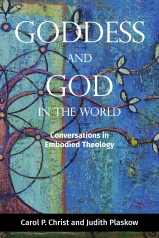 Carol’s new book written with Judith Plaskow, is Goddess and God in the World: Conversations in Embodied Theology.
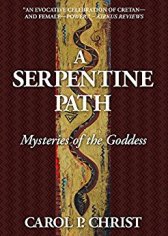
FAR Press recently released A Serpentine Path: Mysteries of the Goddess.
Join Carol on the life-transforming and mind-blowing Goddess Pilgrimage to Crete. Sign up now for 2018! It could change your life!
Carol’s photo by Michael Honegger
Holy Women Icons Bearing the Light of Advent by Angela Yarber

There’s nothing like the holiday season to bring out everyone’s least feminist self. In one of the courses that I teach—Gender, Food, and the Body in Popular Culture—students are assigned to examine gender roles throughout the holiday season through the lens intersectional ecofeminism. Inevitably, almost every student returns from holiday break with the same assessment: mom, grandma, and a kitchen full of women prepare, cook, and clean every family meal; women do the holiday shopping; men in the family watch sports. Of course, this isn’t true of everyone. There are plenty of families who subvert and dismantle stereotypical gender roles, but the holidays seem to heighten these roles, undergirding them with some kind of nostalgic and theological weight that claims that if mama doesn’t arduously prepare her famed casserole, the season will be ruined. Otherwise committed feminists find themselves singing carols filled with sexist language and participating in holiday rituals that they would critique any other time of the year. Subversion be damned because we want our traditional family holiday!
I’ve long struggled with creative ways to subversively approach the holidays as a queer clergywoman, parent, artist, and author. People like their nostalgic and heart-warming traditions, even when they sometimes smack of patriarchy, racism, and heteronormativity. I’ve confronted this as a preacher and worship planner, often to raised eyebrows or angry phone calls from congregants who just want to sing the carols without the preacher changing the words, or dismissing the notion of a virgin birth, or hanging enormous paintings of pregnant women all over the sanctuary.
Continue reading “Holy Women Icons Bearing the Light of Advent by Angela Yarber”
Rest and Renewal: Gifts of Women’s Ritual Dance by Laura Shannon

Samhain is past, and we in the northern hemisphere are once again entering the final outbreath of the solar year. At the winter solstice, light will be reborn. Until then, it is important to embrace the time of rest and renewal which is the great gift of this season. Like the falling leaves and the drying seeds, we too can relax and release old burdens. This is the best way, perhaps the only way, to draw new strength for the next active phase in the ever-changing cycles of our lives.
Many of us no longer follow the rhythms of the year and consequently subsist in an ongoing state of near-exhaustion. But rather than letting our energies get too depleted, we can learn to thrive within the limits of our available resources. As well as vastly improving the quality of our lives, this may lead to solutions for sustainable living in the long term – perhaps the most important skill humanity needs to develop now. Continue reading “Rest and Renewal: Gifts of Women’s Ritual Dance by Laura Shannon”
My Connection to Bengali Vaishnavism by Nazia Islam

Last summer I began a deep inquiry of Gaudiya/Bengali Vaishnava culture. That inquiry had its origins in a dream I had two years prior where Radha and Krishna appeared in the form of miniature clay figurines. Krishna went missing and Radha asked me to help find him like how she implores her sakhis/friends in much Vaishnava literature. Seeing deities in that manner, as I know in some aspects of Bengali culture, is a big deal. It usually signifies some spiritual connection to those deities. I wrote the dream down because of how vividly I saw it but brushed off as anything significant to me personally though the dream sparked my inquiry.
I had gotten some great information from an academic I met at the American Academy of Religion conference in 2015 who recommended I start with an ethnographic study, The Place of Devotion (Open source by UC Press), published that year by scholar Sukanya Sarbadhikary on the diversity of Bengali Vaishnavism. That was my start of my spiritual-academic journey of understanding Bengali Vaishnavism, but it has taken a while for me, through a lot of counseling, to get mentally and emotionally stable before I could start processing and analyzing all the information I’ve been collecting on this topic. I’m not going to divulge on the details about this in depth, but I can say it is connected to the politics of religious purity found across South Asian Muslim and Hindu communities which is exacerbated by non-Muslims and Hindus who can’t comprehend, for lack of a better word, folk religion or religious syncretism apart from the framework of dual religious identity through intermarriages and the term “multiple religious belonging.” But even those terms are not readily ascribed to non-white bodies.
Continue reading “My Connection to Bengali Vaishnavism by Nazia Islam”
The Impact of Marija Gimbutas on My Life and Work by Carol P. Christ
Last winter FAR contributor Glenys Livingstone lovingly and professionally edited all of the interviews for the film on Marija Gimbutas’ life and work, Signs Out of Time, by Donna Read and Starhawk, and posted them on youtube. Though I received a link to my interview from Glenys, I was too busy (or too depressed?) to watch it at the time.
As I watched and listened to my twenty years younger self yesterday, chills went up and down my spine. How, I wondered, did she know so much way back then? Maybe (I thought) she really was drawing on the underground spring described by Marija Gimbutas as bursting forth from time to timε to bring us wisdom from the ancestors of Old Europe.
Thank you Glenys for the fantastic editing job.
* * *
Carol’s new book written with Judith Plaskow, is Goddess and God in the World: Conversations in Embodied Theology.
FAR Press recently released A Serpentine Path: Mysteries of the Goddess.
Join Carol on the life-transforming and mind-blowing Goddess Pilgrimage to Crete. Sign up now for 2018! It could change your life!
Carol’s photo by Michael Honegger
Learning Gratitude for the Gifts of Life on the Goddess Pilgrimage to Crete by Carol P. Christ
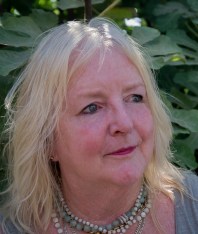
In Crete we are always being given gifts—fresh cherries, ice cold bottles of raki, yogurt swimming in honey, and so much more. Over the years it finally hit me that this spirit of great generosity is a living remnant of the ancient Cretan egalitarian matriarchal tradition of gift-giving.
In egalitarian matriarchal cultures gift-giving is not something reserved for birthdays and holidays. It is a way of life rooted in the primary understanding that life is a gift that is meant to be shared.
Our lives are a gift from our mothers. Our individual lives have are not something we create or created for ourselves. We all emerged from the body of a mother. We were all given the gift of care and feeding by a mother or others. Our mothers did not create themselves. They emerged from the bodies of mothers and were cared for and fed by mothers or others. And so on back to the original mother of the human race, known as the African Eve.
Honey: A Thousand Flowers by Mary Beth Moser
 Today I am finishing the last bit of the honey I hand-carried home from my most recent trip to Trentino. Sun yellow in color, it is made from the nectar of mountain flowers. Its label tells its origin—di montagna, of the mountains, and its type — mille fiore, often translated as “wildflowers.” Literally, however, it means “a thousand flowers.”
The valley where my maternal grandmother was born, Val di Sole, is renowned for its honey. In Croviana, one of the villages in the valley, new honey is celebrated in July with a sagra, a communal food festival. There are more than a dozen different types of honey from Trentino, including apple, chestnut, and rhododendron. These are plants of place – nature’s gifts that appear in the folk stories and are present in everyday life. Continue reading “Honey: A Thousand Flowers by Mary Beth Moser”
 Feminism and Religion