Tree Talk: Dr. Susan Simard by Sara Wright

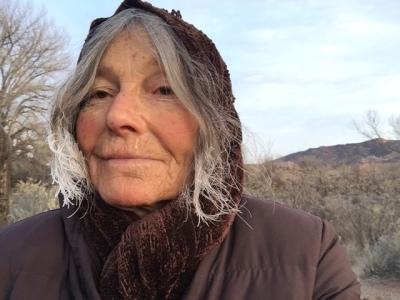
Scientist Susan Simard is a professor of forest ecology at the University in Vancouver, British Columbia, who has been studying the below-ground fungal networks that connect trees and facilitate underground inter-tree communication and interaction. Over a period of more than thirty years this field scientist and her students have learned how fungi networks move water, carbon and nutrients such as nitrogen between and among trees as well as across species. Her research has demonstrated that these complex, symbiotic networks in our forests — at the hub of which stand what she calls the “mother trees” — mimic our own neural and social networks. This groundbreaking work on symbiotic plant communication has far-reaching implications that include developing sustainable ways to ‘manage’ forests, and to improve tree and plant resistance to pathogens. Although much of Simard’s research occurs in forests, she has also studied the underground systems of grasslands, wetlands, tundra and alpine ecosystems.
Under our feet there is a whole world of biological pathways that connect trees and allow them to communicate and share resources and information. Other scientists who study these networks (like Dr. Merlin Sheldrake) agree with Susan who suggests that the forest behaves as though it’s a single cohesive organism. Continue reading “Tree Talk: Dr. Susan Simard by Sara Wright”

Welcome to the New Year by Natalie Weaver

Welcome to the New Year.

One year ago, on New Year’s eve, I buried my father’s ashes.  It was an incredible experience to orchestrate the funeral and burial of the man who begat me.  He was nowhere near a Hallmark greeting card kind of father.  He was complicated and difficult in ways both minor and severe.  Yet, this was the man I called “Dad,” and I was left to deal with the baggage of his life.  I cried in a way I had not cried before and felt a kind of sadness that, when given over to, seemed fathomless.  There is no real answer to grief like that.  I decided that one must just confront it or become it or traverse it.  And, there were things to do, practical things, such as repurposing clothes and rehoming cats, for which no one, I believe, could ever be totally prepared. I did not resent what I had to do; I just did it.  These things were hard for me.

Yet, despite the pain, something in that loss was deeply freeing.  There was no progenitor in the person of my father to come before me now, so there was suddenly no sense (however falsely constructed it may have been to begin with) that someone stood between me and whatever it is that was and is coming at me.  There is no longer even the false perception of a windbreaker, no frontline, no wise man, no one to shield, no guide.  There is just a naked sense of myself in the world, and though others surely came before me and stand around me now, on an existential level, I am not answering to him any longer.

Continue reading “Welcome to the New Year by Natalie Weaver”

Becoming Scrub by Sara Wright

In the precious hour before dawn I walk down to a river that no longer empties into the sea – the circle of life has been broken – the earth’s veins and arteries are hopelessly clogged by human interference (stupidity) – the birds and animals that used to be able to rely on the river waters for food and resting places can no longer do so because dams control the water flow and westerners “own” the water. This morning black stone sculptures appeared overnight because the water level has been dropped another foot. And yet, acknowledging the flowing waters in their death throws seems like an important thing to do. For now, at least, the river turns crimson, reflecting the raging beauty of a pre dawn sky, and I am soothed by water rippling quietly over round stone.

I open the rusty gate to enter the Bosque, a place of refuge, for the cottonwoods and for me. Now I am surrounded by desert scrub and graceful matriarchs arc over my head. As I traverse the well  – trodden path I enter a meditative state without effort. Soon I am walking in circle after circle passing through the same trees and desert scrub hearing voices.

Continue reading “Becoming Scrub by Sara Wright”

The Door by John Erickson

Faith is something we get from each other, and sometimes in the most magical of circumstances, faith becomes embodied by the person you love the most.

I have a Ph.D. in American Religious History but I’ve never been much of a religious person.  It’s been one of the conundrums of my life but nevertheless, I found religion and its role in influencing, for good and bad, the lived experiences of the LGBTQ community something worth exploring.

I’ve been struggling with writing this post ever since I graduated and officially became “Dr. John.” In preparing for my defense, the Chair of my Dissertation Committee requested that at the start of the defense, he wanted me to introduce my project, its overall scope, and most importantly why I wrote it.

Why did I write it?  How does one answer why they chose to devote 8 years of their life to a single subject in search of an original idea?  While some would sit and grapple with this question, I knew what the answer was all along because it always was (and always will be) about my maternal grandmother, Gladys Hritsko.

I wanted to know what made me different.  Throughout my dissertation, I interviewed people who, much like myself, grew up in similar small towns, attended the same conservative church services, and heard the same damning things that I did about my sexuality being preached from the pulpit. Many of my subjects were deeply hurt by religion and it set some of them up for years of searching and painful memories and experiences that both forced them to leave their religious and faith-based communities they grew up in or, in the worst case, being kicked out by their family as a result of their religion.

Continue reading “The Door by John Erickson”

Embracing the Darkness by Judith Shaw

judith shaw photoFor most of my life I dreaded both the approach of winter and winter itself. Having grown up in the semi-tropics of New Orleans I had little tolerance for the cold. Living further north as an adult, the shortening days seemed to contradict the joy I found during the blooming of spring and the abundance of summer. Though I certainly appreciated the crisp, clear, golden days of fall they also caused feelings of trepidation as the days continued to shorten.

Continue reading “Embracing the Darkness by Judith Shaw”

The Feast of Santo Tomas by Sara Wright

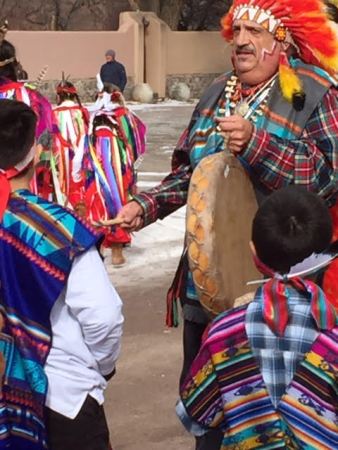
This morning I went up to the village plaza in Abiquiu to watch the dancers parade around the church with their saint who is also honored at this village festival held every year at the end of November.

This is one of the two Native American festivals that is honored each year by the genizaros who are mixed Spanish and American Indian people who embrace and practice the Catholicism that was once forced upon them.

This eclectic community is made up of descendants of Native American slaves. Those captured in warfare were brought here, converted to Catholicism, taught Spanish and held in servitude by New Mexican families. The young women and female children endured the usual atrocities perpetuated on captive females including rape at the hands of their captors. Some New Mexican male genizaros gained their freedom by serving as soldiers to defend frontier villages like Abiquiu from Indian raids. By the late 1700s, genizaros comprised one-third of the population of New Mexico. Ultimately these non – tribal peoples were assimilated into New Mexican culture.

The dances are beautiful to witness with the smallest female children dressed in predominantly white regalia some wearing a rainbow of ribbons, the young girls were dressed in red and white and had red circles of war paint inscribed on their cheeks, some of the older women also wore red, many carried turkey or eagle feathers in their hands. Most wore face paint.

Continue reading “The Feast of Santo Tomas by Sara Wright”

Mother – Daughter Betrayal by Sara Wright

(1)

Today is my mother’s birthday and although she has been dead for more than a decade I still think of her almost every day. At the time of her death I had not seen her for twelve years. Not by choice. After my father’s sudden demise my mother chose my children, her two adult grandsons to be her protectors, and dismissed me from her life, permanently.

When she died, my mother divided her assets evenly between my children and me, forcing her only daughter to live beneath the poverty level for the remainder of her life.

The final betrayal.

At the time of her death I was teaching Women’s Studies at the University.

Continue reading “Mother – Daughter Betrayal by Sara Wright”

What I Learn from Women in Southern Morocco by Laura Shannon

I feel deeply fortunate to be able to travel regularly to southern Morocco. In Taroudant in the Souss Valley, and further south in the Anti-Atlas Mountains, my groups of students have the chance to discover women’s cultural traditions including music and dance, weaving and embroidery, household and healing rituals. In the seven years I have been leading these tours, women have joined me from a dozen different countries and as many different faiths, and most of them end up feeling at home here just the way I do.
What makes southern Morocco so special? Many threads come together to create the extraordinary ambience which permeates this part of the country. First of all, there is the Berber influence: a large percentage of Moroccans in the South are Berbers, and many elements of ancient North African Berber culture, with roots in Neolithic times, remain percepible beneath the relatively recent overlays of Arabic culture and Islam.

Continue reading “What I Learn from Women in Southern Morocco by Laura Shannon”

Mother of All Fears by Trelawney Grenfell-Muir

This time of year, the general public tends to pay more attention than usual to witches. Much of it is lighthearted – halloween costumes and memes about where to park your broom. Some of it is spiritual – adherents of the modern religions of Wicca and neopaganism discussing symbolic and supernatural beliefs. And some of it is historical – analyzing the witch trials of past centuries and wondering how they apply, ethically, to modern day intolerance and violence.

Within all these discussions, usually unnamed and unexamined, is the framing metaquestion: what should we fear? And what should we do about that which we fear?

Historic witch trials (from a time when witches were believed to be evil agents of Satan) reveals how we humans always try to externalize badness and goodness, so we can exterminate badness and excuse ourselves for our lack of goodness. So we have heroes and villains, neither of them very human, but rather idols and symbols of our fears. I honestly think the patriarchy’s fear of females is as strong as it ever was. When the most popular videos on the most popular internet porn sites are of ****TRIGGER WARNING RAPE, INCEST**** raping a stepsister, or doctors raping a teenage girl in the hospital for cancer, or of border agents raping a pregnant young refugee, and these sites are visited by 98% of the men in our society, what does that say about us as a species? Or a culture? As Tallessyn Grenfell-Lee says, “Scary, scary vaginas!

Continue reading “Mother of All Fears by Trelawney Grenfell-Muir”

Wealth In Imagination by Laurie Goodhart

Artwork and sustainable agriculture are the two threads of my professional life. They mingle fruitfully beneath the surface as I sift through remaining evidence of ancient worlds, trying to sense how people of lost cultures met basic survival needs and also how they responded to the very human hunger for beauty, meaning, and story.

In revisiting the remnants with empathy and wonder, scavenging for resonant clues and forks in the road that we didn’t take, some subtle but significant things continually resurface. For one, various ancient Greek writers  (males, e.g., Plato, Strabo, Euripides) noted that it is “the women” who keep things sacred and maintain spiritually oriented rituals; that without the impetus of women, men would not bother to honor the sacred in everyday life, carrying on without much concern beyond themselves. Continue reading “Wealth In Imagination by Laurie Goodhart”