

 For most of my life I dreaded both the approach of winter and winter itself. Having grown up in the semi-tropics of New Orleans I had little tolerance for the cold. Living further north as an adult, the shortening days seemed to contradict the joy I found during the blooming of spring and the abundance of summer. Though I certainly appreciated the crisp, clear, golden days of fall they also caused feelings of trepidation as the days continued to shorten.
Category: Ancestors
The Feast of Santo Tomas by Sara Wright
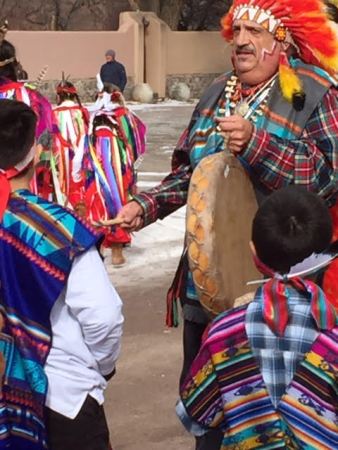
This morning I went up to the village plaza in Abiquiu to watch the dancers parade around the church with their saint who is also honored at this village festival held every year at the end of November.
This is one of the two Native American festivals that is honored each year by the genizaros who are mixed Spanish and American Indian people who embrace and practice the Catholicism that was once forced upon them.
This eclectic community is made up of descendants of Native American slaves. Those captured in warfare were brought here, converted to Catholicism, taught Spanish and held in servitude by New Mexican families. The young women and female children endured the usual atrocities perpetuated on captive females including rape at the hands of their captors. Some New Mexican male genizaros gained their freedom by serving as soldiers to defend frontier villages like Abiquiu from Indian raids. By the late 1700s, genizaros comprised one-third of the population of New Mexico. Ultimately these non – tribal peoples were assimilated into New Mexican culture.
The dances are beautiful to witness with the smallest female children dressed in predominantly white regalia some wearing a rainbow of ribbons, the young girls were dressed in red and white and had red circles of war paint inscribed on their cheeks, some of the older women also wore red, many carried turkey or eagle feathers in their hands. Most wore face paint.
Mother – Daughter Betrayal by Sara Wright

(1)
Today is my mother’s birthday and although she has been dead for more than a decade I still think of her almost every day. At the time of her death I had not seen her for twelve years. Not by choice. After my father’s sudden demise my mother chose my children, her two adult grandsons to be her protectors, and dismissed me from her life, permanently.
When she died, my mother divided her assets evenly between my children and me, forcing her only daughter to live beneath the poverty level for the remainder of her life.
The final betrayal.
At the time of her death I was teaching Women’s Studies at the University.
Continue reading “Mother – Daughter Betrayal by Sara Wright”
What I Learn from Women in Southern Morocco by Laura Shannon
I feel deeply fortunate to be able to travel regularly to southern Morocco. In Taroudant in the Souss Valley, and further south in the Anti-Atlas Mountains, my groups of students have the chance to discover women’s cultural traditions including music and dance, weaving and embroidery, household and healing rituals. In the seven years I have been leading these tours, women have joined me from a dozen different countries and as many different faiths, and most of them end up feeling at home here just the way I do.
What makes southern Morocco so special? Many threads come together to create the extraordinary ambience which permeates this part of the country. First of all, there is the Berber influence: a large percentage of Moroccans in the South are Berbers, and many elements of ancient North African Berber culture, with roots in Neolithic times, remain percepible beneath the relatively recent overlays of Arabic culture and Islam.
Continue reading “What I Learn from Women in Southern Morocco by Laura Shannon”
Mother of All Fears by Trelawney Grenfell-Muir

This time of year, the general public tends to pay more attention than usual to witches. Much of it is lighthearted – halloween costumes and memes about where to park your broom. Some of it is spiritual – adherents of the modern religions of Wicca and neopaganism discussing symbolic and supernatural beliefs. And some of it is historical – analyzing the witch trials of past centuries and wondering how they apply, ethically, to modern day intolerance and violence.
Within all these discussions, usually unnamed and unexamined, is the framing metaquestion: what should we fear? And what should we do about that which we fear?
Historic witch trials (from a time when witches were believed to be evil agents of Satan) reveals how we humans always try to externalize badness and goodness, so we can exterminate badness and excuse ourselves for our lack of goodness. So we have heroes and villains, neither of them very human, but rather idols and symbols of our fears. I honestly think the patriarchy’s fear of females is as strong as it ever was. When the most popular videos on the most popular internet porn sites are of ****TRIGGER WARNING RAPE, INCEST**** raping a stepsister, or doctors raping a teenage girl in the hospital for cancer, or of border agents raping a pregnant young refugee, and these sites are visited by 98% of the men in our society, what does that say about us as a species? Or a culture? As Tallessyn Grenfell-Lee says, “Scary, scary vaginas!”
Continue reading “Mother of All Fears by Trelawney Grenfell-Muir”
Wealth In Imagination by Laurie Goodhart
 Artwork and sustainable agriculture are the two threads of my professional life. They mingle fruitfully beneath the surface as I sift through remaining evidence of ancient worlds, trying to sense how people of lost cultures met basic survival needs and also how they responded to the very human hunger for beauty, meaning, and story.
In revisiting the remnants with empathy and wonder, scavenging for resonant clues and forks in the road that we didn’t take, some subtle but significant things continually resurface. For one, various ancient Greek writers (males, e.g., Plato, Strabo, Euripides) noted that it is “the women” who keep things sacred and maintain spiritually oriented rituals; that without the impetus of women, men would not bother to honor the sacred in everyday life, carrying on without much concern beyond themselves. Continue reading “Wealth In Imagination by Laurie Goodhart”
Joan of Arc from The Goddess Project: Made in Her Image by Colette Numajiri
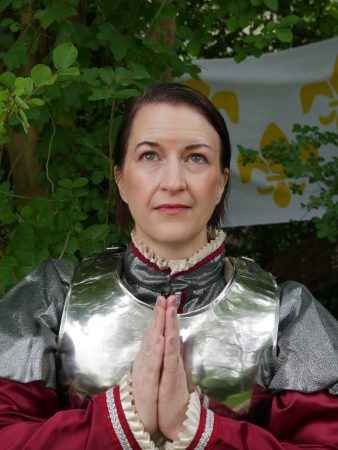
“I’m not afraid. I was born to do this.” -Joan of Arc
Women are inherently valiant. In extreme situations we armor up and lead others through whatever we are battling at the time.
Joan of Arc was a human woman with otherworldly faith who, as a young teenager, listened to Divine voices and lead an army that eventually ended the 100 Years War. “The real Joan of Arc is an uncomfortable fit as an icon of female solidarity or democratic rights. She achieved what should have been impossible for someone of her gender and class in 15th-century France.” wrote Helen Castor in her book Joan of Arc: A History. She was so respected and revered that 20 years AFTER Her death, 115 people testified on behalf of Joan of Arc (Jeanne d’Arc) and overturned the ruling.
Enbodying the Divine Feminine on Earth, women look to Joan as an inspiring example of a brave and active woman. Joan inspired the Suffragettes, they held her banner and wore white (as Joan chose to wear white for purity when She was taken to the stake to be burned for the crime of cross-dressing) as they marched for women’s right to vote. Just as, a few months ago our newly elected Congresswomen all wore white in solidarity.
Continue reading “Joan of Arc from The Goddess Project: Made in Her Image by Colette Numajiri”
The Dying Time by Esther Nelson
At the end of Anita Diamant’s novel, THE RED TENT, Dinah—the same young woman who is only briefly mentioned in the biblical account (Genesis 34)—dies after a long and full life. The biblical text tells us that Dinah “went out to visit the women of the region” and that “Schechem son of Hamor the Hivite, prince of the region, saw her…seized her and lay with her by force” (vss. 1-2). The passage is often titled “The Rape of Dinah.”
In Diamant’s version of the story, Dinah and King Hamor’s son engage in consensual sex. In keeping with the biblical account, the king then attempts to negotiate a bride price with Jacob (Dinah’s father), but Jacob and his sons are reluctant to agree to the marriage. They demand soon thereafter that all the men in Hamor’s kingdom undergo circumcision as a bride price. On the third day after surgery, the sons steal into the city and kill the men.
After just a mere mention of Dinah’s “rape” in Genesis 34, she disappears from the story. In THE RED TENT, Diamant not only gives Dinah a powerful voice, she also weaves a wonderful tale of mothers, daughters, heartache, betrayal, loss, love, and joy. Dinah gives birth to her lover’s son in Egypt, develops a strong bond and working relationship with the midwife, Meryt, and eventually falls in love with Benia, a master carpenter.
Autumn Equinox with the Ancestors, or after ecstasy indeed the laundry*) Eline Kieft

As I hang the laundry back home, I remember how just 24 hours earlier I arrived back on the beach after an incredible time at the ancestral burial mound where I spend the night in ceremony at the Autumn Equinox.
Ile Carn is a neolithic passage grave on a small tidal island in Finisterre, Brittany. I had visited there the summer before, and found that the other world was strongly accessible. When places become very touristy, like Stonehenge or Mont St. Michel, it sometimes appears as if the spirits retreat and the potency of the place thins. I asked them then if I could come back for ceremony, and when the answer was yes, I promised to return.
So here I was, on the Autumn Equinox, or Mabon. This is a time of balance, when the days and nights are equally long. A time in which the harvest has been gathered and we can start to prepare for a time of gestation and growing in the dark womb of winter, before the light is reborn again next year. My personal aim was three fold: I wanted to celebrate this year, especially to give thanks for my life, which had been on a precarious knife-edge earlier in May. I also wanted to ask for guidance for both my budding business and for my academic work in terms of re-discovering our own indigeneity in the west.
Finding Missing Pieces of My Ancestral Story: Scotland and Ireland by Carol P. Christ
 When I began researching years ago, I knew the names of my grandparents and what country in Europe their ancestors were from, but not much more. I have now traced most of my ancestors back to the Old Country, some to the 1600s. But there remained four ancestors with unknown places of origin among my sixteen 2x great-grandparents. A week or so ago, I decided to go back to the online resources, focusing on James Inglis, the Scottish seaman, and his Irish wife, Anne Corliss. This time I was more experienced, and I was determined to find the records.
Several sources confirmed that James’ parents were James and Isabella. Unfortunately, more than one James Inglis was born about 1838 to parents with these names. I had already ruled these Jameses out, because they were living in Scotland during the 1861 census, while my ancestor was by that time married and living in New York City. Scottish birth, marriage, and death records are incomplete before 1855 when civil registration was required; neither the marriage of James’ parents, nor his birth record were online. Continue reading “Finding Missing Pieces of My Ancestral Story: Scotland and Ireland by Carol P. Christ”

