

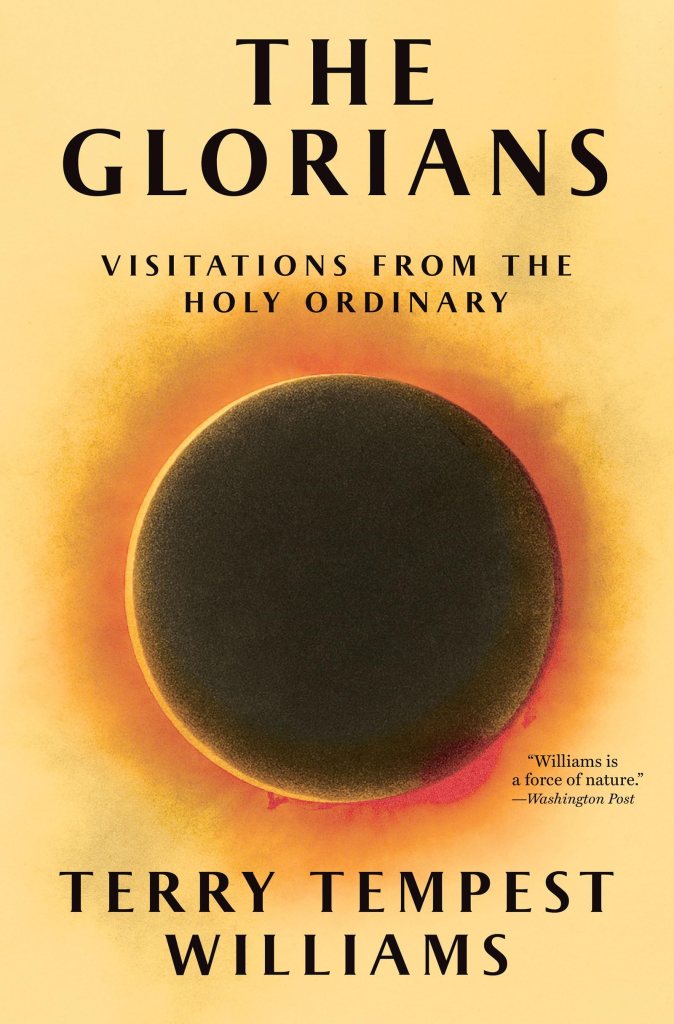
There is something deeper than hope that is calling us writes Terry Tempest Williams internationally acclaimed naturalist, environmentalist, and author in The Glorians. When we focus our attention on what she calls the ‘holy ordinary’ we are transported into a new way of being.
A Glorian can be a life changing dream like the one Terry had that inspired the title of this book. “Your vow is to create the Epic Documentation of the Glorians,” she was told as she reached the top of a tower by way of a spiral staircase. “What the hell is a Glorian” her father asked. A Glorian can be a moment, memory, an animal, plant, root, eclipse, an encounter with self or with others, an ordinary or non -ordinary experience that pulls us into the Now when the cloak of linear time falls away, and presence is all there is.
Terry shares her experiences with Glorians throughout the book but refuses to define who or what they might be believing that each person’s perceptions are different.
Continue reading “What is a Glorian? Almost a Review of Terry Tempest’s book by Sara Wright” Scientist Susan Simard is a professor of forest ecology at the University in Vancouver, British Columbia, who has been studying the below-ground fungal networks that connect trees and facilitate underground inter-tree communication and interaction. Over a period of more than thirty years this field scientist and her students have learned how fungi networks move water, carbon and nutrients such as nitrogen between and among trees as well as across species. Her research has demonstrated that these complex, symbiotic networks in our forests — at the hub of which stand what she calls the “mother trees” — mimic our own neural and social networks. This groundbreaking work on symbiotic plant communication has far-reaching implications that include developing sustainable ways to ‘manage’ forests, and to improve tree and plant resistance to pathogens. Although much of Simard’s research occurs in forests, she has also studied the underground systems of grasslands, wetlands, tundra and alpine ecosystems.
