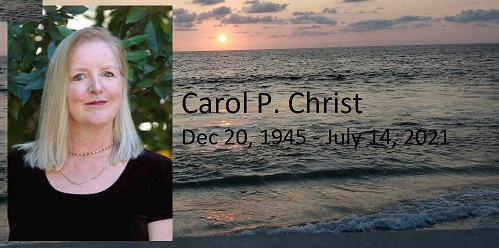
The Legacy of Carol P. Christ: Was Ariadne the Most Graceful Bull-leaper of All? Deconstructing and Re-visioning Greek Mythology

This was originally posted on March 3, 2014

Sometimes we think of Greek myth as a pre-patriarchal or less patriarchal alternative to the stories of the Bible. After all, Goddesses appear in Greek myths while they are nearly absent from the Bible. Right?

So far so good, but when we look more closely we can see that Greek myth enshrines patriarchal ideology just as surely as the Bible does. We are so dazzled by the stories told by the Greeks that we designate them “the origin” of culture. We also have been taught that Greek myths contain “eternal archetypes” of the psyche. I hope the brief “deconstruction” of the myth of Ariadne which follows will begin to “deconstruct” these views as well.

bull leaping ring before 2000 bc phourni

Ariadne is a pre-Greek word. The “ne” ending is not found in Greek. As the name is attributed to a princess in Greek myth, we might speculate that Ariadne could have been one of the names of the Goddess in ancient Crete. But in Greek myth Ariadne is cast in a drama in which she is a decidedly unattractive heroine.

Continue reading “The Legacy of Carol P. Christ: Was Ariadne the Most Graceful Bull-leaper of All? Deconstructing and Re-visioning Greek Mythology”

Whale Continues Singing to Me by Judith Shaw

The mystery evoked by Whale continues to fill my heart as Whale images fill up papers laid out on my drawing table.

Continue reading “Whale Continues Singing to Me by Judith Shaw”

From the Archives: Serpent Healing by Laura Shannon

This was originally posted on October 38, 2014

Snakes have been considered sacred in Greece and the Balkans, as well as other cultures, since at least 7000 BCE. They are symbols of rebirth and regeneration, as they travel between our world and the world below, disappear and re-emerge from the earth in spring, and shed their skins in seasonal renewal.

The Cretan Snake Goddess from Knossos (ca 1600 BCE) stands serenely with serpents wrapped around her body, showing how snakes were considered benevolent and were revered, not feared. Snakes are also powerful symbols of healing. Recently, I had an extraordinary experience of ‘serpent healing’ after a serious injury.

Knossos Snake Goddess

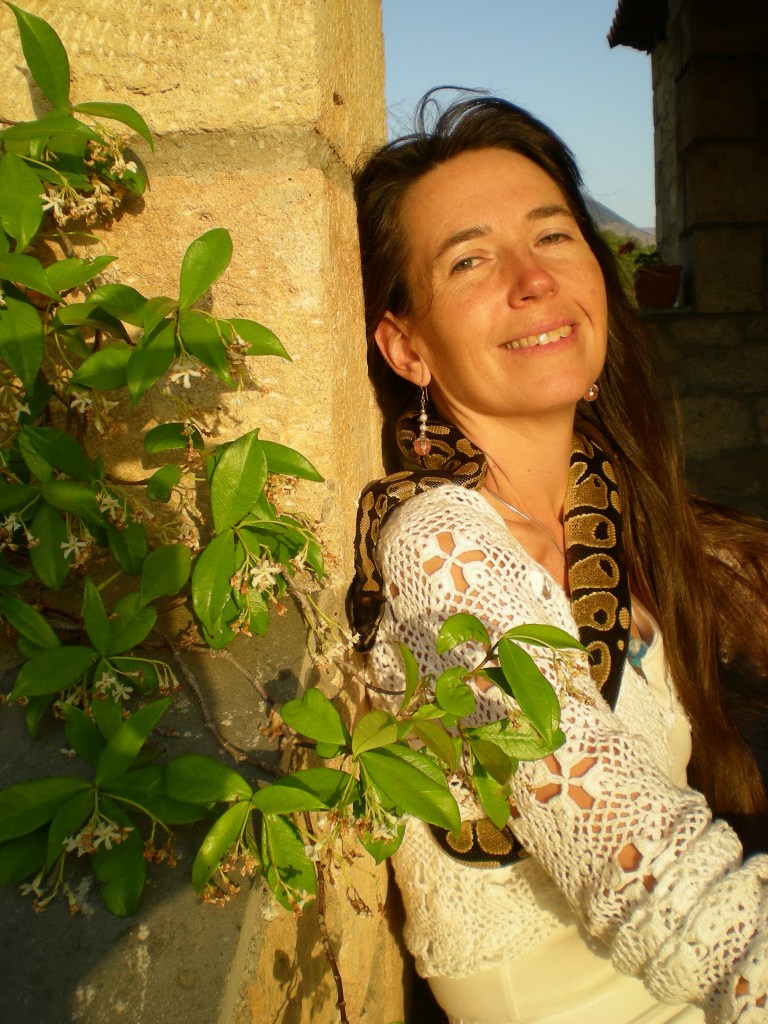
Friends of mine run a yoga retreat centre in Mani, Greece, called The Spirit of Life, where their son keeps a number of snakes including a beautiful Royal Python named Monty. Monty and I have met on several occasions over the years, and whenever I have spent time holding him, I have felt a sense of great peace and calm. More than that, Monty has shown an uncanny ability to move directly to places of tension in my shoulders, and to gently yet firmly massage sore muscles in a soothing way.

Continue reading “From the Archives: Serpent Healing by Laura Shannon”

Whale – Lord of the Sea by Judith Shaw – Part 2

Whale, a bridge between the spirit world and the physical world, breathes air but dives deep into the sea, reminding us to embrace duality while seeking balance and our highest truth.

Continue reading “Whale – Lord of the Sea by Judith Shaw – Part 2”

Whale – Lord of the Sea by Judith Shaw – Part 1


In the deep waters of Earth’s soul, Whale – Lord of the Sea – lives long, dives deep and emerges within a cascade of sea foam to greet the day . Considered divine beings by some cultures and demons by others, this enigmatic being inspires both awe and fear in the human heart.

Continue reading “Whale – Lord of the Sea by Judith Shaw – Part 1”

Be the Donkey: On Parshah Balak by Ivy Helman.

The Torah portion for July 16, 2022 is Balak (Numbers 22:2 -25:9).  Some of what happens in Balak is familiar: idolatry, divinely-sanctioned death penalties, and a plague.  But, did you know that this parshah has a talking female donkey who stands up to abusive behavior?  Perhaps not.  That talking donkey and the larger story of Balak’s attempt to curse the Israelites raises questions about gender, how we treat animals, choices, free will, violence, courage, and having one’s eyes open to what is really happening around one’s self. All of which is what we will be looking at today.

Balak begins with this story about Balaam.  The Moabite king, Balak, wishes to curse the Israelites because he is worried about their size and their impact on the land and its current inhabitants (22:3-4).  He sends representatives to bring  Balaam, a powerful man whose curses and blessings have tangible effects on their recipients (22:6), to him.  Balaam meets with those representatives and tells them to wait; he has to talk to the deity in order to know what to do.  The deity commands Balaam to stay put and to not curse the Israelites, for they are blessed (22:12). Indeed, a first in quite a while. 

Continue reading “Be the Donkey: On Parshah Balak by Ivy Helman.”

Sheep – Gentle Wisdom by Judith Shaw

Sheep – soft-footed, fluffy creatures – graze and amble along with frolicking lambs by their sides. Know worldwide as docile and friendly, sheep – in particular the female ewes and their lambs – have come to symbolize innocence, gentleness and peacefulness. The symbolism of rams takes on a slightly different, more masculine tone and will be looked at separately. 

Continue reading “Sheep – Gentle Wisdom by Judith Shaw”

On the Good and the Bad of Behar by Ivy Helman

The Torah portion for May 21, 2022 is Behar (Leviticus 25:1 – 26:2).  In it, the Israelites receive instructions for sh’mita and yovel – two types of sabbatical years.  These years attempt to set up right relations between the community, the inhabitants of the land, and the land itself.  From an ecofeminist perspective, not all is as idyllic as the Torah wishes it to seem.   

Behar begins with sh’mitah, a sabbatical year that takes place every seventh year.  During sh’mitah, the land must lay fallow.  Both humans and animals can eat from what the land will naturally grow.  

Continue reading “On the Good and the Bad of Behar by Ivy Helman”

Tzav: Holiness, the Situation in Ukraine, and Eating Animals by Ivy Helman

The parshah for this upcoming Shabbat is Tzav (Leviticus 6:1-8:36).  It details the investiture of Aaron and his sons into the priesthood and lays out the basics of various offerings (mostly, although not exclusively, animal sacrifices) and the rules regarding the eating of them.  As I’ve mentioned before on this site, I would like to complete at least one commentary on each parshah of the Torah.  Yet, there are only so many times that one can question the establishment of the temple, condemn animal sacrifice, and denounce the absence of women.  Yet, as we approach another Torah portion this week, Tzav , this is more or less what we have.  So, what do we do?

Tzav starts, as parshot from the book of Leviticus often do, with descriptions of various laws.  Here, the laws focus on various offerings including the grain, sin, peace, thanksgiving, and burnt.  Only the male members of Aaron’s family can eat the offerings.  Consumption of the offering increases the holiness of the consumer as long as the eating of the animals falls into the guidelines outlined within the text.  

The parshah ends with an explanation of how to consecrate Aaron and his sons.  The process lasts a total of seven days.  It includes residing at the entrance to the tent for the duration, offering various animals as sacrifices, eating copious amounts of said animals, the donning of specific ritual clothing, and multiple anointings of the men and the altar (often with blood).   

Continue reading “Tzav: Holiness, the Situation in Ukraine, and Eating Animals by Ivy Helman”

Hawk – A Soaring Visionary by Judith Shaw

Hawk, beautiful and deadly, soars high in the air –  circling and circling –  its piercing eyes focused below. Spotting Hawk, one is amazed by its elegance and power while feeling a strange and ancient connection to this magnificent bird. Yet it strikes fear in the hearts of small animals.  

Continue reading “Hawk – A Soaring Visionary by Judith Shaw”