Looking Again at The Magic Flute by Barbara Ardinger

I have just spent a week watching four productions of Mozart and Schikaneder’s 1791 opera. Four in a row! Now we all know that I adore musical theater more than almost anything else in the world. Operetta. Nelson and Jeanette. Fred and Ginger. Broadway musicals (but not the movies made from them that rewrote them completely). But opera?? Certainly not Italian opera seria. It’s just too loud. Besides, why isn’t La Boheme sung in French? Carmen in Spanish? Madame Butterfly in Japanese? Aida in Egyptian? Turandot in Chinese?

All right—yes, these are ridiculous questions. I’ve seen La Boheme and Turandot live. I’ve seen The Magic Flute live two or three times. Mozart is my favorite classical composer. Born in Salzburg (which was then part of the Holy Roman Empire and now is the site of an annual Mozart festival), he began composing at age five, and he and his sister Nannerl toured the courts of 18th-century Europe and performed before Louis XVI and Marie Antoinette. (BTW, while much of his story is told in the play and film Amadeus, Mozart was not murdered by Salieri. He died from a highly contagious miliary fever.)

Continue reading “Looking Again at The Magic Flute by Barbara Ardinger”

Leonora Carrington’s THE HEARING TRUMPET – Book Review by Sally Abbott

Sally Abbott

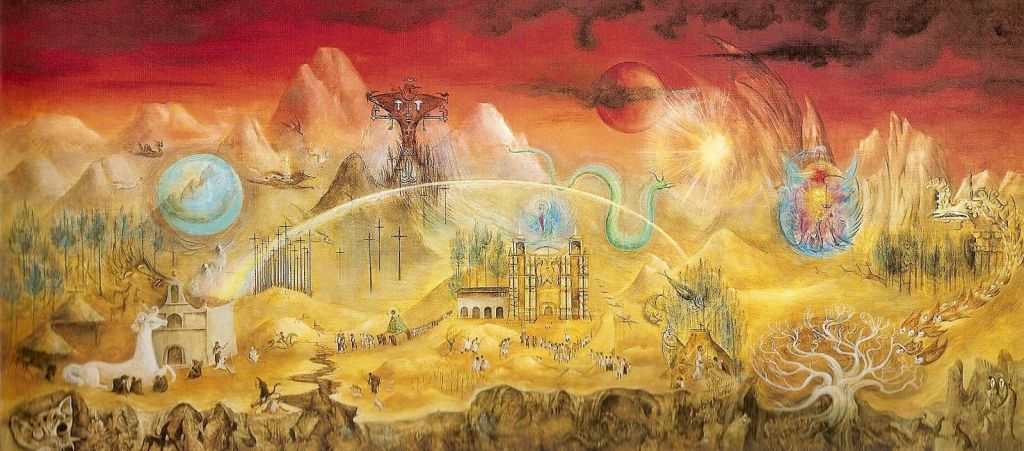
Long a fan of Surrealist artist Leonora Carrington, I was initially hesitant when the New York Review of Books reissued her 1974 novel, The Hearing Trumpet.  I didn’t know what to expect when this extraordinary painter picked up a pen.

To my delight and surprise, Carrington shows the same artistry and whimsy in her writing that she does in her painting.  She also reveals herself to be an astute feminist and aficionado of the Goddess, well-versed in arcane lore, with which she accents her fantastical world.  The Hearing Trumpet is full of British humor and eccentricity, set in a finely spun, other-worldly landscape.

The World of the Maya

Her heroine Marian Leatherby is a 92-year-old, who lacks teeth, is hard of hearing, and sports a beard–a whimsical, endearing character who loves cats.  She has been given a hearing trumpet by her great friend Carmella, and thereby learns that her son and his wife plan to send her away to an old folks’ home run by a Dr. Gambit and the Well of Light Brotherhood.

Continue reading “Leonora Carrington’s THE HEARING TRUMPET – Book Review by Sally Abbott”

Loving Venus, a poem by Marie Cartier

Dedicated to Carol Christ, 1945-2021, who taught so many of us how to love the Goddess


She is called “Nude Woman” and currently lives
in her natural museum house in Vienna.
Nude woman. She is art, but she is not in an art museum.
And there are questions:
why was she originally painted red? Why are her breasts so large?
Why is her stomach so large?
Why does she fit in a human hand?
What was her purpose?
Was it to entice men, or to comfort women?
Historians disagree.
Is her hair woven? Or is it a hat?
Why does she have no eyes? No feet? Why is she there?

Continue reading “Loving Venus, a poem by Marie Cartier”

The Red Hand on the Cave Wall by Carolyn Lee Boyd

As I have gotten older, I find I am drawn more to non-anthropomorphic, inexpressable-in-words, nature, and everyday focused visions of the Divine. Whereas before my spiritual practice involved more rituals and circles, unusually indoors, with others, now I more often engage in solo quiet contemplation, outside in the wild when I can. I think more about ways of being rather than ways of doing and more about the small messages I want to leave to generations to come instead of  major accomplishments.  I feel as if I am contracting in towards the center of the spiral of my spiritual journey.

All over the world, very ancient cave art includes hand prints made by painting or blowing ochre around a hand or putting ochre on a hand and pressing it to the wall. Research has shown that about 75% of these were made by women, making them a very early form of feminist art. I wonder if some of them might have been made by women who had transformations and thoughts similar to mine. Here is a poem in the voice of such a woman. 

Continue reading “The Red Hand on the Cave Wall by Carolyn Lee Boyd”

The Healing Spirit of Sacred Play by Carolyn Lee Boyd

Many years ago I participated in seasonal, Goddess-focused celebrations featuring handmade decorations, including some by enormously talented artists who attended.  One year, our spring fete was graced with gorgeous paintings, intricately woven and colorful fabric art, sensuous sculptures, and exquisitely painted eggs. I brought a Peeps diorama depicting the reunion of Demeter and Persephone.  (For anyone wondering, Peeps are brightly colored marshmallows in the shape of bunnies, chicks and other shapes and are sometimes made into dioramas for contests in schools and libraries.) The reason I brought the diorama was partly because, though my own artistic talent is somewhere between extremely questionable and non-existent, I thought people might enjoy a little bit of whimsy to honor spring’s exuberance. In addition, however, I was  also going through a time of great personal and professional stress and my soul deeply needed to be creative with just a little outrageous fun. 

Demeter and Persephone diorama

To recap the story, Persephone had been abducted by Hades and taken to the Underworld. Her mother, Demeter, made the Earth barren until the gods agreed to Persephone’s release. Demeter is the purple Peep and Persephone is yellow, and they are about to be reunited. Hades is pinkly enraged as he stands at the gateway to Hades. Gummi bears are romping while green humans dance in a circle. Snow is on the trees to show that winter is giving way to spring as Demeter returns abundance to the world.

Continue reading “The Healing Spirit of Sacred Play by Carolyn Lee Boyd”

C.G. Jung and the Heroine’s Journey by Sally Abbott


I was intrigued by the discussions of Jung and Jungian motifs, such as the sacred marriage, that sprang up in response to Mary Sharratt’s wonderful post “The Via Feminina:  Revisioning the Heroine’s Journey,” partly based on Maureen Murdock’s book. Carol Christ pointed out the problematical nature of the whole notion of the sacred marriage, relying as it does on our stereotypes of the masculine and feminine.

Sara Wright reported that her sense of the dangers of Jungian thought led her to change her profession; she had once been a Jungian analyst. Barbara McHugh put forward a well-thought out and articulate version of the Heroine’s Journey, corrected for sexist thought.

Continue reading “C.G. Jung and the Heroine’s Journey by Sally Abbott”

Buddhist Misogyny Revisited – Part II by Barbara McHugh

Read Part I here first

Webster defines myth as “a usually traditional story of ostensibly historical events that serves to unfold part of the world view of a people or explain a practice, belief, or natural phenomenon,” and in this way myths tell us who we are. Unfortunately, they include stories, from Adam and Eve to Cinderella and Sleeping Beauty, that define women by using criteria such as gullibility, passivity, and the size of their feet.

But today women are shining light on the likes of Circe, Mary Magdalene, and Briseus, the young woman dismissed by Homer as an impediment to Achilles’s higher purposes. These stories counter the traditional narratives that restrict women, as well as men, to roles that rob them of their full humanity. In my novel, Bride of the Buddha, the Buddha’s wife embarks on a spiritual journey of her own. When her quest leads her to the Buddha’s all-male sangha, she disguises herself as a monk, eventually becoming Ananda, who in the scriptures is the Buddha’s attendant, the one who struggles with all the questions unenlightened practitioners face today.  The answers to these questions cannot be stated as propositions; they must be felt and lived. Hopefully, my version of Ananda suggests new possibilities for feeling and living these responses. If this “violates” the myth, it does not violate the Buddha’s fundamental views.

Continue reading “Buddhist Misogyny Revisited – Part II by Barbara McHugh”

Buddhist Misogyny Revisited – Part I by Barbara McHugh

Recently, I wrote a novel about the Buddha’s wife disguising herself as a man to join his religious community. When I showed the manuscript to a Buddhist friend, whose knowledge and practice I respect greatly, he expressed apprehension that it violated the basic myth of Buddhism. I assumed he meant that my storyline of gender deception strays too far from the versions of the Buddha’s life as recorded in the traditional canon, which adherents regard as the Buddha’s inviolable teachings. The last thing I wanted to do was to misrepresent these teachings.

What does it mean “to violate a myth”?  If I had portrayed the Buddha as a psycho-killer or wife-beater, I could appreciate this charge, but I had presented an enlightened Buddha whose values were in alignment with standard scripture and the mores of his day. The change I made was to tell the story from a woman’s point of view, and to do so, I modified some of the traditional legends and created new material to make my choices plausible. Predictably, my modifications came up against many of the stories’ misogynistic elements.

Continue reading “Buddhist Misogyny Revisited – Part I by Barbara McHugh”

Crane Song: Finding my way Home through Image, Myth, and Nature – Part 2 by Sara Wright


Read Part 1 here…  

Recently, I returned from the Southwest where I was introduced to the ceremonies of the Pueblo peoples, ceremonies that reflected my own spiritual practice reinforcing its authenticity. This interlude also allowed me to be part of a people who had never lost access to their roots. They had never given up their ceremonies or surrendered their way of life.

I returned to Maine with a much stronger sense of my Indigenous cultural identity than I had when I left. I hadn’t realized until I went to the Southwest how much this identity had been eroded by local people. Living in western Maine had brought me in contact with the frightening bias people have towards Indians; some are openly despised. Continue reading “Crane Song: Finding my way Home through Image, Myth, and Nature – Part 2 by Sara Wright”

Crane Song: Finding my Way Home through Image, Myth, and Nature – Part 1 by Sara Wright


The last gift I received from my very distant parents was a print of a Native American Medicine Wheel by Ojibway artist Joe Geshick. I received this present on my birthday in 1993.

When I opened the cardboard tube I was astonished by the image. A Medicine Wheel? As far as I knew neither of my parents had any idea that I had picked up the thread of my Native heritage and was studying Indigenous mythology. What could have motivated them to send me such an image? I was stunned by the seemingly bizarre synchronicity. Continue reading “Crane Song: Finding my Way Home through Image, Myth, and Nature – Part 1 by Sara Wright”