Sappho’s Prescription For A Healthy Heart & the Taoist/Buddhist Concept of Forget (忘)

Stuart WordPress photoA two line fragment of Sappho’s poetry (S.120) reads:

But I am not one to keep venting my anger:
Rather I let some things in my heart go unspoken

Sappho’s word choices here make this as difficult as any of her fragments to appreciate in translation.  Yet, not only do those choices make attribution of this fragment to Sappho secure, they also manifest her importance in an area for which she rarely receives attention: early Greek medical thinking.  One reason her importance in that regard is largely unnoticed is that Western medicine in general has abandoned its own tradition, retaining only the nomenclature and some of the symbolism of early Greek medicine. Continue reading “Sappho’s Prescription For A Healthy Heart & the Taoist/Buddhist Concept of Forget (忘)”

Bodies of More and Less Value by Oxana Poberejnaia

oxanaThere is a story in the collection called Avadanasataka (One Hundred Legends) of the Sarvastivadin school, one of the schools of early Indian Buddhism that did not survive to present day, relating one episode from the Buddha’s previous lives. The story is about king Padmaka who sacrificed his life to cure his subjects of a disease. Here is an academic article about this episode.

The Buddha was prompted to tell this story of his previous life in order to illustrate to his monks, once again, the workings of karma. All of the monks in the Buddha’s milieu were sick with a digestive disorder, while he remained well. The Buddha presented the story of king Padmaka as a proof that no good deed is ever lost and that what he had done then has an effect now in that the Buddha has good digestion.

Continue reading “Bodies of More and Less Value by Oxana Poberejnaia”

Mother of All Buddhas by Oxana Poberejnaia

oxanaQueen Maya, the Mother of the Buddha of our age, who before his Enlightenment was known as Siddhartha Gautama, died shortly after his birth. So the future Buddha was raised by his aunt and stepmother. It is said that the womb of the Buddha’s Mother needed to remain unsullied by further pregnancies. This is similar to the belief that Mary Mother of Christ did not bear any more children after Jesus, which is held by some Christian traditions.

280px-Dream_Queen_Maya_BM_OA_1932.7-9.1In addition, the Buddha’s conception and birth were both miraculous, according to the legend and some Mahayana texts (such as the 44th chapter of the Gandavyuha Sutra). The Buddha was conceived when a white elephant entered Queen Maya’s right side, or, in the Sutra, light entered the Queen’s body. The Buddha was born from his Mother’s right side. The light was emanating from every pore of the body of the Bodhisattva Buddha, while he resided in the Tusita (joyous) heaven before descending to earth. This light reminds us of the golden rain form that Zeus took to reach Danaë in her cell to conceive Perseus, and links these two Indo-European patriarchal discourses. Continue reading “Mother of All Buddhas by Oxana Poberejnaia”

Islamic Feminism, Body Autonomy and Spiritual Liberation by Vanessa Rivera de la Fuente

Vanessa Rivera de la Fuente. Women and Body AutonomyWomen’s bodies are the preferred territory in which religious oppression becomes cruelly evident. Misogynist narratives in religions are always addressed to them: decency, honor, virtue, holiness, discretion, and shame are embodied in us, We pay for the absence of these patriarchal principles of control, on our bodies too: imprisonment, slut-shamming, bullying, rape, punishment, mutilation, and death.

Feminism makes sense in this world because women allow their struggles to push the boundaries that have been imposed on us by patriarchy, on our minds, spirits and bodies. The right to decide issues concerning our bodies is not only linked to reproductive rights and planning parenthood, but also to the experience of sexuality on the terms we freely decide and the way we interact with our body and relate to it. Freeing women from the traditions’ narratives of oppression accumulated over hundreds of years and designed to indoctrinate a hatred against our bodies is one of the purposes of feminism, including the work of feminists inside those religious traditions. If I have no right to my body, then I have no right to anything. A God who considers me free and worthy, but allows others to decide how I should embody that worth and that freedom is not a God of justice and equality at all.

Continue reading “Islamic Feminism, Body Autonomy and Spiritual Liberation by Vanessa Rivera de la Fuente”

Body through Buddhist Lens by Oxana Poberejnaia

oxana

One of my concerns with the philosophy of contemporary women’s spirituality movement is what I see as uncritical adoption of views about body from patriarchal culture.

I feel that often the seemingly “new” and radical ideas about women’s bodies that originate from contemporary Sacred Feminine movement are simply reversals and counter statements to dominant patriarchal notions.

menstruationTent I myself have been working with my menstrual cycle. However, I also can say that this is one of the classic examples of a “reversal”. While patriarchy says that menstruation is something hidden, dirty and corrupt, the new view is that menstruation is something worthy of open discussion, sacred and a source of spiritual power.

Continue reading “Body through Buddhist Lens by Oxana Poberejnaia”

Responding to Human Suffering by Elise M. Edwards

Elise EdwardsIn the past few weeks, there have been renewed debates throughout the US about death with dignity laws and the role of government is providing or securing access to health care. The tragic story of Brittany Maynard and the incessant election-year politicking about the Affordable Care Act (Obamacare) have made issues about human suffering more visible and volatile than usual. These are topics I deal with in two courses I am teaching this semester–one about Christian ethics and the other about bioethics.

I truly admire those who work in the presence of suffering daily by caring for others.   It’s difficult to even talk about suffering in the classroom day after day. My intention behind doing so is for my students to resist simplistic responses by either valorizing human pain and suffering or retreating to escapism. I caution them about using religion to legitimize suffering when it accompanies from evil, yet encourage them to see the meaning in suffering as well. We try to maintain the fine line of affirming the experiences of those who claim to gain strength or some other good from their pain without crossing into discourse that names the pain itself as something good. We debate whether there can be any way of discussing suffering as redemptive. We discuss disparities in medical treatment and health care along economic, racial, gendered, cultural, and international divides and what the responses of clergy, medical providers, and everyday people to remedy them.

Through these heavy debates, I’ve gained more clarity about the ways that suffering is often a result of human injustice and I’m deeply saddened by it. Continue reading “Responding to Human Suffering by Elise M. Edwards”

Honoring Our Mothers, Honoring Our Selves by Safa Plenty


moon

“The moon has always been the primary symbol for female energy; its cycle around the earth takes approximately twenty-nine days, the same amount of time as the average woman’s menstrual cycle. It is often felt that as the pull of the moon affects the waters of the world, so does its motion affect the body of woman.” —Women’s Medicine Ways’ Cross-Cultural Rites of Passage by Marcia Starck 

Her full moon arose today,
sprinkling liquid stardust
onto her bathroom floor,
decorating her mattress
with vibrant hues of deep red,
staining her pajama pants
with artistic, circular symmetry.

For days, she had waited
for the completion of her moon,
while the sun shun
its luminous rays upon her,
the fall equinox bringing that
massive star into greater centrality.

And on a night, her moon had not set,
she sang to the four directions,
shattering myths of tainted womanhood,
tales of storks placing fragile care packages,
under willow trees.

Sang to Grandmother Moon,
Honoring the feminine Divine,
Celebrating her Sacred Waters,
Occupying her sanctified space
for the rejuvenation of Mother Earth,
honoring our Mothers,
honoring our selves.

wpid-wp-1409462860041.jpeg

Safa N. Plenty is currently pursing her Ph.D at Claremont Lincoln School of Theology in the area of Practical Theology, Spiritual Formation and Education. She holds a Masters of Social Work from Columbia University and an undergraduate degree in interdisciplinary studies with a minor in Africana Studies. For the past three years, she has worked as a K-12 education contractor and assistant counselor at a community college. Her research interests include Sufism, Attachment to God, indigenous cosmology, particularly Native American and Australian spirituality and somatic psychology. She is also interested in religious mysticism, mindfulness practice in Buddhism and the role of feminism and religion in cultivating a peacemaking capacity among young Muslim women. She is currently working to develop a faith based healthy relationships program for Mothers and Daughters. She enjoys writing poetry, research, and contemplative practice and tuning in with nature.

Fannie Lou Hamer’s Commitment to Life by Elise M. Edwards

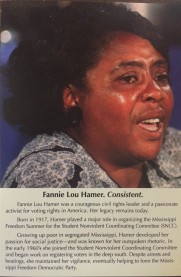
Elise EdwardsA few weeks ago, I came across a postcard that I was given at a conference last year. I got the postcard (advertisement?) because it has a picture of Fannie Lou Hamer on it, and in my home and office, I like to display images and quotes from inspirational women, especially black women. Hamer was a sharecropper from rural Mississippi who became a leader within the civil rights movement in the United States. I was happy to have something with her likeness on it. It was only later that I looked at the text on the front and back of the card, which read in part, ”Often called the ‘spirit of the Civil Rights Movement,” Hamer worked tirelessly on behalf of the rights of others—including the unborn. [She said,] ‘The methods used to take human lives such as abortion, the pill, the ring, etc. amounts to genocide. I believe that abortion is legal murder.’” I realized then that the card was distributed by an organization called Consistent Life, who, in support of a “consistent ethic of life,” is “committed to the protection of life threatened by war, abortion, poverty, racism, capital punishment and euthanasia.”

I was conflicted about the ushamere of Hamer’s image for this organization’s purposes. It is true, Hamer did have those views about abortion and birth control. But I did not know if her image and story was being manipulated for a particular political and religious agenda—one I do not align myself with. I put the card in a box of other images and quotes. I didn’t display it, but I didn’t throw it away, either, which is why I came across it again a couple weeks ago as I was cleaning and decorating my home office. I had the same misgivings about the image as before, and I set it aside again. Continue reading “Fannie Lou Hamer’s Commitment to Life by Elise M. Edwards”

One Year After Giving Birth- My Story by Valentina Khan

valantina I sat at the bottom of my stairs exhausted, lost, not knowing what day it was or rather not really caring what day it was. I was the overtired mother, who was still getting the knack of breastfeeding around the clock. Panicking each and every time I heard the baby cry. As soon as I heard his cries, I would think to myself, hurry and grab the boppy, the burb cloth, the iPhone so I could click on the breastfeeding app! Hurry, hurry, hurry….!

My first child was born in March 2013. I thought I prepared myself for his birth. The diapers were stacked, the crib was pristine, his clothes were neatly arranged, the stroller was the best on the market, what else could being a mom be about? This was my naïveté as I entered motherhood at probably not the best time in my life (but when is?). I was in my last year of grad school at the Claremont School of Theology, I also had on my to-do list to take the bar exam and become a licensed attorney should I ever decide to practice, and because my fitness hobby turned into a “job” over the last 4 years, the same year my son was born, my husband and I opened my first brick and motor business- UpLift- body, life, community. Too much too soon? Yes, indeed. Crazy? Absolutely.

Continue reading “One Year After Giving Birth- My Story by Valentina Khan”

More than Individual Concerns by Elise M. Edwards

Elise EdwardsWell, the fall semester of the school year has begun. I’m teaching undergraduate classes in Christian Ethics and Bioethics this fall. I’ve designed my classes so that they are much more discussion-based than they have been in previous semesters and as a result, I’m noticing the things that challenge and confuse my students fairly early. I have readings from feminist, womanist, and mujerista thinkers in these courses, and unsurprisingly, some of my students don’t know what to do with the arguments feminists make about how we arrive at moral decisions and live them out. I hope that as we work through the essays together, my students and I learn from each other.

I assigned an essay called “Theology’s Role in Public Bioethics” by Lisa Sowle Cahill that was included in the Handbook of Bioethics and Religion edited by David E. Guinn (2006). Cahill, a feminist thinker, asserts that theology can be a conversation partner in public debate about bioethics and also an advocate for just, compassionate, and inclusive health care practices. Citing the work of another feminist, Maura Ryan, Cahill argues that ethical questions about reproductive technologies should be examined not only as individual dilemmas but as issues that exist within a social justice context. In the conclusion of the essay, she states, ”Specifically, one of [theology’s] most important and distinctive contributions to public discourse is a critique of the ways in which modern biomedicine and biotechnology have become luxury items marketed to economically privileged classes, while the world’s poor majority lacks basic health needs.” (55).

I suppose because I’ve been reading feminist thought, theology, and social ethics for years, some of the claims that my students see as radical and new are commonplace and go unquestioned by me. I expected some of my students to disagree with Cahill and Ryan’s particular positions about assisted reproduction. But I was surprised by students’ rejection of the idea that debates about reproductive technologies include MORE than individual considerations.

I’ve blogged on this site about reproductive rights before, and let me be clear that I do not think that the church, state, or any institution should have more governance over a person’s body than that person herself. But while respecting individuals’ rights to make health decisions for themselves, I also acknowledge that these “individual” decisions have broader social implications and meanings. This is one reason second-wave feminists have insisted that “the personal is political.”

Feminists routinely relate individual, “personal” acts and beliefs to larger constructs and the too-often asymmetrical power dynamics at work within them. This is why we are disturbed by video of a man who knocks his fiancée out and drags her unconscious body from an elevator and pop stars who gain commercial success by graphic displays and descriptions of sexuality that is objectifying or exploitative. And, in response to one of my students who wondered if feminist interpreters of religious texts go too far, that is why they point to patriarchy in a story that seems to be about devotion (referring to the Book of Ruth).

I’m grateful to my students for prompting me to explain some of these convictions that feminists hold. Certainly feminism is not monolithic. We feminists disagree on many issues including the scope of individual rights, the role of religion in public debate, and the extent of harm (or lack thereof) in media portrayals of female sexuality. But I believe we tend to agree that our personal decisions as well as our societal issues should be addressed with a consciousness that as humans we are beings-in-relation. Our conviction that we are connected and affected by each other lies behind our motivation to make the world a better place for women and girls and others who suffer from patterns of dominance.

What do you think?

Elise M. Edwards, PhD is a Lecturer in Christian Ethics at Baylor University and a graduate of Claremont Graduate University. She is also a registered architect in the State of Florida. Her interdisciplinary work examines issues of civic engagement and how beliefs and commitments are expressed publicly. As a black feminist, she primarily focuses on cultural expressions by, for, and about women and marginalized communities. Follow her on twitter, google+ or academia.edu.