What Traci West Taught Me about Dominant and Excluded Voices by Elise M. Edwards

Elise EdwardsIn my previous post, I mentioned a book I am writing about how theological and ethical considerations in architectural design can define good architecture.  In that post and in ones to follow, I am acknowledging the feminists and womanists and mujeristas who have influenced me while also opening up the dialogue to the feminists in this community who continue to inspire and guide me to do my best work.

But today, instead of talking about creativity or architecture, I want to discuss how I arrived at the conviction that community decisions about how we ought to live—whether those are decisions about laws, institutional policies, religious practices or architectural buildings—need to include the voices of the diverse people they directly and indirectly influence. Continue reading “What Traci West Taught Me about Dominant and Excluded Voices by Elise M. Edwards”

A Crone’s Life, an Embodied Experience by Deanne Quarrie 

Deanne Quarrie, D.Min.In January of 2013, I wrote an article here for FAR called Embody the Sacred. In it I wrote,

“If we are to fully embrace living a magical life it is important to remember how to live in our bodies comfortably and safely. If we re-awaken all of our senses, our awareness is expanded and our perceptions clarify and develop. Without this, our magical life will not develop as it could. Our enjoyment of all that is Sacred will be impeded, as if walled in and separated from all that is possible.”

I would like to rephrase this statement just a bit to reflect where I am in my thinking now.

If we are to fully embrace living, it is important to remember how to live in our bodies comfortably and safely. If we re-awaken all of our senses, our awareness is expanded and our perceptions clarify and develop. Without this, our lives will not develop as they could. Our enjoyment of all that is Sacred will be impeded, as if walled in and separated from all that is possible. Continue reading “A Crone’s Life, an Embodied Experience by Deanne Quarrie “

Body of Nature by Oxana Poberejnaia

oxanaIn the medieval European philosophy, woman’s body was seen as a vessel filled with sins, while man was regarded as a more spiritual being. This is one of the reasons why the concept of body is reassessed in feminist studies and why body is elevated in neo-paganism and Goddess spirituality. My fear is that nowadays body can be treated as an instrument for social advancement.

OLYMPUS DIGITAL CAMERA

We still live in a society that is deeply hostile to women’s bodies. Alla Demidova, an actress I respect for her talent and her critical mind, did a programme of Christmas-related poetry. I could not listen to more than five minutes of it.

The poems have been all written by men. I am not saying that men do not have the right to write about birth. I am saying that our prevalent image of Christmas should not be based on male view alone. In this sense I much better like the Carol from “The Vicar of Dibley” (one of my favourite British comedy series, about a female Vicar), which describes the movement of baby Jesus through Mary’s birth canal.

Continue reading “Body of Nature by Oxana Poberejnaia”

Seeing Through My Nipples by Karen Moon

Karen 2006

This article is inspired from my Facebook group’s book study of Women Who Run with the Wolves by Clarissa Pinkola Estes, specifically Chapter 11: Retrieving a Sacred Sexuality.

I confess that I had never before heard of the term ‘seeing through your nipples.’ I continue to think on that. But I tell you what though; I do know the power of a nipple. And I can definitely say that it made me take one definitive path in life that has led me right here.

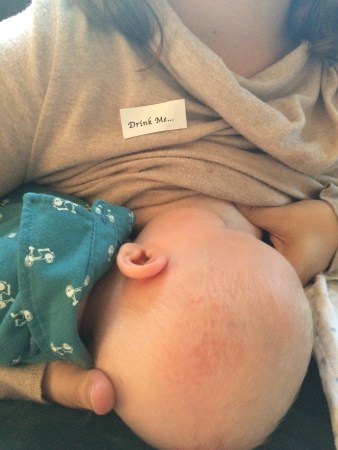
I’m going to take a moment and also ‘speak through my vulva’. I get that, too. It’s raw, and it’s honest. And I hope I don’t offend as it’s always so ‘touchy’ this talk of breastfeeding. But I am not meaning any of this in a judgmental way. I just wanted to speak of my experience personally. I wish I had had these stories before I became a mother so I could try them out, test them on my tongue and make a decision that worked for me without some of the trials I went through.

When I had my first child, way back in 2000, we were living in an apartment east of San Francisco in the rolling green hills. My mother-in-law came for the birth as my mom was on vacation somewhere in South America with my stepfather.

I had planned on breastfeeding, and my mother-in-law decided to ‘humor’ me. She is one of those tough New Jersey, Brooklyn born and raised women who have no idea how something like breastfeeding could actually work. She doubted the value of it. She wanted to see the can, the formula inside it, a nicely sanitized bottle and a chart with three hour intervals. And she was quite the persuasive lady. Continue reading “Seeing Through My Nipples by Karen Moon”

Breastfeeding and the Abject? by Sara Frykenberg

The trappings of motherhood are all too powerful reminders that, as Catherine Keller reminds us in her book From a Broken Web, mother goddesses have to be continually slain for patriarchal heroes to be born. Indeed, she suggests that conceptions of Western selfhood are based upon this symbolic matricide—so it is no wonder that breast milk might be considered abject…

IMG_3269Once upon time formula companies and complicit medical experts launched a serious campaign to sell more formula, telling a generation of mothers that this product was both superior to breast milk and far better for baby and mother. Some were convinced, others found formula a good alternative to breast milk given their employment status, hormonal changes, their particular baby’s needs,personal choice, difficulty producing their own milk, or the like; and still others chose to breastfeed despite criticism, like my mother-in-law, who received scorn and derision from medical personnel as the only breastfeeding mother in the hospital in which she gave birth in 1970.

Despite this effort, science has finally “proven” that breast milk, when it is possible to give it, is better for your child than synthesized alternatives. Wow. Well, the politics of believability aside, women in the U.S. are now encouraged to trust their own bodies to feed their babies and give the breast a try. In fact, every new book, article, website and internet forum, birthing class teacher and hospital nurse will tell you that “breast is best,” repeatedly, for months, asking you about your breastfeeding plan, and urging you to keep trying until you and baby get it right. A counter-campaign, this vigorous encouragement is working to undo the attitudinal changes within popular culture that placed a stigma on the breastfeeding woman. Continue reading “Breastfeeding and the Abject? by Sara Frykenberg”

When I Dance I Am I Greek by Carol P. Christ

Carol Molivos by Andrea Sarris 2When I first moved to Greece I spoke of being attracted to a culture in which people express their emotions easily and do not hold on to anger. In the part of American culture I know, the opposite is often the case: people do not express their emotions easily and hold onto their anger. When I joined a therapy group in Greece, my therapist said that I made the right decision to move to Greece. “You needed to learn to live from here,” she said touching her belly, “and this is where Greeks live.”

During the first years I lived in Greece, I often said that I wanted to become Greek. Like others had done before me, I romanticized Greece and the Greeks. Then one winter I learned that family violence is as prevalent in Greece as it is in every other country. The cultural ability to express emotion does not stop Greek men from beating their wives or Greek women from hitting children. Indeed the more expressive nature of the Greek culture may make it easier for Greeks to resort to physical violence. On the other hand, violence stemming from withheld feelings can be cruel and unpredictable. Continue reading “When I Dance I Am I Greek by Carol P. Christ”

Broken Mirrors, Broken Bodies, and Sophia Wisdom by Angela Yarber

angelaFreshly cleansed, I stood naked in front of a foggy full-length mirror. I had just taken my first hot, indoor shower in nearly two months. I’ve been volunteering in a National Forest all summer with my wife and toddler; it is stunningly beautiful. While there is a lake for bathing, we have no access to running water and there are certainly no mirrors hanging from the birch trees. Sure, I can catch a glimpse of myself in the rearview mirror of my car, but this was the first time I saw all of me—sun-kissed and mosquito-bitten—in a while. This may not seem like a big deal, and I didn’t think it would be, but the absence of mirrors has had a profoundly holy impact on me this summer.

As the dirt of two months swirled down the drain and I savored every drop of warm water pouring endlessly over my aching body, I thought about the mirror that awaited me. I thought about how it has been almost 15 years since I’ve intentionally starved myself or shoved my finger down my throat to induce calorie-purging vomiting. I thought about how I weigh thirty pounds more than I did during the nadir of my eating disorder. I thought about how much grace I’ve offered my body over these years. The grace to grow. The grace to age. The grace to gain. The grace to work hard. The grace to accept.

I thought about the tremendous privilege my body carries: the privilege of my whiteness, the privilege of being temporarily able-bodied, thin privilege. I thought about how my white body has never feared for her life when pulled over for a traffic violation. I thought about how my body has access to do whatever she wants—climb stairs into inaccessible buildings, or mountains to stunning vistas. I thought about how I can find clothing in my size in virtually any store, how no one offers me health advice when ordering at a restaurant, or diminishes my concerns at the doctor’s office based on my size. I thought about racism, ableism, and fatphobia. I thought about what it means to be a queer femme body. Continue reading “Broken Mirrors, Broken Bodies, and Sophia Wisdom by Angela Yarber”

Two Wrongs Don’t Make a Right by John Erickson

Kim Davis does need a lot of things but saying of suggesting that she needs a haircut, a makeover, or even to lose weight, makes you and those that continue to repeat it no better than she is; to state such statements doesn’t purport the ideal that #LoveWins, which took over social media just mere months ago, but changes the whole narrative to symbolize that sexism and hate are more important than love and equality.

John Erickson, sports, coming out.Kim Davis, the defiant county clerk, is currently sitting in isolation in a jail cell after refusing to issue marriage licenses to same-sex couples in Rowan County, Kentucky, even after she was ordered by a judge to comply with the Supreme Court’s ruling on same-sex marriage or be held in contempt of court.

Everywhere I turn on both social media or in person people are talking about Ms. Davis, her actions, personal history and for some weird reason her hair and looks.   I’m all for individuals taking a virulent stand against an individual who chooses to not uphold the law of the land as well as continually acting in an unjust discriminatory way but bringing her looks or anything else about her physical appearance into the narrative is not only just plain wrong it is sexism in its worst form. Continue reading “Two Wrongs Don’t Make a Right by John Erickson”

Hidden Seeds in Laudato Si by Peg Conway

Peg Conway headshot2

The opening two paragraphs of the recent environment encyclical just might be saying even more than the pope intended. Beginning with a quote from the famous Canticle of the Creatures by St. Francis of Assisi, Laudato Si refers to “our sister, Mother Earth,” and compares the earth to “a sister with whom we share our life and a beautiful mother who opens her arms to embrace us”. Sister and mother are seen here as two separate images. But some translations of the Canticle read “Sister Mother Earth” without commas, consistent with the style of the rest of that text, which names Brother Sun and Sister Moon, etc.

Does a little punctuation difference matter? I think it does.

The single term Sister Mother Earth suggests a seamless linkage between all female bodies, whether our sisters, our mothers, our planet. We are brothers and sisters to one another as Christians (and members of the human family), every person has a biological mother, and the earth sustains us all. “Sister Mother Earth” means there are no distinctions among the three; they are one body. This interpretation lends even greater impact to the second paragraph, where the pope speaks of “this sister who now cries out to us” because of abusive treatment:

Continue reading “Hidden Seeds in Laudato Si by Peg Conway”

Four Days of Bliss (or How I used The System to beat The System) by Vibha Shetiya

Vidha SI’m not particularly fond of my periods – they’re painful, full of cramps. But they are a part of who I am, and I’m not going to apologize for them. We women, especially those of us belonging to the sub-continent, have been shamed or embarrassed into silence, while being reminded that motherhood is the most exalted position a woman could ever hope for. I mean, isn’t that paradoxical – if it weren’t for the bloody nemesis (pardon the pun), we would never get to experience motherhood.

I grew up in a Western environment (in southern Africa) where “period” wasn’t necessarily synonymous with repulsion. But when I moved to India, the land of my birth, soon after my “life-altering” experience, things began to look different. I came to realize that I ought not to be like the neighbour girl who was so besharam, or shameless, that she insisted on announcing her monthly ignominy to the world by refusing to conceal the fact that she had indeed been at the pharmacist’s to buy sanitary pads. Why, the pack of pads, sealed in newspaper and carried in a little black plastic bag was right there for the entire world to see on her ten minute walk back home! I gradually came to understand that “those four days” were taboo – do not speak of “it,” do not make it obvious even if you are writhing in unbearable pain, do not contaminate sacred space with your womanly profanity. Continue reading “Four Days of Bliss (or How I used The System to beat The System) by Vibha Shetiya”