“Learning entails more than the gathering of information. Learning changes the learner. Like dwarf pines whose form develop with winter’s design, the learner is shaped by what he learns.”
Learning from Nature: A Personal Reflection on Charlie Russell
Naturalist Charlie Russell never went to college. Instead he spent his youth backpacking through the Canadian wilderness with his family. Nature was his mentor and home.
When Merlin Stone’s book, When God Was a Woman, was published in 1976, it was a lightning bolt of feminist scholarship that told the world that before there was a Judeo-Christian god there were goddesses, and before there were goddesses, there was the Goddess. If you’re reading this review and you have not read When God Was a Woman, buy the book. Right now. As you sink into Stone’s book, try to imagine what it was like before we knew about Isis or Inanna or Astarte, before we knew that the tree in the Garden of Eden was probably a sacred fig and that the serpent was a symbol or aspect of the Goddess and that people (mostly women) who ate figs or worked with serpents were honored priestesses and prophets. Just imagine! The work of the second wave feminists added to the work of scholars like Merlin Stone and Marija Gimbutas, but it didn’t begin until the second half of the 20th century. Before that? All there was, was God the Father, maker of heaven and earth. Yes, Merlin Stone hurled lightning bolts into our hearts and minds and bookshelves.
But what if there was a space for the danger of dragon-ing? What if society expected it, welcomed it, and made room for our, women’s, subsequent growth? It might still be hard and risky, as is all growth and change. But as I believe Barnhill is trying to suggest, it might also be less traumatic, less splitting, and give us so much more space to be.
Knowing that I like dragons and feminism, a friend of mine recently recommended the book, When Women Were Dragons (2022) by Kelly Barnhill. I have been reading it (okay listening to it on audiobook, but that counts right?) all week. The premise of the book is that women dragon, as an act, and can do so by choice or spontaneously; and in the “Mass Dragon-ing of 1955” over 600,000 women flew away from American homes, “wives and mothers all” (Barnhill, 2022). But despite the destruction, eaten husbands and bosses, and destroyed homes that dragons leave in their wake, society, the government, and individual families do everything they can to forget it happened. The history is repressed. Individual memory is policed and repressed. The dragon-ing goes on.
Beginning this book the week before Mother’s Day, I found the recommendation timely, or even fateful, because with every chapter and hour that I listen, I find myself thinking of my mother. And I wonder if or when she would have dragon-ed if given the chance.
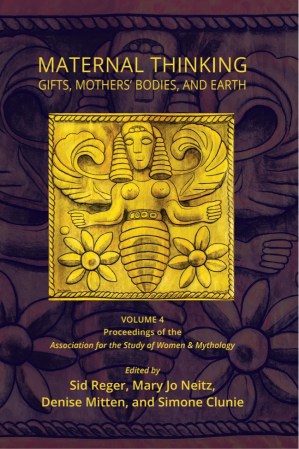
Cover designed by Rebekkah Dreskin ~ http://www.blameitonrebekkah.com Front cover art “Bee Goddess of Rhodes Banner” by Lydia Ruyle. Bee goddess logo by Sid Reger
Maternal Thinking: Gifts, Mothers’ Bodies, and Earth, the fourth book of proceedings of conferences held by the Association for the Study of Women and Mythology (ASWM), is an instructional guide to saving ourselves and our planet. Many pre-historic, and even contemporary cultures, especially Indigenous communities, feature “Maternal Thinking.” Such cultures perceive that societies are successful when they center qualities associated with mothering: care, nurturance, cooperation, and meeting everyone’s basic needs while respecting the Earth and reciprocating nature’s generosity. Some 5000 years ago, Maternal Thinking was superseded in many societies by a perspective valuing instead competition, exploitation, and domination, and we and our planet are now facing the catastrophic consequences.
The fifteen contributors and four editors represent myriad disciplines and life experiences. They are academic researchers in wide-ranging fields, artists, activists, a storyteller, a therapist, scientists, educators, and more. This diversity reflects the expansiveness of the book’s vision, including many layers and facets of “mothering,” and the need for as many voices as possible to be heeded if we are to envision and birth a peaceful, just, equitable, compassionate, and environmentally balanced Earth.
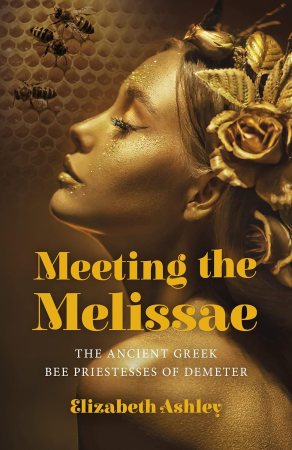
The Mysteries at Eleusis, a nine-day festival in ancient Greece based on the myth of Demeter and Persephone, has fascinated and baffled us for millennia. Here thousands of people from all over Greece and beyond came to understand, in the words of Plutarch, “an undoubted truth our soul is incorruptible and immortal” (277). Producing this festival was the task of the Melissae, the bee priestesses of Demeter, powerful and honored women in a society in which women had few rights, famous in their own time but almost unknown in ours.
In Meeting the Melissae: The Ancient Greek Bee Priestesses of Demeter, Elizabeth Ashley offers us not only facts about the Melissae and other ancient Greek priestesses gleaned from archaeology, art and literature from the period, and modern academic research but her own glimmerings of their deepest spiritual life. She explores what is known about the priestesses and their everyday lives, the goddesses whose temples they presided over, and bees themselves. An aromatherapy researcher, she began her journey to discovering the secrets of the Melissae when she kept reading references to them in ancient botanicals about the herb lemon balm (Melissa officinalis) but nothing more. (The connection between lemon balm and bee priestesses? Pheromones. That’s all I’m going to say).
Queer Chicana feminist author, Gloria Anzaldúa, once claimed, “The world I create in my writing compensates for what the real world does not give me.” I’ve long connected with the revolutionary Anzaldúa, believing in the prophetic power of the written word to create new worlds, worlds big and wide and just and beautiful enough for all people. Worlds where the perspectives of the marginalized are brought to the center.
This is what I aim to do as a publisher and writer myself. It was a meandering path to get here, but on the cusp of a new year, I find myself finally in place with my calling and vocation where all my skills as an activist, writer, professor, artist, and pastoral presence are coming together.
I believe more women—and particularly queer and/or BIPOC women—deserve to publish books. Let me explain why.
It was my first year of seminary. After majoring in religion in undergrad, I had a decent handle on feminist theology, but I hadn’t yet reconciled my strong, feminist upbringing with the faith tradition that held my ordination in their patriarchal hands. A seminary friend recommended I read Sue Monk Kidd’s Dance of the Dissident Daughter and everything changed.
This was twenty years ago. That one book helped me internalize the intersectional feminist theory that had always dwelled outside of me. Decades later, I find myself teaching in my own seminary classrooms and mentoring DMin students, requiring that same text, along with one of my own books, Queering the American Dream, and Christena Cleveland’s God is a Black Woman when discussing the power of feminist memoir in religious leadership.
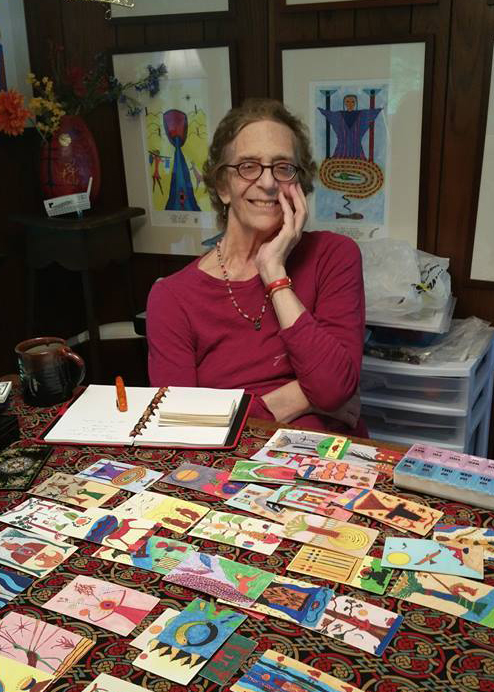
How do you speak about someone who not only rocked your own world, but those of countless others? Whose fertile imagination and generous nature inspired and transformed so many lives? My friend, teacher, and mentor Rachel Pollack died in April. It’s hard to wrap my head around what a huge loss this is, not only for me, but for the world. She had an encyclopedic knowledge at her fingertips of mythology, tarot, historical trends, cultural trends, ancient civilizations. She was a storyteller at heart, using personal stories, universal stories to teach. She encouraged and guided each of us to discover and tell our own stories. Her stories won both the Arthur C. Clarke and the World Fantasy Awards. I call her the Grandmother of the Tarot because her work in that area has been so ground-breaking, far-reaching and depthful.
I write JIA, instead of RIP, special for Rachel. JIA means Journey In Adventure. Rachel was adventurous to her core. Rather than resting in peace I see her continuing her immensely adventurous journey just now on the other side of the veil. I see it as a continuing wondrous, magical ride that she has earned.
Very early in Henri Bosco’s 1948 novel Malicroix, a young man, Martial de Mégremut, living placidly amid fruitful orchards in a tame Provençal village, receives a letter informing him he has inherited “some marshland, a few livestock, a ramshackle house” from a reclusive great-uncle, Cornélius de Malicroix. Against his family’s strenuous objections–with alarm they speak of “marshes, mosquitoes, miasmas”–Mégremut resolves to travel alone to the remote Camargue to claim his “wild” Malicroix inheritance. The house is on an island, and to reach it Mégremut must cross a rough river, at night, in a frail wooden boat piloted by a taciturn old man who meets him at dusk in the middle of a vast plain.
So begins a deeply internal quest narrative, an initiatory journey that forces Mégremut to come to terms with himself and with the elements–earth, water, wind, and fire–that are ever-present, sometimes terrifyingly so, on the island. For once he arrives, he learns that he must remain there alone for a full three months if he wishes to obtain the inheritance. Torn about whether to stay or leave, he finds that the decision to stay is made of its “own accord,” unconsciously.
Moderator’s note: This marvelous FAR site has been running for 10 years and has had more than 3,600 posts in that time. There are so many treasures that have been posted in this decade. They tend to get lost in the archives. We are beginning this column so that we can all revisit some of these gems. Today’s blogpost was originally posted October 1, 2017. You can visit it here to see the original comments.This post is the 3rd and final of a series which has been posted for the past 2 days. They were curated by Barbara Ardinger to stand together for their relevancy, now, 5 years later.
Members of this community (and others) have been feeling that the world is out of balance since the 2016 election. There’s a feeling that people are becoming less kind and that some men (following the model that lives and tweets in the White House when he’s not at one of his golf resorts) are more misogynistic. I’ve heard that Orwell’s novel Nineteen Eight-Four is more popular than ever before. We seem to be living in a new dystopia. It’s very sad and very scary.
I’ve recently reread three novels written by women that I think may be both prophetic and inspiring. I’m hoping that if you read them, too, you’ll inspired by their brave heras to keep on resisting. The novels are Gibbon’s Decline and Fall (1996) by Sheri S. Tepper, Woman on the Edge of Time (1976) by Marge Piercy, and The Fifth Sacred Thing (1993) by Starhawk.
Starhawk (Miriam Simos) was probably the most famous “out” witch in the last quarter of the 20th century. Her book The Spiral Dance (1979) introduced uncountable numbers of people to the Goddess, Paganism, and Witchcraft. Nowadays, she’s teaching “Regenerative Culture, Earth-based spirituality, and Permaculture.” She is no doubt working up to the Uprising described in The Fifth Sacred Thing that separated northern and southern California—a generally bucolic San Francisco filled with Pagans and an eclectic mix of every other religion with free healthcare for all and a City of Angels (Los Angeles) filled with Stewards, ruins, and sex slaves.
The Fifth Sacred Thing opens in 2048 with Maya, a 98-year-old Orthodox (sic.!) Pagan climbing a mountain. At the Lammas (August 1) ritual, she tells how the Uprising began. Global warming has happened, and during the drought of 2028, four old women (remember Tepper’s bag ladies?) went with pickaxes to a major thoroughfare in San Francisco, dug up the pavement, and planted seeds in the earth. The Uprising was led by people who had participated in the Summer of Love (1967) and demonstrated against the Vietnam War.
In the next chapter we begin to meet the Stewards, who in 2028 canceled the elections and took control. Now “the Corporation,” which banished women from every profession but the oldest one, owns the Southlands and apparently most of the U.S. Although Starhawk wrote this novel in 1993, the Stewards look like Trump’s cabinet and true believers exponentially multiplied. The Steward are allied with the Millennialists, who have suppressed every religion but their own and whose Creed reads in part, “…we abhor the earth, the Devil’s playground, and the flesh, Satan’s instrument. We abhor the false…gods…who tempt us to wallow in the worship of demons, whether they be called Goddesses, Saints, Lucifer, or the so-called Virgin Mary. For we know that Our Lord never lowered Himself to take on loathly flesh….” Maya’s grandson, Bird, has been their prisoner for ten years. He’s been drugged (like Connie), but now he’s beginning to feel his magical powers returning.
Another protagonist is Madrone, a healer and midwife. As we read through a long Council meeting (they’ve got Councils for everything), we see the similarities between San Francisco is 2048 and Piercy’s free future of 2137. The values are much the same, although Starhawk’s future is determinedly Pagan and Witchy (and very PC). Madrone has lost a patient to a mysterious fever that morning. In the council meeting, one character says they’re still living in the “toxic stew” of pollution in the Bay. Is this fever becoming an epidemic? Is it biological warfare?
Bird summons the best magic he can and escapes with two other prisoners. As he travels up the California coast, sometimes along what was once the Pacific Coast Highway, sometimes along what was Interstate 5, he learns what happened to him ten years ago. When he and some other Witches destroyed an atomic reactor (probably in Santa Barbara County), his friends were killed by the Stewards and he was captured. Now he’s regaining his memory and his powers as he’s meeting other outlaws.
When Bird arrives in San Francisco, not much has changed: there’s still a lot of free love and arguing and they all still work collectively. Madrone recently went into “the ch’i worlds” to search for the virus, caught it, and almost died, but now she’s mostly recovered. They hold a meeting in which they discuss nonviolent resistance. After much argument about how best to resist, Madrone finally decides to travel south to find out if the Stewards are really planning an invasion. As she retraces Bird’s trail and meets the people who helped him, she gives them free healings and teaches them Witchy powers. The book thus turns into what is essentially a handbook of resistance and Witchy powers. When Madrone goes to Hollywood to take part in raid on a drug warehouse, we learn that in the Southlands only the rich have water, medicine, fresh vegetables, cars, access to education, healthcare, and any kind of technology (which is mostly built by prisoners).
Yes, there is a war in this novel. Just think of any superhero-action-adventure movie and add Nazis, and you’re seeing it. The Stewards’ army invades San Francisco, and nonviolent resistance seems to wither under bullets. Although she finds pockets of rebellion and resistance, Madrone nearly dies in Los Angeles. She finally gets home and learns that Bird has been captured again. But the Witches are also learning how to get soldiers to desert.
The novel has a sort of happy ending. Is it prophetic? I hope not! I live in the Southlands. But anyone who is paying attention to the daily news sees that we’re already on the path to a world run by the Stewards and the Millennialists. Starhawk has written a sequel, City of Refuge (2015), around the three major characters to tell what happens next in the North and the Southlands. I have not read the new novel.
But I know that Witches can prophesy. And so can writers, and so we have in these three novels four protagonists—Carolyn Crespin, Consuelo Ramos, and Maya and Madrona—who can teach us a great deal about resistance. The four sacred things are earth, air, fire, and water. The fifth is spirit. Blessed be.
BIO:Barbara Ardinger, Ph.D. (barbaraardinger.com), is the author of Secret Lives, a novel about crones and other magical folks, Pagan Every Day, a unique daybook of daily meditations, and other books. She really enjoys writing her monthly blogs for FAR. Her work has also been published in devotionals to Isis, Athena, and Brigid. Barbara’s day job is freelance editing for people who have good ideas but don’t want to embarrass themselves in print. To date, she has edited more than 400 books, both fiction and nonfiction, on a wide range of topics. She lives in Long Beach, California, with her rescued calico cat, Schroedinger.